Sunday, June 26, 2011

Making hay whilst the sun shines and gathering winter fuel

3 comments:
It's been a funny old couple of weeks, making hay whilst the sun shines and gathering winter fuel. The warm weather has brought with it the need to cut the long grasses and wild flower areas we let grow in various areas in and around La Pasera. It is ideal time for the seed heads to dry naturally and shed their load onto the ground ready for next year. The grasses and plants will be allowed to dry for a few days, then gathered and used as brown material in the compost heaps. The islands and areas will regenerate in the next few weeks and give a second flower and grass crop for the bees and insects to feast from, way into autumn.


The large amount of pruning material from the fruit and nut trees have been processed for kindling and the wood store has been replenished ensuring plenty of dry burning wood for the wood burners. Two unexpected sources of wood came about this past fortnight, the first from a man in the village who is clearing some of his woodland to subsidise his income now he is unemployed and secondly from a plot opposite La Pasera where the owner has sold off his mature eucalyptus trees to a local company. As they were felling them we negotiated a price for two large (20M) trees - they felled them and we processed them.


In retrospect, the second lot of wood wasn't a good deal as taking into account the amount of fire wood it has generated plus all the effort of processing and splitting it combined with the time taken, it would have be cheaper to buy it from them once they had done all the work! You live and learn... Eucalyptus is tough wood and heavy. At least we have a well stocked wood store that should keep us going for the next winter and beyond.

Friday, June 17, 2011

Vegetables: sourcing, germinating and planting seeds and young plants

1 comment:
There is no doubt about it that raising vegetables from seeds is time consuming and unpredictable. Germination rates depend on the viability of the seed, the temperatures, methods and disease. Wherever possible we save and dry seed for the following season but of course that is not always possible. Seeds are sometimes exchanged with friends, bought from online catalogues or from nurseries both here and in the UK. If possible we buy or source organic seeds, especially old fashioned varieties or varieties that are known to us for their cropping, taste and resilience.

We have a heavy clay-based soil here at La Pasera and despite digging in as much organic matter as we can possibly get, the structure remains heavy and seed unfriendly - the rain and sun combination help form a hard crust that seeds find impenetrable. Luis has developed various methods of seed germination that work for different seeds and that overcomes the soil problems we face.


Some seeds such as brassicas, beetroots, legumes, sweetcorn, peppers, marrows, cucumber and fennel are pre-soaked in a moist cloth and contained within a small plastic box. This method ensures a high germination rate and advances the growth much faster than sowing direct. The downside of this method is that once germinated, handling the sprouting seeds is fiddly and takes a bit more time. The seeds are planted with tweezers into pods or half drainpipes filled with a home-made mixture of compost where they grow very quickly and are ready for planting into the prepared beds.


Other seeds are sown directly into pods, yoghurt pots or pipes and then transplanted when robust. Salad crops, tomatoes, celery, celeriac and herbs are sown using this method. Very few vegetables are sown directly into the ground, potatoes, onions and leeks being the exception.

We generally buy our onion and leeks from a local plants-man as young plants. They are good quality and cheap. 100 leeks cost around 5 euros and we always end up with more than we pay for as he usually puts extra in the bag. If we produce too many, young plants and seedlings are given away or exchanged with friends and neighbours although some vegetables we grow are met with quizzical and perplexed expressions by some of our neighbours who have never grown or eaten anything like them before. Preparation and cooking advice is always offered....


If anyone is interested in seed swaps or has spare seed that they think might do well in our warm and humid climate, please get in touch. We are particularly interested in blight resistant tomato strains and any unusual old fashioned varieties of vegetables or fruit.

Saturday, June 11, 2011

Making and using natural insecticides and fungicides for the garden

5 comments:
If you are a regular visitor to Tales from Toriello you will already know that we do not use chemicals in the garden and rely on natural control or potions that are derived from natural sources. Our climate here on the coast is a temperate climate that is humid and prone to sea mists. Conditions are such that our vegetables and plants are very susceptible to fungal infections such as mildew and blight, and infestations such as caterpillars, black fly and aphids.


With tomatoes, potatoes, courgette and marrow in full swing it is important for us to minimise the damage caused by fungal infections and reduce the infestations of caterpillars, aphids and black fly on plants around the garden.


The first thing to mention is that healthy plants, grown in fertile and well structured soil, in conditions that suit the individual plant will of course minimise any problems that may occur as will the use of companion planting  to encourage natural predation. We'll cover companion planting in a future post. Even the most efficient, experienced and knowledgeable gardener will succumb to the laws of nature from time to time so for us who are still serving our apprenticeships, infestations and plant diseases are all part of the valuable learning journey that we find ourselves on.

Natural Insecticides:

At the first sign of attack of aphids or black fly, we would normally spray the affected plants with a light soap and water mixture or garlic water made from macerated garlic and water, strained and then sprayed. This will need to be repeated in two or three days time but can be an effective control that is harmless to other wildlife. Rhubarb macerated in water for a few days also works well as a general insecticide.

Caterpillars are not that easy to get rid of and we have found that by far the most effective method is quick dispatch with gloved fingers. Birds in the garden can also help keep caterpillar populations under control especially if nesting nearby and feeding the voracious appetites of a young brood.

If your salad rocket is affected by Flea beetle they try using a spray made up from catnip soaked in water, it wont eradicate them but it will drive them away giving you a better looking crop during their short season.

Natural Fungicides:

Due to our humidity and climate we spray both prophylactically and symptomatically. Our main lines of defence come from two commonly occurring plants i.e. Rhubarb leaves and Horsetail plant. Both mixtures are made by the same method. In a large bucket or container, soak about 500 grams of bruised rhubarb leaves or bruised horsetail plant in a litre of water,  leave covered for about 5 days and stir occasionally. The liquid eventually stinks vile ( a bit like nettle juice if you are familiar with that). The liquid is then strained through a fine cloth and colander to prevent residues that might clog up the filter mechanism on the sprayer. Plants are sprayed, preferably on a dry day, with a good dose of the mixture and repeated as necessary.


This year we are trialling the horsetail mixture on the onion crop, marrows and cucumbers to prevent fungal infections and mildew.

We would love to hear from you if you have any other remedies or suggestions. Sometimes what works for one does not work for another and the experiences of others, trial and error is a great way of learning. Please get in touch or leave a comment if you have found that your own concoctions work for you.  


As with all potions, take care when handling both the raw plant and the liquid. Gloves and masks are should be worn to minimise inhalation or skin contact. If storing the liquids, keep out of reach of young children and pets.

Tuesday, May 31, 2011

Control of slugs and snails in the garden

4 comments:
Slugs and snails are a problem. Where we live on the coast in Asturias, we enjoy an ideal temperate climate that is also just right for the proliferation of slugs and snails. Their favourite habitat is in the crevices of the limestone walls, snuggled into the roots of long meadow grass, hiding in the shelter of leaves on a multitude of favourite plants, clinging precariously to the walls of the house, or just below the surface of exposed soil... In other words, wherever it is warm and damp.


When we were in the UK we successfully used nematodes to reduce the population but where we are now, the amount of land we have and the position we are in makes this method of control too expensive and probably a waste of time.

We have tried various methods of control, some of more use than others and some, more strategic and less haphazard. We only use organic or natural methods in the garden so chemical control is excluded. The methods we have tried include:

Prevention Methods:
Reducing the population of slugs and snails where possible - collection and disposal after rainfall or early evening is a good time to do this;

Increasing natural habitats for frogs, hedgehogs, toads, slow worms, beetles and birds, all natural predators of slugs and/or snails. This has worked to a point and the added bonus of garden visitors is a joy to see;

Organic slug pellets - we have tried these and they work but alas they are not available here in Spain so the small supply we have, is used sparingly. The advantage of these pellets is that there are harmless to animals and birds unlike the ordinary pellets some people use in abundance;

Sowing seeds into pots or half a drain pipe to give young plants a good start - this has helped reduce the number of fatalities early on.


Barrier Methods:
Coffee grinds can help - this is supposed to be toxic to slugs and snails but beware, using coffee grinds extensively can increase soil acidity - it works but needs regular renewal;

Copper rings around the base of new trees and shrubs can help act as a deterrent. When the slug or snail glides over the copper, they apparently get a small electric shock. This method was only successful a couple of times for us in combination with other methods;

Crushed egg shells - egg shells, baked and crushed surrounding the plants can act as an effective barrier - works well but needs renewal;

Ash - wood ash from the fires can also be used as an effective barrier particularly around salad crops - renewal necessary especially after rainfall;

Sheep wool pellets - I brought a couple of tubs of this new product back from the UK and it seems to work very well. A barrier of pellets is put around the base of the plant and then watered - it mats together like felt and eventually breaks down into the soil.  http://www.sluggone.com


There are of course other methods such as beer traps, half a grapefruit skin placed on the soil, grit.....and so on. If you have found any methods that work for you, please get in touch or leave a comment. We would love to hear from you.

Thursday, May 26, 2011

How to make a quick and easy Garden vegetable quiche

No comments:
In the second instalment of my celebrations of 50 years a vegetarian, I will give you my recipe for the easiest quiche in the world. This dish is an adaptable, quick and foolproof recipe for a tasty meal for a picnic, lunch with salad or dinner with roast vegetable, however, before that, a little memory from my experiences of being a vegetarian.


On a night out in Dewsbury with old friends Heather and Malcolm we had booked a meal at a newly opened restaurant/bistro. Arriving at 8pm, and to cut a long story short, our starters finally arrived at 10pm. Luis had ordered vegetable samosas which arrived looking like they'd been attacked by a rabid pigeon. As we attempted to tackle rock hard honeydew melon, Luis enquired as to why his samosas had seen better days. Not even I was prepared for the reply. "We've run out of vegetable ones so the chef has taken the lamb out of the lamb ones and just left the vegetable", explained a young, naive and hapless waiter. Needless to say, we soon departed, without paying, without the spectacle of our main course and with our stomachs and thoughts still rumbling.

Normally, quiche bases are pre-cooked and typical short crust pastry doesn’t stay crisp for more than a day. I use this particular pastry recipe as it is easy to handle, stays crisp for a couple of days, it doesn’t need pre-cooking and is a bit more transportable for events like picnics or village gatherings. Never having tasted quiche before, our neighbours and fellow villagers really enjoyed this dish and always request I bring one should a gathering take place.
Garden Vegetable Quiche  - 28cm tin
For the pastry:

200g margarine
300g Flour
1 Egg
Crushed oregano
Salt

Bring all the ingredients together with a fork then by hand, cover in cling film and chill in fridge until next stage is complete.

For the filling:

2 Medium onions
2 grated carrots
Half a cup of sweet corn (peas, red pepper  or tomatoes can be used in place of sweet corn)
4 eggs
100 gm of grated cheese
350 ml of milk
1 teaspoon of mustard
Salt and ground black pepper (to taste)
Oregano to taste

Heat oven to 200 degrees centigrade.
Roll out pastry on well-floured surface. Line quiche dish/tin by rolling pastry around the rolling pin and gently lifting it into place. Mould to dish and trim excess (use for a smaller quiche or cheese and onion pasty).


Put all the filling ingredients into a dish and mix well. Pour into the uncooked pastry case and spread evenly. Place in a hot oven for 15 minutes then reduce the temperature to 175 degrees centigrade and cook for a further 45 minutes, turning occasionally to ensure it gets evenly brown. Cool in tin and enjoy.

For a smaller quiche, half the ingredients or make two and freeze one pre-cooked.

Tuesday, May 24, 2011

New blog for mosaics by Luis

1 comment:
Due to the overwhelming success of Luis' blog for chair restoration and mosaic making, we have decided to split the two crafts and develop a new blog for his mosaic making. With an upcoming exhibition and increased interest from garden designers and members of the public, we felt the mosaics were worthy of their own site. 

Roman Mosaic for an occasional table

Although the blog will be in Spanish, with translation tools widely available, you can follow his mosaic making exploits easily enough. The un-laid mosaic slabs pictured are from a set made from pebbles and slate which will form a flight of steps and sitting area around the garage and workshop.

His new blog for mosaics is: www.mosaicoslapasera.com - links for both his blogs can be found on the right hand side of this page. Don't forget to keep up to date with all our blogs by subscribing by email.


www.mosaicoslapasera.com

Sunday, May 22, 2011

Protecting strawberries from slug and snail damage

3 comments:
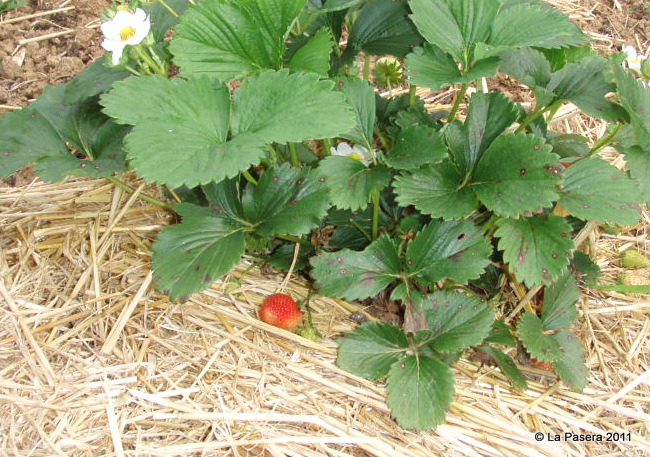
We have a small number of strawberry plants that are in their second and third year of growth. Each year they produce well but the fruits are susceptible to damage from slugs and snails if we are not careful. Up to now we have relied on organic slug pellets, crushed egg shells or wood ash to help protect or to form a barrier around the plants. This has worked, up to a point.


This year we acquired a few bales of straw and decided to try using some to protect the fruits. Not only does it help keep them free from rain damage but it has been a great success in keeping the slimy creatures at bay. The organic slug pellets act as a second barrier but as these are not available here in Spain, we use them sparingly.

Wednesday, May 18, 2011

Great Tits nesting in the garden

2 comments:
Birds in the garden are always a joy to see. La Pasera is surrounded by lush vegetation in the form of fields, pasture land, woodlands and coastal plains, giving the local bird-life a range of habitats on which to feed, roost and nest. One element that is in short supply locally is a reliable, fresh water supply.

Since we installed the wildlife pond and three shallow birdbaths we have seen the number of garden visitors increase dramatically. At the end of last year we made a bird box from old scraps of wood and attached it high up on the trunk of the old cherry tree in the hope that birds would nest. Some weeks ago we noticed several birds exploring the box and we hoped that one of them would decide that it was a safe and secure nesting site.


This past week or so we observed Great Tits franticly flying to and fro desperate to keep their newly hatched chicks fed. They bring a never ending supply of large green juicy caterpillars, grubs and an assortment of flies and insects, consumed by the hungry chicks in seconds, the exhausted parents fly off again to seek more food for their young.

Not wishing to get too close (and bring the nest box to the attention of Gawber the cat), I managed to get a few shots of the male / female in full action. I think they must be near to being fully fledged and hopefully, the surrounding trees and bushes will provide the young birds with plenty of cover once they leave the nest....dangerous times.


This next picture is a female Blackbird having a well-deserved bath in one of the birdbaths we have in the garden. This particular birdbath was spotted by Luis when we were out on a walk once. Washed down from a hillside following a mud slide, it is sandstone and has a natural smooth and curved hollow. He carried it for 5 Km or so back to the car, a hard and heavy task but well worth his effort.


We'll definitely build more nest boxes this year and both enjoy and value what they bring to La Pasera.

Sunday, May 15, 2011

Renewable energy - tea and cake in the garden

1 comment:

Every once in a while it is good to sit back, relax and enjoy a bit of free time in the garden. Watch the world go by, review ideas, think about life in general and take stock. It is one of those days when weeding, mowing the grass, planting, cutting back, dead heading and the rest can wait. Time to enjoy a slice of cake and a pot of tea... Renewable energy.


Wednesday, May 11, 2011

Review of the vegetable garden in late Spring

No comments:
At this time of year we review how the vegetables and salad crops have performed. Luis keeps a notebook recording what grew where, what seeds were sown and when, varieties that perform well and problems and challenges that we faced in the previous season. The notebook is a useful reminder of when and what to sow.

We are lucky in so much that given our temperate climate and being so close to the coast, we can maintain the growing season throughout the year. We are just coming to the end of our leeks and fennel and in the middle of a rather splendid mange tout harvest.


We have three main vegetable beds: two measuring 10x5 meters and one of 10x2 meters. We use a standard rotation system to ensure the soil is not depleted of essential micro nutrients and we add, on a yearly basis, as much manure as we can get and plenty of home-made compost. Manure this year has been a short supply and we are currently looking at alternative sources.

Bed 1 contains: beans, squash, marrow/courgette, cucumber, sweetcorn, sage and a small lavender hedge (great for pollinating insects)

Bed 2 contains: gooseberry bush, strawberry plants, beetroot, peppers, chilli peppers, aubergines and wild tomatoes.

Bed 3 contains: Potatoes (100), tomatoes (12), onions (150 red, 150 white plus another 100 early local variety, peas and mange tout.

Seedlings at the moment include: salad leaves, sweetcorn, beetroot and basil. Still to come later in the season: 2nd crops of cucumber, marrow, beetroot. Winter lettuce, fennel, brassicas, leeks, celery, celeriac, turnips and swede.


Other beds we maintain are a salad and herb garden which contains various types of salad leaves and a range of herbs and plants for infusions and cooking.

Year on year we use more of what we grow and rely less on bought vegetables. All our produce is chemical free. Some crops are bountiful whilst others disappoint, some get attacked or diseased but experience has taught us that there are many natural remedies or prophylactics that can minimise damage or loss of crops. We learn each season from experience, trial and error but that is what growing your own is all about.


Thursday, May 05, 2011

The challenge of growing tomatoes outdoors

No comments:
Tomatoes are a fruit we have always enjoyed growing to use raw in salads, juiced in refreshing drinks and cooked to make passata and pisto, a typical castillian recipe that mixes tomatoes, peppers, pumpkin, marrow, onion and herbs.

Since we came to La Pasera, we have found that tomato growing can be a challenge due to the high air humidity and sea mist that we get at this time of the year causing tomato blight. Even those varieties reported to be more resistant to this common fungal infection succumb if the conditions are such.

The local vegetable growers tend to grow the tomatoes in a sheltered position next to a south facing wall and with some added protection from a roof.

For the last few years we have grown our tomato plants under partial cover as in a mini poly tunnel that we can site in different parts of the vegetable plot according to our crop rotation system. In addition to growing them under cover, we may also use Bordeaux mixture and natural anti-fungal remedies during periods when the weather is particularly humid and still.


This year we bought seeds for a variety of tomato called Alicante, a fairly small but very tasty fruit that seems to like the conditions our vegetable plot presents. We are also trialling a local wild tomato that has small but sweet fruit.

We sowed seeds in early February in a compost that we mix ourselves based on garden soil, well rotted manure, leaf mould and vermiculite. After a few weeks, we potted up the seedlings in fresh compost with added organic slow release fertiliser to be grown on in a sunny and sheltered position before they were planted o the ground in the second half of April. So far the plants are looking very healthy and some are starting to have their second set of blossom.

As the tomato is a plant very susceptible to blight, we prune the side shoots on the young plants and leave only the main stem to flower. We have found that this method increases air flow and makes infection less likely.


The tomatoes we produce will be used fresh whilst the large quantities of fruit we need to make the passata and pisto is gathered from my sister Rita's vegetable plot in Palencia where she grows about 150 tomato plants in a climate that is much hotter than ours. We process about 60-80 kg of tomatoes each year, ensuring we have plentiful supplies of pisto and passata for the coming year.

Wednesday, May 04, 2011

Creating a wild-flower meadow in the garden

2 comments:
Creating a wild-flower meadow in the garden was always on the plan. This year it is looking spectacular and they more than meets expectations. I don't know why more people don't have one. You can create a wild-flower meadow in the garden even in the smallest or unlikeliest of places. Leave a grassy border to grow, see what happens. Create an island in the middle of a lawn, let it grow, scatter seeds gathered from walks in the country side. Grasses, flowers, wild herbs...what ever is native.


Here at La Pasera we were fortunate because the house was built on an old orchard where the meadow had been traditionally maintained with regular, seasonal scything. This method ensures that biodiversity can be maintained by letting plants and flowers reproduce and run to seed, next years display safely deposited in the soil or stored in roots and tubers.

Each year, we leave three islands of grass, in the same place every year, we also leave the grassy borders down two sides of the garden and a small patch down by the old cherry tree. At this time of year it really comes into its own with a magnificent display of wild flowers, orchids, grasses, plantains and more. We think there maybe up to 30 - 40 species of plants at any one time in each area. This changes through the year. We have scattered seeds collected from around our local area and let it take its chance.


Each year, in late June, when most of the seed heads from spring have dried or are drying, we scythe the areas and leave it to dry for a few days. This is then raked and the dry vegetation is added as useful dry matter to the compost heaps. The grasses and flowers soon begin to grow back again and by August, a whole new batch of flowers and grasses are beginning to bloom again. It is left until late October, early November when it is once again scythed, dried and raked.

Not only does it look great, these mini environments create great habitats for crickets, spiders, beetles, butterflies, bees, shrew, lizards, slow worms, moths, grasshoppers, field mice, rato topos, snails and birds. Both Wentworth and Gawber are often distracted by the jump of a grass hopper or the hum of an insect. Stopping and listening for any likely prey that maybe lurking inside.


Sunday, May 01, 2011

April's photograph album

No comments:
Each month I publish a photograph album of images that inspire me. Taken in and around La Pasera, the photographs are not the best technically, but they capture the beauty and diversity that surrounds us. April's offerings can be found here:

April Album

Wednesday, April 27, 2011

Making home-made balsamic vinegar

No comments:
This recipe for home made Balsamic vinegar has been adapted from one found in a herbal book many years ago. It is not the pure balsamic that is associated with Italy but a variation on a theme - a flavoured and marinated condiment that can be used in a variety of ways. Salad dressings, soups, sautéed vegetables and any other dish that needs a spicy, flavoursome vinegar.

We use a good quality cider or apple vinegar but any other basic vinegar can be used as a base. The mix of herbs and spices is really down to personal taste and therefore you might wish to change some of the ingredients we use to others that you prefer. The key to producing a balanced vinegar is to ensure the overall taste is not over powered by one ingredient.


Decant a third of the 750ml bottle of vinegar to make space. Add, a generous sprig of sage, thyme and rosemary. Place 15 black peppercorns, 20 coriander seeds, 12 cloves and 15 cardamom seeds in the bottle along with 30 raisins. Top up the bottle with the remaining vinegar, seal and store in a cool dark place for 2 months. The colour will change slightly as the herbs and spices infuse with the vinegar. Decant and discard the herbs and spices and use as required. We make about 3-4 litres a year for personal use and occasionally a few extra bottles for gifts to friends and family.

An additional use for this vinegar is for cleaning surfaces - use diluted, not only does it disinfect, it will help deodorise as well.

Saturday, April 23, 2011

Easter Horse Racing on the Beach

No comments:
Every year (beach conditions permitting), Ribadesella hosts a horse racing event on Santa Marina beach in the town. Fortunately, there had been no last minute storms taking the sand back out to sea or bringing in tonnes of wood and debris. What flotsam and jetsam had arrived in town had been diligently cleared by the local council in the days leading up to Good Friday.

Luis' birthday fell on Good Friday this week so we walked into town to meet with friends and watch the racing. A much smaller event than previous years (recession and all that I suppose), never-the-less enjoyable and well supported by locals and holiday makers in Town for Semana Santa.

Here are a few pictures and a short video of the event:


Wednesday, April 20, 2011

Snake in the grass - Vipera Berus - Adder - Viper

1 comment:
It is not often we come across snakes but when we do it a great opportunity to take a closer look. The adder is probably the most common snake around here that we see. This one was about 55 centimetres long and 6 or 7 centimetres thick in the middle. This little beauty was crossing the road in front of us when we were out walking near Gaudamia cliffs at the weekend.


I tried to get up close and personal but he was obviously not in a friendly mood and wanted to disappear into the grass verge as soon as possible. Needless to say, Luis was well out of reach...(his pet hate, ssssnakesssss...).


More information here: Vipera Berus on Wikipedia

Monday, April 18, 2011

The garden in Spring

3 comments:
The garden is looking really vibrant at the moment with sharp spring weather encouraging lush and healthy growth. We've lost a few plants over autumn and winter but replaced them where necessary with cuttings given by neighbours or with divisions we made in early spring.

Most of our blog posts are about the growing food side of life at La Pasera. We thought it was about time to celebrate the garden and take stock of where we are and where we are going to with regard to the future of the garden.

We use the garden a lot throughout the year and have tried to find a balance and sympathy to the local landscape.


It has developed slowly over the past 6 years and there is still lots of things to do. We need to pave the patio and steps leading down to it. We are also about to complete a  flight of pebble mosaic steps and small seating area now Luis has nearly finished the 40 mosaic slabs it needs in total. The driveway and front garden still require  attention but as we are doing all the work ourselves, it takes time, money and energy.


The wildlife aspect of the garden is important to us and where we can we encourage insects, amphibians and birds by creating areas that are attractive to them i.e. water, shade and shelter, food. A future project soon to be started I hope, is to build a small transportable hide for photography that can be used in the various areas of the garden. I will let you know how we get on with the design and construction - If anyone has any ideas or plans for such a hide, please get in  touch soon.


Wentworth and Gawber enjoying one of their many vantage points.


Monday, April 11, 2011

Chives - many uses and a great, delicate taste

No comments:
We grow a wide variety of herbs and use them in cooking whenever we can. They add a certain quality to dishes and if used appropriately, they can add a depth of flavour and enhance the flavour of the ingredients of the dish.
Chives have always been a firm favourite. Not only do they look great in amongst other herbs and flowers but they are so versatile.


Fresh chives can be used in salads (including the flowers), chopped and used in egg, cheese or potato dishes. In fact chives can be used wherever its delicate onion flavour is not overpowered. The flowers can be marinated in a good wine or white vinegar for two weeks, strained and then the vinegar used is a variety of dressings and dishes. The vinegar has a lovely pale purple colour which fades over time so it is best made fresh each year.

Beware.....chives have aphrodisiac properties according to Siberian legend and have been cited as an aid to relieve congestion, cold and flu. This year we are also growing garlic chives, not sure how much of an aphrodisiac they will be....

The mass of chive flowers in early spring is also a magnet for numerous species of insects.

Friday, April 08, 2011

Course: Weaving a cane seat - Cursillo: Restauración de sillas en Rejilla

No comments:


Short course in chair restoration – Weaving a cane seat.

Dates: May 20-22nd  or October 7-9th 

Venue: Asturias, Spain

Cost €200 (includes materials, lunch and refreshments)

Content:

Due to demand generated from www.artesanialapasera.com I am pleased to offer a short course in chair restoration – weaving a chair seat in rattan cane. The course will include:

1.   Preparing a chair for restoration
2.   Materials and techniques
3.   Finishing and aftercare

At the end of the course the participants will have woven a chair seat using rattan cane.
Participants can bring along their own chair for re-caning or purchase one from our small stock (details on request)

The course will take place in a workshop at La Pasera. There will be a maximum of 5 participants on each course to ensure quality tuition from the instructor Luis Laso Casas. 

Luis has been restoring cane and rush seating for the past 10 years. He has re-caned and re-rushed chairs old and new from a variety of sources. From exhibition pieces to dining room suites, boudoir chairs to Thonet, he has restored somewhere in the region of 500 chairs and overcome many challenges to accomplish the craftsman finish that has become his trademark. There maybe both English and Spanish participants on the course but as Luis is bi-lingual, this is not a problem. You can also practice your Spanish is you so wish!
   
The programme will commence on Friday lunchtime with an informal chat and lunch. The course will be structured to ensure maximum support for participants and where necessary, one to one tuition. A vegetarian lunch will be provided on each day the course. If you are unsure about anything or if you require further information, please contact Luis at :  artesanialapasera @ gmail.com (no spaces) Telephone 0034 646436562


Cursillo de restauración de sillas: Rejilla

A consecuencia del número de gente quienes me han preguntado donde poder aprender a tejer un asiento de rejilla, esterillado francés, me complace el poner a su disposición los siguientes cursillos de restauración de asientos de rejilla o rattán.

FECHA:

20, 21 y 22 de Mayo del 2011


y 

7, 8 y 9 de Octubre del 2011

LUGAR:

Ribadesella, Asturias, España.

CONTENIDO:

El curso incluye:

Preparación del asiento antes de la restauración.
Materiales y herramientas
Técnicas.
Tintes y cuidados.
Al final del cursillo, los participantes habrán tejido artesanalmente un asiento usando junquillo o tireta de rattán. Los participantes podrán traer su silla si así lo deseasen; de lo contrario, dispongo de una pequeña selección de sillas listas para ser restauradas las cuales están a la venta en caso de que un participante no tenga una silla propia para restaurar.

MATRICULA:

€200.00. La matrícula incluye los materiales, tres comidas principales basadas en una cocina vegetariana y bebidas no alcohólicas durante el día. Puedo facilitar una pequeña lista de hoteles cercanos donde los participantes puedan alojarse durante el cursillo.

Aquellos interesados en participar en este cursillo deben ponerse en contacto con: Luis Laso Casas a través del email artesanialapasera@gmail.com

NUMERO DE PLAZAS:

El número de plazas está limitado a un máximo de 5 participantes.