Showing posts with label walking. Show all posts

Sunday, August 09, 2015

Walking in Asturias: Collado Jermoso refuge

2 comments:

My last outing with the Peña Santa mountain walking group was one of the most memorable walks in the Picos Mountains National Park I have so far had. It was a two day walk with an over night stay at Collado Jermoso refuge, one of the several manned mountain refuges dotted across the National Park.

Only 15 members of the group undertook this particular walk which entailed a two hour journey via a small minibus that could pass the small roads that would take us past the stunning scenery of the Beyos Gorge and El Ponton mountain pass before we could reach the start of our hike in the Valdeon area at the edge of the Central Massif.


The Central Massif has the highest peaks within the three massifs that comprise the Picos National Park and I have always been mesmerised by the beauty and sheer drama this part of the mountains presents those who walk any of the many hiking routes that can be undertaken across a sea of limestone that at times resembles a lunar landscape. Conquering one or several of the peaks over 2000 m high is always a choice depending on personal experience and/or technical ability required.

Salinas Tower
During the first day of this outing, we conquered a peak known as Salinas Tower  at 2450 m high, a peak with fantastic views in all directions. Climbing this peak as part of a rather large group of 15 people poised some challenges especially when we were required to scramble up some mountain passes or when extra care need to be taken to avoid been injured by a falling loose rock accidentally been dislodged by someone higher up the slope. 


Having left our rucksacks at the base of the peak (as they were rather heavy not only with water but also food for the two days and the required equipment to sleep in the open at high altitude), lunchtime was delayed until we had descended. I have always enjoyed eating outdoors and doing so in this part of the mountains is something I value as it is a great opportunity to admire some fantastic scenery while listening to those who are familiar with the terrain identify some of the many peaks before us or the paths that cross the mountains pastures and slopes.
With renewed energy levels, we took the path that would lead us to the refuge were we would spend the night.

Collado Jermoso refuge. Image by Silvia Castro

Within the several mountain refuges dotted across the entire National Park, the refuge at Collado Jermoso is without doubt the one that rests within the most dramatic and beautiful setting of them all. As you approach it from the south, the most common route to reach it, you can appreciate the drama as it appears to precariously perch at the edge of a precipice while to its right the peaks tower up to dizzy heights over 2600 m while a few meters behind it the Cares Gorge also known as the Divine Gorge drops over 1000 m. The back of the refuge is a particularly beautiful and much loved beauty spot where those staying at the refuge for the night can enjoy the drama of a sun setting behind  the Holy Crag of Castille within the Western Massif. Within this vantage point, the views down into the Cares Gorge below and the Valdeon valley opening towards the West adds to the overall drama and beauty of this particular area and certainly attests for the Jermoso name, a word that means beautiful in Bable or the dialect that is spoken within Asturias.

Sunsetting behind Holy Crag of Castille.

Sleeping in the refuges at this time of the year requires booking a place early but you can always have a drink, dinner and breakfast even when you sleep outside as we all did on this occasion. As darkness approached, we settled into our sleeping and bivouac bags and waited for the stars to come out. The beauty of the night sky and the shadows the moonlight cast onto the rocks is something I will never forget and certainly made up for the lack of sleep. A sloping ground was certainly not the best place to lie down to sleep.

The climb up La Palanca with Salnas Tower behind
 to the left and Friero Tower right behind.
After a much welcomed breakfast and coffee at the refuge, we were eager to start climbing up the second peak, La Palanca at 2614 m. The hard efforts rewarded us with magnificent views of the Salinas Tower, the peak we climbed the previous day.

Sitting with our feet dangling at La Palanca's summit was a great photo opportunity and provided perspective to the background peaks one of which is Torrecerredo, the highest peak in the National Park and one I plan to conquer this Summer.
  

From La Palanca, a 2200 m descent was certainly a challenge and the reason why we all ended with stiff legs the following day. The scenery we walked through and the views down towards Cain, a quaint little village in the heart of the Cares Gorge and where the bus that would take us back after having a drink at the local bar made this tough descent a little more bearable.


Walking through an area still covered with snow is something you can still anticipate when hiking in this part of the National Park but with a little care and attention there is no reason why these areas cannot be crossed safely. Safety should always be paramount and we certainly had a reminder of the risks this type of activity entails when we saw the mountain rescue helicopter in action in our vicinity. We would later on, sadly discover that it was a serious accident the rescue team were taking care of. One reason why appropriate equipment, insurance and going out with experienced and competent guides is essential when venturing in this stunning part of the Asturian landscape.   


Sunday, March 15, 2015

Walking in Asturias: Carria Peak in Winter

No comments:

This is one of the latest Winter walks I recently did with the  Peña Santa walking group as part of my ongoing training for the three challenges I will undertake this Spring to raise money for the Donkey Paradise.

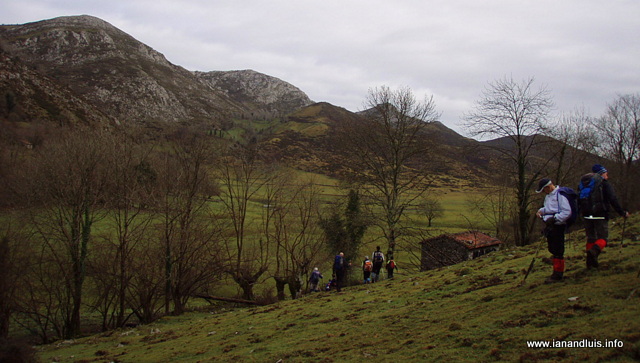
Going out with the group when your orienteering skills are not very good is a good opportunity to walk across some beautiful valleys and mountains as was the case with this stunning walk I did on a beautiful and sunny Winter's day in the area locally known as Ponga which lies next to the Picos National Park.


In Ponga the mountains are lower that those found in the Picos National Park and in Winter the snow soon melts so as a group we have an area where we can go out walking without the need to use crampons, snowshoes or skies, equipment that will be a must for those venturing at this time of the year within the higher peaks.


The drama when walking in the Ponga area at this time of the year resides primarily in the stunning beauty of its alpine meadows and woodlands surrounded by impressive lime stone mountains and ridges. The wild daffodils, of which in Asturias there are 4 native varieties, soon herald the colourful carpet that the warmer weather will bring over the next few weeks. In addition to the beautiful and brave occasional clamp of daffodils, I particularly like the vivid colours of the mosses and lichens so prolific within Ponga's limestone and, stunning at the moment as they are fully hydrated with the melting snow and rain.


Today's walk would take us to Carria Peak at 1431 meters high and was the last of a series of events the Peña Santa walking group had organized on a yearly basis and  as part of a week full of different presentations and exhibitions that celebrate the many outdoor activities that can be enjoyed in the mountains and as a result, the number of people doing this walk was slightly larger than usual.


The walk took us across some stunning scenery and as soon as we gained a bit of altitude and were out of the woodlands, we were rewarded with impressive views of the coast to the north and the snow covered peaks in the National Park to the south without forgetting the stunning area of Ponga itself.


Coming across the occasional bit of snow proved to be too great a temptation not to have some fun as was the case when Cori and Noelia decided to let themselves fall backwards and draw angels in the snow. Who could blame them with the Picos National Park as a backdrop.


The peaks are often crowned with a sort of letter box usually detailing the name of the peak, its altitude and who the sponsor for the box was. As you can see, Peak Carria had a letter box attached to a cross. There is a tradition for people to leave a note in the letter box indicating the name of those who conquered the peak, the date and any other information they may wish to share. The walking group usually leaves one of its publicity cards.


Reaching the summit is always a good opportunity for admiring the views and it is always interesting to hear from those who know the mountains very well, about others walks or when they point out some interesting detail about local history.


The second part of today's walk after leaving the summit would takes us across some areas still covered with frozen snow as we made our descent towards the lowers slopes where we eventually found a suitable place to stop for lunch.


After a short break for lunch we all felt rested and ready to undertake the descent down towards the Beyos Gorge just over 1000 m below where the bus would be waiting for. We walked down the terraces that many centuries ago were created across the mountain side to provide pasture for the livestock. These pastures supported life in the now abandoned and rapidly becoming derelict village of St Ignacio. Other than for one elderly shepherd who occasionally uses one of the huts and gathers the hay as Winter fodder for his animals in a traditional Asturian manner around a long pole, the village and grass terraces are rapidly been reclaimed my nature, an indicator and consequence of a rapidly disappearing way of life.


We came across a lady who as a child would have to walk up the slopes to gather the animals and whose knowledge of the area is invaluable and one of the reasons it is always nice to stop and talk with them as they are a great source of information as Jar, the main group leader would tell us.


Here is the link to my sponsorship page, please visit and if possible make a small donation or help us to promote this worthy cause. Many thanks.

Thursday, February 19, 2015

A walk to the local nudist beach...

5 comments:
Following a couple of weeks of grim weather it was great to wake up to bright blue and clear skies and a golden sun that was going to rise high and begin to bring some warmth and much needed energy. Foregoing the pruning of the fruit trees we decided to take the morning off and head for our local nudist beach...


Just along the coast is the stunning beaches of Toranda and Torimbia. In the height of summer they do get busy but not packed however, at this time of year it is almost guaranteed they will be deserted. Torimbia is a popular family-focused nudist beach that can only be reached by foot along a track that winds its way down the hillside to a secluded beach bar and golden sands. The bay provides protection from the elements and the gentle sloping beach provides safe swimming for all ages.


Toranda is a beach in the next bay to Torimbia and although smaller and more exposed to the ocean, it is equally stunning. There is a small car-park near the beach down a rough track next to a never-completed, and now derelict) building - probably built without permits and prevented from being completed. This morning even the local police were enjoying their patrol and took their patrol car along the beach and parked up. Along the way we passed divers returning from their foraging for sea urchins and goose-foot barnacles which they will sell to the local restaurants.


There is a track along the headland that leads from the car-park in Toranda to the beach at Torimbia but sadly with the recent spate of torrential rain the track down to the beach has suffered a landslide and it is precarious to get down although another track has been trod which was relatively easy to navigate.


Now the big question is DID WE STRIP OFF? Maybe if you look close enough you might just spot us.... Click here to reveal all


Tuesday, February 03, 2015

Walking in Asturias with Peña Santa Mountain Group

2 comments:

We have always enjoyed walking and since we arrived at La Pasera in Asturias, we continue to explore and enjoy the varied landscapes this region in Northern Spain has to offer. There are several walking groups in the region and I recently joined a local one that shares the name with one of the main peaks in the Western Massif. The Peña Santa mountain group is the largest of the groups and based in the nearby town of Cangas de Onis, one of the three main gateways into the Picos De Europa National Park, it is the oldest and an efficiently run group.


There is a yearly membership fee to join the group and once you are a member, you can access insurance cover at a much lower rate. This insurance card also gets you a discount when you stop overnight in a mountain refuge.

Other benefits of going out with the group when taking into account my lack of orientation skills is, that all the walks are led by guides who knows the mountains and the particular routes we are doing.


On each walk, in addition to the guide, there is also a person who closes the walk and whose role is to ensure no one is left behind or gets lost. Luciano is a group member who enjoys this particular role and lately I find myself joining him as he is someone very passionate about the mountains, nature, a way of life that is rapidly disappearing and whose knowledge of local history is incredible.

Luciano telling me about water and wildlife. Image by Cristina Perez.
In addition to the two monthly walks the group organises within different parts of Asturias, the organising committee also celebrates what is knows as the "mountain week" in early February when during the course of the week there will be a series of events celebrating outdoor activities in the mountains with numerous exhibitions, projections and presentations given by local and national mountaineers.

El Friero Peak, simultaneous Peak Climb, Summer 2014. Image by Sergio Perez Castaño


The calendar of activities and events for 2015 also includes 3 mountain bike rides, two walking trips with overnight stays in Madrid and the Basque Country, the 9th Lakes of Covadonga Marathon Xtreme and the simultaneous multiple peak conquering when the group splits into very small groups and tries to conquer as many peaks as possible within one of the three massifs that comprise the Picos National Park. This year this event will take place within the Eastern Massif and I already have my mind set in one of its peaks.

The group's yearly calendar always closes with a climb to a suitable peak just before Christmas when young and grown ups can accompany the group taking a Nativity set (Belen de Cumbres) that will be left on top of the chosen peak, a tradition celebrated by most of the mountain groups here is Asturias.

Belen de Cumbres 2014. Image by Silvia Castro
Image by Silvia Castro

In addition to the monthly outings, smaller groups of members get together to do more challenging and technical walks not suitable for a group of up to 25 walkers with varying abilities and ages ranging from 11 and 83 years of age.

The group has recently seen and increase of younger members lowering the average age of the group. One must not forget the coach driver, Javier, who after dropping us at the start of the walk would patiently wait for us at the end of the day and would always allow us time to stop at a local bar were we can enjoy a drink and come together to celebrate after a hard day's walk.


Bustiellu horreo (granary). Image by Gema Castaño
What is clear is that the group never cancels a walk come rain or shine as I have realised after some walks when the use of waterproofs and umbrellas was a must. The rain never bothered me and in spite of the limited views when walking across valleys or having to slightly adapt the route to take in the day's adverse weather condition. The warmth, friendship and laughter from the members of the group never fails to brighten up the mood on a rainy day. After all, it is the rain that adds to the beauty we enjoy in Asturias. Cheers to the group and future days enjoying the stunning scenery in Asturias.


Friday, January 02, 2015

A cliff-top walk from La Isla to Lastres in Asturias

No comments:
On New Year's day we decided to go for a coastal walk about 20 minutes drive from us: La Isla to Lastres. This path is well sign-posted and apart from a small amount of road walking at either end, it takes you along a vertigo inducing cliff-top path with spectacular views; just the thing to work off the excesses of Christmas and New Year. We started this linear walk on La Isla beach.


La Isla

It was a very cold start to the day with a wide-spread frost which is very unusual for where we are, we rarely get frost at all. The sky was blue and cloudless and as the sun rose, it warmed the air quickly rendering our two layers of fleece, shirt and gloves somewhat excessive.

Lastres in the distance


With a picnic of tortilla, walnut bread, celery, dried figs, fruit and drinks we were well set up to spend the day exploring, taking in the views and enjoying the warmth of the winter sun. We were surprised at the amount of flowers in bloom and how little evidence of Christmas there was in the villages along the way.


The eroding cliffs, mud slides and 50 meter vertical drop into turquoise blue seas and jagged rocks, is not something I or my newly acquired vertigo relish but never-the-less it was enjoyable and as long as I didn't get too far near the edge I was OK...ish. We spent a few minutes watching a diver navigate the rocks, probably fishing for goose-foot barnacles (percebes), a delicacy here in Asturias.

Searching for Goose-foot barnacle?


As you approach the far end of this linear walk you head slightly inland through the village of Guerres before heading down to La Griega beach (famous for dinosaur footprints) and on to Lastres. We passed more cattle and horses than people along the way and enjoyed our home-made picnic before heading back to La Isla to spend a few minutes on the beach as the sun began to set.