Showing posts with label Mosaic. Show all posts

Thursday, July 16, 2015

Portraits in Mosaic

2 comments:
Luis has just returned to Asturias from a two week mosaic course in Belgium and from visiting fellow mosaicists in both Belgium and Holland. Needless to say he has had a brilliant and very productive time. The piece he chose to work on in Belgium under the tutelage of Mireille Swinnen at http://www.mozaiekstudio.be/ was based on an ageing Pierrot clown - a portrait in tessarae using a direct method in a painterly style. I was really pleased with his choice as for those of you who don't know I was once a keyboard player for a band called My Pierrot Dolls in the early 1980s (who incidentally are still playing gigs in and around Yorkshire in the UK - check them out if you get a chance). Despite a very active social programme, with Mireille's guidance he managed to complete the portrait with only the framing and mounting left to do.


Whilst in Belgium he shared some studio time with Jeannot Leenen a really talented mosaicist who you may remember created a portrait of one of our cats, Wentworth. Jeannot has very kindly now completed a second portrait, this time of Gawber so we will be able to display them in their full glory together: The Asturian Prince and The Asturian Hunter.


Luis ended his mosaic adventure in Holland and spent a few days with another great mosaicist Conny Van Der Wende who owns and runs  Tiles and Tools . Now back and filled with renewed energies, new techniques and numerous ideas, I am looking forward to his new projects... Watch this space.

Wednesday, December 31, 2014

Looking forward to 2015

1 comment:
It has been an eventful year for Luis and I here at La Pasera and in the UK. Luis continues to develop his artistry and knowledge in mosaic art and following a visit to an exhibition and meeting of mosaicists in France he has booked a mosaic course in Belgium for summer 2015.  He continues to restore both cane and rush chairs but increasingly finds his energies and thoughts moving towards mosaics.


I have continued writing, taking photographs and making music and have one or two interesting projects in the pipeline for 2015.


La Pasera still offers us our little bit of paradise, we continue to grow the majority of our vegetable and salad crops and no doubt that will continue for the foreseeable future. Plans for 2015 include the addition of hens for fresh eggs and finishing off the final bit of hard-landscaping.


We would like to thank all of you who read and/or visit our blog and wish you all a happy, prosperous but most of all healthy 2015.


Don't forget you can visit our other blogs as well, the links can be found at the top of this page.

Best wishes
Ian and Luis x    

Saturday, October 25, 2014

Mosaicos La Pasera, an update.

3 comments:

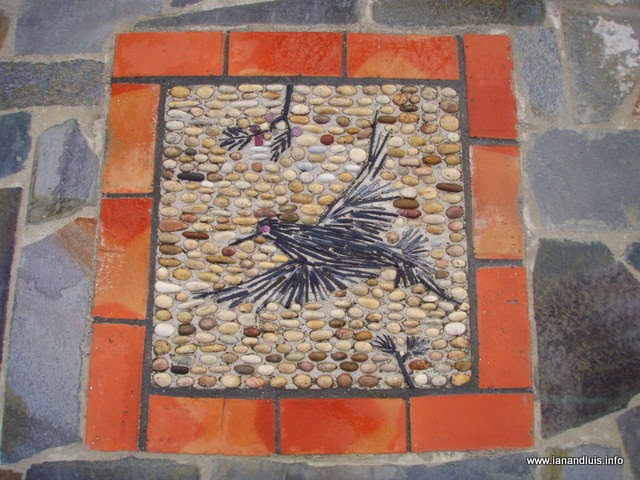
As a mosaicist and whilst living at La Pasera, I have designed and created numerous decorative pebble mosaics that now adorn paths and a small terrace. My passion for this mosaic genre stems from my love for pebbles and a holiday we once took in the Greek Island of Rhodes where we saw many decorative mosaics been used as pavement. After returning home, Ian got me as a present, a book by Maggy Howarth titled "the art of pebble mosaic". Since then, I have completed a good number of mosaics that decorate our garden and have had several as commissions.


For my latest pebble mosaic of a flower pot made out of small pebbles and terracotta roof tile, I spent several hours selecting the right sized pebbles no grater than 1 cm in diameter. Using these small pebbles, I was able to create small mosaics light enough to be used as a decorative picture hung on a wall,

This little Mosaic (31x22 cm)  was made as a present for a mosaic artist friend of mine who comes from Belgium and whom I recently met when I travelled to Chartres in France to visit several international mosaic exhibitions.
Although I usually I work with natural stones for my Roman style mosaics my last two commissions required me to use smalti (vitreous paste) made by the Orsoni family in Venice following centuries old recipes. This allows me to choose from a wide colour palette. This was the case of my latest commission for a birthday present depicting a lobster.

Using smalti has been an enjoyable challenge that not only required me to learn to use new tools but also required to adapt and use different processes and as a result I am researching several mosaic courses to see which one can suit my needs better specially since I want to learn more about colour use within mosaic art.

XII th century stone carving in one of the porticoes of the Gothic cathedral in Chartres.
I recently returned from Chartres where I attended the opening ceremony of the 10th edition of the internationally renowned mosaic "Prix Picassiette" celebrated on alternating years. During this event, I met many mosaicists and mosaic artists with whom I have been communicating via the Internet and several mosaic art forums I am a member of.

In Chartres I was able to spend time not only admiring the beauty of many works of art but also having an opportunity to study different mosaic techniques specially those used in 3D mosaics as I have in mind several projects for mosaic sculptures that in time I want to create and place around our garden here at La Pasera. You can follow my mosaic work on my dedicated and newly updated blog: Mosaicos La Pasera 

Monday, July 21, 2014

The Asturian Prince - Wentworth

4 comments:
The Internet attracts a lot of criticism for all sorts of reasons but it can also be a wonderful resource and mechanism to connect with people you would not normally come across by other routes.

We have developed friendships with many people over the years via the Internet both through our blog and through various social networks. It never ceases to surprise us both how generous these virtual friends can be.


One such friend offered to make us a portrait, in mosaic, of Wentworth, our beautiful black cat: named after an area of South Yorkshire where we used to live. Jeannot Leenen is a mosaic artist from Belgium Luis initially met through one of the Internet based mosaic groups they both belong to. We have always admired her beautiful work and over the years Luis has became very good 'pen-pal' friends with her via the Internet. Her kindness and generosity both as an artist and a person are boundless and later on this year Luis plans to meet up in person when they both visit the internationally renowned mosaic exhibition that will take place in Chartres, France.


Words cannot express how magnificent this portrait is. She has captured his character, his posture and his ever-changing black glossy coat as it reflects and absorbs the changing light - absolutely stunning.


Jeannot knows how pleased we are with this gift and it will be a lovely moment when Luis can meet with her in person and share their passion for the art of mosaic.

Thursday, June 19, 2014

Restoring a garden bench and making a rustic one from recycled material

3 comments:
We like sitting in the garden. Typically the weather allows us to use the garden much more than when we were in the UK. We have various areas dotted around where we sit and watch the natural world go by.


Some years ago I came across an old wrought iron bench that was in urgent need of repair. The wooden slats were rotten and the wrought iron had broken and was in need of welding (not an easy job).


After sitting around gathering dust, we managed to get it repaired by Luis' brother-in-law and we sourced some new hard-wood slats which we treated with white spirit and linseed oil. A coat of paint and with new slats fitted, it looks great and is a welcome addition to the terrace.


The other bench we made this week was from a discarded beam someone had dumped on the roadside. We cut it in half, fastened it together with a couple of metal plates either end and stood it on two old terracotta chimney pots we have had lying around for some time.


This week we also decided to site the mosaic coffee table Luis made several years ago. He now needs to get on with making a couple of matching mosaic pedestals on which to stand it, in the mean time bricks will do.....


Wednesday, May 21, 2014

The Kingfisher has flown its nest - mosaic

11 comments:
A few weeks ago Luis was asked to design and create a mosaic intended as a gift for a birthday. The brief was: a Eurasian Kingfisher. Working with the people involved they agreed on a design and composition, size (quite large 70cm x 85cm), how it would be constructed to suit the position it was to be hung and what materials it would be made from.

A pencil sketch was used to agree the main design elements but they very much left it up to Luis to interpret their idea.


The next task was to source the appropriate materials, choose the colour palette, prepare the base and plan the construction methods. He decided to use a mixture of marble, limestone and Orsoni Smalti from Italy as this would give him the colour palette he required to capture the beauty of this wonderful bird. Materials were sourced and work commenced.


Mosaic work on this scale and with such detail is labour intensive. Long hours were spent studying kingfishers and refining the design, planning the project, cutting the tesserae and reviewing methods and techniques. The mosaic is worked in reverse so you never know what the finished surface will look like until it has been set, dried and turned.


Once the mosaic is complete, the worrying times commence as cement glue is spread carefully across the surface of the mosaic and onto the cement backing board on which it will be mounted.


Several days later the mosaic is turned, cleaned and closely examined.


The next stage is to grout elements of the picture, seal, polish and generally put the finishing touches to it including a hanging device and more weather-proof sealant and wax.


Phew, all was well and the 130 hours he put into the mosaic was well worth the effort, it looks magnificent. Needless to say the recipients were very pleased with it and will now have the pleasure of seeing it proudly displayed on the wall of their cottage and garden.

There is always a sadness to see such a piece fly the nest but on the other hand there is a sense of achievement and consolation knowing that it is going to a place where it will be cherished.


A big thank you to Jeannot Leenen and Ornella Martens, two mosaic artists from Belgium for their generosity and guidance throughout the project.

Anyone interested in Luis' work can view his range of work here: www.mosaicoslapasera.com

Email: artesanialapasera @ gmail.com (remove spaces)


Wednesday, April 02, 2014

Mosaics in and around our garden.

4 comments:
Those of you who follow our blog will know by now that I am passionate about all things mosaic related. My mosaic journey really started when following a holiday in the Greek island of Rhodes where we visited numerous sites with beautiful mosaics Ian got me a book on pebble mosaics written by the British based artist Maggy Howarth.


During our time at La Pasera, I have had an opportunity to explore the technical and aesthetic aspects of mosaic art both relating to pebble and roman style mosaics. My abilities as a mosaicist continue to evolve with each individual piece I design and make.


In my journey into the mosaic world as a self taught mosaicist, I enjoy reading books and publications relating to mosaic art and greatly value the information and sharing of ideas with fellow mosaicists and artist via the Internet based mosaic groups I belong to.


Thanks to these groups, I found that there is a two yearly international mosaic exhibition in the Italian city of Ravenna which I visited last November. Taking part in Ravenna Mosaico 2013 as a visitor was an incredibly valuable experience during which I was able to admire contemporary mosaic art and some of the most beautiful Byzantine mosaics dotted across the city in several World Heritage Sites. This submersion in the mosaic world was very inspirational and on returning I started to create a Byzantine style mosaic representing Prometheus, the titan that Greek mythology tells us that as a protector and benefactor of humans presented us with the gift of fire, a myth that has always fascinated me.

Prometheus

The making of Prometheus gave me an opportunity to explore some technical and aesthetic aspects relating to this beautiful art and craft that help me to gain the expertise that enables me to create more complex mosaics not only to adorn our garden but also when I get a mosaic commission as is the case with the latest one I am working on at the moment. It is a mosaic intended as a 50th birthday present for some keen birdwatchers who have commissioned me to do a kingfisher for which I am using vitreous paste or smalti in order to achieve the bright colours of this beautiful bird.

Birdbath


My first mosaic

Recently, we have also completed the paving of the patio and the path leading down to it in which we have incorporated a series of 19 small mosaic fish and 4 lily pad mosaics directing your attention towards the pond area creating the illusion of a stream. We have also set within the patio two more mosaics depicting a bird in full flight and a lizard. The step from the patio down into the grass area is also paved with a simple but beautiful pebble mosaic; this is the very first mosaic I ever made and which originally adorned our garden when we lived in the UK. This is a very important mosaic for me and I value the opportunity to enjoy it here at La Pasera.


Thursday, February 06, 2014

A road trip along the route of silver part 2: The treasures of Zamora

No comments:
The architecture of Zamora spans Roman, Romanesque, Islamic, Gothic, Neo-classic, Art Nouveaux, Modernism and Post Modernism. The city, like many others in Spain, is struggling with high unemployment and rising prices. Many of the streets and alley ways are blighted by graffiti; a sign that all is not well amongst a disaffected youth which is understandable given that unemployment in the under 26 years of age is 52%. Winter doesn't bring the tourists in any great number and seasonal work is not available. There are many empty properties in the centre both in terms of shops and apartments, maybe a sign that rents are high and that cheaper social housing and a faltering economy is driving people out of the centre into the sprawling estates on the edge of town.


Zamora will survive not least for it's extravagant festivals, the Tapas and Ribera del Duero wines, its many glorious buildings and the treasure which they contain. Coaches bring people on a daily basis to see the Cathedral, its museum and various other gems dotted around the city, of which there are many.


The cathedral of Zamora dates back to 12th century and is Romanesque in style with later Proto-Gothic additions. The highlights for me were: the dome; the intricately carved choir stalls (15th C); the wrought-iron work.  The craftsmanship of the the richly decorated alter pieces constructed from silver with gold embellishments is to be admired but they leave me wondering how such extravagance could have been justified in past times full of hardship and suffering.


The dome is stunning with its sixteen arched windows that allow light to flood into the Cathedral as the sun circumnavigates it throughout the day.


The stone carvings are spectacular. On the south side of the Cathedral is the Bishop's doorway with its semi-circular arcades and Romanesque sculptures. Many other fine stone carvings can be found around the museum and Cathedral.


The Cathedral museum was equally impressive with its large collection of 15th - 17th Century Flemish tapestries and abundant religious artifacts and iconography. The tapestries include a collection of 5 from 8 original pieces that tell the story of Hannibal and his quest for power. Other pieces tell the story of Helen of Troy and the Trojan war and, the life of the Etruscan King of Rome; Tarquin. The amount of work and detail in the tapestries is mind-blowing. One can only imagine the thousands of hours young women and girls spent in the workshops sewing and weaving by candlelight with their needles and thread creating such beautiful works of art. (Slide show at the end of the post)


There are many churches and and buildings worth visiting but most do not allow photography. The Cathedral and Museum allowed you to take photographs without flash but only if you paid an extra euro on top of the 6€ entrance fee. They even issued me with a sticker. It was worth it just to photograph this magnificent pietra dura table with its polished stone and marble flowers, birds and butterflies. The lack of flash shows on the quality of the photos but I did my best under the circumstances.


Other highlights for us were the Parador of Zamora which we looked around at the insistence of the manager in the hope that we would dine, stay a few nights or spread the word to our friends. The Provincial Government council chambers were stunning if not somewhat over-the-top, but worth a visit as was the permanent exhibition of Baltasar Lobo whose stunning bronze sculptures are tastefully displayed in a modern gallery space built inside a much older town building.


We also came across one or two pieces of street art that were ill-thought out such as this Opus Sectile Mosaic by Domingo Iturgaiz. The majority of the mosaic was obscured by trees planted too close and without much thought of their size or proximity.


Our lasting memories of Zamora are for me, the tapestries and the graffiti which in much the same way tell stories of a time of hardship, war, extravagance, protest and privilege, both making a statement of their time; the difference being is that the former had great wealth and hope whilst the latter have little.  For Luis, the Romanesque architecture is a big draw and something he always relishes.


Don't forget to join us for Part 3 Onward to Cátheres.