Showing posts with label garden. Show all posts

Sunday, September 13, 2015

Black magic in the garden

7 comments:
As the garden has developed we have both grown very fond of deep red, dark purple and almost black planting in the garden. Sunlight enhances the rich coloured leaves by enabling them to show their rich deep red and purple tones whilst the dullest of days serves to bring out the black. Add rain or dew to the mix and you get an altogether different perspective: the raindrops reflect the light like diamonds. This group of hues adds focal points to the garden and serves as a splendid backdrop to other plants and flowers or helps to lead the eye to a view.  If you have any recommendations for black or deep purple foliage plants, please let us know in the comments below.


Sunday, August 30, 2015

A high summer peek at the garden

17 comments:
Most gardens have several faces that are determined either by natural cycles or through their purpose and the resources allocated. Ours is no different. We have beautiful places that are pleasing to the eye and other senses where you can sit and idle the time away. We have both tidy and not so tidy working areas which are in a constant state of flux, piled high with wood to chop or stone to cut and use. We have unfinished areas that are at the end of a list that grew and grew over the past 9 years and that will one day on completion, serve as the full stop to the overall preparation and build elements or at least signal a semi colon.

Here are a few photographs of the pleasing elements of our garden (in our eyes at least). As the late summer colours overtake the fresh shades of the spring greens, the changing summer light advances bringing with it rich hues and tones to the nearby landscapes and, the midday skies take on an increasingly erratic carpet of blue, grey and white.


Friday, June 12, 2015

June in the garden

6 comments:
The weather continues to be cooler than usual with several days of prolonged drizzle and low cloud. Sunny days have been few and far between but never-the-less the garden is looking colourful and filling out at a pace; sadly, the flowers do not last long enough when they get saturated in the persistent drizzle. We tend to wander around the garden daily to spot what is happening, to see what's in flower, prioritise weeding and spot any potential problems such as infestations and damage. We noticed several heavy infestations of aphids on the fruit trees. We had been told about a soap based product (soft potash soap) that is supposed to help eradicate such infestations so we bought some and have sprayed all the fruit trees to see if it works (50g/litre of water). We will let you know how efficient it is.


There are several spectacular flowers and plants in bloom at the moment including: The bird of paradise which we rescued from a house in the next village. It was constantly on the floor, dry and in a bad way so we knocked on the door and asked if we could take care of it. The lady said yes and with a bit of tender, loving care, it is back in great shape. It just needs re-potting now in something appropriately splendid.


The bee orchid is common in these parts but we have found some in the garden amongst the flowers -  We are not sure if it is a bee orchid or a woodcock ophry (thanks Nigel) as they are almost indistinguishable, they are truly lovely and we will encourage their spread. We now have at least four types of wild orchids that grow in the garden.


The Alliums are in full spectacle. As you approach they appear like miniature galaxies suspended in green space. Their structure and form are fascinating and a wonderful distraction.


A few years ago we planted a series of terracotta roof tiles with succulents. These were easy to make by blocking off the ends with pebbles and cement, filling with soil, adding plants and a few decorative pebbles and topping off with fine gravel. We have lined the steps down into the garden with them and they make a lovely addition and need very little attention.


Luis has been busy making mosaics in between all the other things we get up to. He has just completed two column bases for a mosaic table he made some time ago. They are designed so that they can be used independently but we will use them with the top as intended. The are a lovely addition to the terrace. We will feature them in-situ once fully dry (currently sealed and awaiting positioning).


Elsewhere the garden continues to keep us occupied with lots of fruit and vegetables to sow, maintain and harvest as appropriate. The lawns need regular cutting and the flower borders need dead-heading to prolong the flowering season. There is always something to do but it brings with it the opportunity to savour the beautiful colours, shapes and structures that nature provides. What do you enjoy in your garden?


Sunday, March 29, 2015

The first grass cut of the season.

4 comments:
The grass has taken a bit of a beating over winter with excess rain and a few rare frosts. The growth has remained stunted but it has given dandelions and daisy plants time to gain a strong-hold and proliferate now the better weather is here. After a couple of warmish days and light breezes, the grass is ready to be cut; the first of the season.


The grass cuttings are layered with dry material in the compost bins and overtime it will rot down and be put back into the garden. We try to make as much compost as possible; if you grow vegetables, you need as much compost as you can produce and more.


We don't have a lawn as such, the land used to be an old neglected orchard and meadow. It would be impossible to create the perfect lawn as we are surrounded by fields and meadows, plagued by land voles, abused by the wild boar and use the garden as a work, rest and play area. This suits us and as long as the grass/weeds/mosses are kept in check, it really doesn't look too bad.


We have just had the strimmer serviced and it is starting and stopping when it should, I think we really should have the petrol lawn mower serviced and sharpened as well as it is chugging along at times and takes some battering.


We have left most of the borders as they are filled with celandine's, primroses and narcissus. We also have a few wild orchids that are yet to show their heads so we will probably leave the grassy borders until May or June when we will strim or scythe and let the grasses and seed heads dry and fall before collecting.


It is a real pleasure to feel the warmth of the sun on your back again after what has seemed a really long and dull winter. We are looking forward to the months ahead in the garden and hope to finally finish the front gardens and driveway.


Friday, January 09, 2015

Thinning and pruning

4 comments:
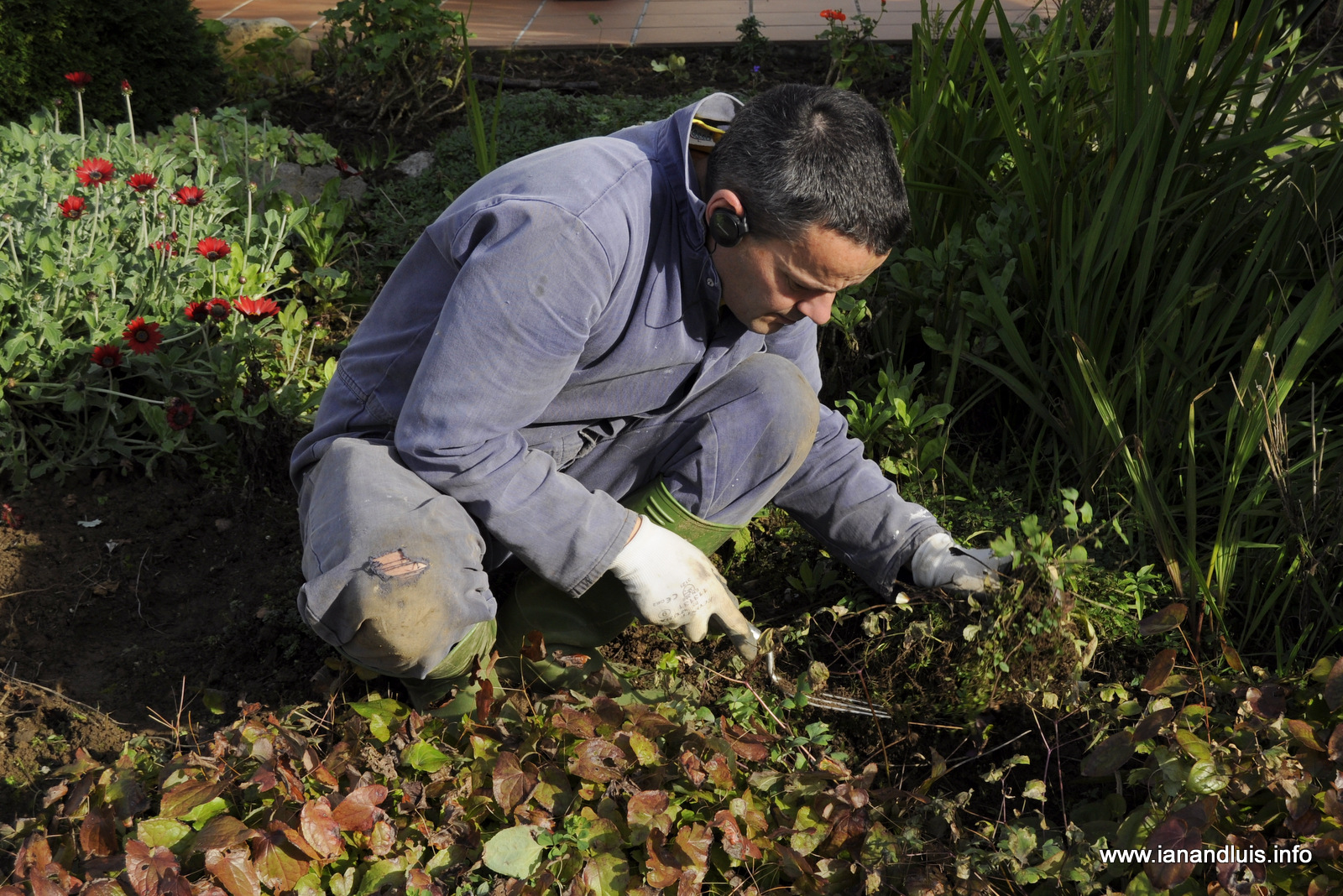
We don't have a massive piece of land, about 1500 sq m in total but what we have is certainly enough to keep us busy throughout the year and especially in winter. When we bought La Pasera we asked the builder to leave in situ, the existing orchard trees and any trees and shrubs that were on our borders. One of the first tasks we accomplished was bringing plants from our garden in Yorkshire to Asturias, some of which were successful and others not. After creating various planting beds, rockeries and borders, adding our UK stock and planting more plants, trees and bushes over the years, we have learnt a valuable lesson: living in a temperate climate makes things grow, spread and multiply with such vigour. This week we have been cutting back, pruning, thinning and disposing of many plants and shrubs that had become just too big or cumbersome for their allocated space.


The two dying apple trees - leafless

Sadly, two of the old apple trees have also come to the end of their life after hardly any leaf and no fruit last year. The woodpeckers have been visiting daily and stripping the bark and feasting on the grubs that have taken up residence in these dying trees. Fungus has claimed their bases and it will be sad but necessary to chop them down and replace them with young apple trees that will provide us with lots of fruit.


I have been trying to prune lots of our bushes that over the time have been cut back and have subsequently grown in not-so-pleasing shapes. It'll take a couple of seasons but with time they will grow into better shaped and more pleasing to the eye specimens. We need to tackle the north border of our land that has hazel, blackthorn, hawthorn and pyracanthus, all of which grow with great gusto and apart from the useful coppiced hazel, are difficult to handle and dispose of due to very sharp thorns. We will probably burn this in the garden as it is almost impossible to process into useful firewood. In Spain, it is recommended that you apply for a license to burn even the smallest amount of garden rubbish. If you burn without one, if your fire spreads you can be held liable for costs and fines so a (free) license is advisable... I'm really not sure as to why a free license and registering protects you but if nothing else it raises the issue of the dangers of fires in rural and wooded areas. You can only use the license between October and May which makes sense due to the cooler and wetter weather.


We will process the wood for kindling and firewood which will take up to a year to dry sufficiently. The plants, weeds and leafy off-cuts will be composted and provided us with much needed nutrients to add back into the beds in a few months time. Working in the garden is therapeutic on many levels and helps us fine-tune our ideas. It is now nine years since we bought La Pasera and looking back at old photographs certainly reminds us of how much has been achieved over the years.

2006

Thursday, November 27, 2014

Autumnal jobs around the garden - the working area

2 comments:
Every season brings with it the need to keep on top of work in and around the garden. Autumn is especially busy for us. Surrounded by mature trees, we have many fallen leaves to collect which provide us with leaf mold for the following year. The colours of autumn are especially vivid this year prompted by an extended warm and dry period followed by cooler and damper weather.


Our main working area in the garden is down by the potting shed. When we first came here we built a partition hedge/fence around it made out of coppiced twigs, branches and logs: an idea we saw first used at Worsborough Reservoir in Barnsley, UK. This has worked well for us and has not only provided a natural looking compound around the working area but also a haven for wildlife including slow worms, beetles, lizards, birds, amphibians, mice and many moths and other insects which are so important in maintaning the natural balance in and around our vegetable beds and small orchard. We call this creation a fedge for want of a better word.


The fedge has served us well and each year we add more and more surplus branches and used bean poles and such which over time rot down and provide a valuable habitat - a functional and manicured wood pile. From time to time we have repaired it with new supports cut from coppiced hazel and last year we added discreet iron bars to help hold its shape and substance.


This year we will have a lot of coppiced hazel to add to the fedge so we decided to purchase some treated posts which will increase the height of the fedge and enable us to add a lot more material.


At the same time of renovating the fedge we decided that the leaf bin needed replacing as it had begun to rot and break apart. Fortunately we had a few pallets in stock from recent building work so with a bit of tweaking, a few nails and a staple gun we were able to produce a replacement leaf bin which is much stronger, slightly bigger and that will last us a good few years.  We will need to think about replacing the compost bins next year and we still need to re-treat the shed with preservative but for now, the working area is once again fully functional and will serve us well in the coming weeks as the autumnal garden jobs are tackled.


More creatures from our garden can be found on Smaller Tales from Toriello