Showing posts with label Harvest. Show all posts

Friday, August 22, 2014

It's time to harvest the pears

1 comment:
It's time to harvest the pears, well at least one of our two pear trees. The tree is laden with fruit, the first time it has fruited in the 5 years we have had it. There aren't masses but we are pleased with what we have considering we don't spray with chemicals. The type is Manteca Hardy. Our other tree is a conference pear which did well last year but it doesn't have much fruit at all this year.


The birds had started to attack and eat the pears which is always a good sign that they are ready for harvesting. Gawber, never one to miss an opportunity to climb, joined in the pear harvest and made sure no birds pinched our crop.


We will eat the larger pears and plan to make a pear and tomato chutney with the smaller or damaged ones. Our gooseberry bush failed to fruit this year so we are pleased we have an alternative for chutney making.


Source: http://www.frutas-hortalizas.com/Fruits/Types-varieties-Pear.html
Mantecosa Hardy: It also comes from France, and it is sometimes called Hardy or Gellerts Butterbine. This fruit is short and asymmetric, of average size. The skin is of greenish yellow colour, with rough brown spots. The pulp has fine grains, it is tender, juicy, sweet and aromatic. It is consumed as dessert fruit from August until the beginning of October or even later. 

Friday, August 02, 2013

Drying and gathering herbs for infusions - What's your tipple?

4 comments:
We are making the most of the hot dry weather and gathering supplies to make a range of infusions to drink. Luis has always taken infusions but for me, there is nothing like a strong cup of coffee.


On a recent Skype consultation with Lucy Jones from the Myrobalan Clinic, part of the advice offered was to drastically reduce my caffeine intake as she felt it was partly to blame for a range of minor health problems I had been experiencing. Since reducing my coffee and switching to herbal infusions, and increasing my hydration generally, most of my symptoms have subsided and I am feeling much better.


Whilst the growing season is in full swing we are gathering and drying: Lemon Verbena, Lemon Balm, Mint and Chamomile. These will be stored in air-tight jars and will last us most of the year.


There is a problem with our chamomile though - by itself it has a really bitter after taste. We were sure it was the German Chamomile and not the English which can be bitter. I will probably source another plant when I am next in the UK just in case.


We also use rosemary, wild fennel, green and black tea, sage and dried liquorice. We have started blending our own infusions and making note of combinations that taste refreshing, warming or restorative as required.


In addition, we are growing for the first time, Stevia to dry and use as a sweetener. We managed to buy a small plant in Oviedo and up to now we are pleased with the results. We rarely use refined sugar and normally use honey sourced from a vet who keeps bees. We pay around €5 per kilo and order 30 kilos a year for home use. Introducing Stevia will help reduce the calorie intake a little.

Stevia

I have read about adding spices such as cinnamon, cloves, nutmeg or cayenne so I will be experimenting with these in the coming months.


What's your tipple?

Do you drink infusions?

If so, what do you recommend? I'm sure we have lots more usable plants and herbs in the garden but we are a bit unsure what to try...Suggestions?

Coffee breaks have been replaced with tea-breaks, cake or biscuits replaced with foraged nuts, what could be better than iced tea on a summer's afternoon...


By the way, if you are looking for a consultation with a Registered Medical Herbalist, I can recommend Lucy Jones who I found to be really thorough, helpful and insightful. Myrobalan Clinic

Friday, July 05, 2013

Making dolmades from local vine leaves

2 comments:
One of the great benefits that come from blogging are the friends you make along the way and the many things you can learn from each other. One such blog friend is Andrea at Casalinho in Portugal. Andrea and Jeroen run several permaculture courses each year and take volunteers from all over the world to help and to gain experience on their 10 hectare plot.


Recently one of their volunteers made Dolamades for everyone and they looked so good we decided to have a go. We used Nicola's recipe and fine-tuned the ingredients to suit our taste.


The first challenge was to source vine leaves. Asturias isn't known for grapes but we were sure we'd seen vines growing locally when out on one of our walks. Sure enough, a walk around the villages and we found a whole load of them trailing over a disused wall and plot. Being late in the season we collected the medium sized ones so they would be less tough and used the following recipe:

Dolmades by Nicola


We cooked ours in the pressure cooker for about 15 minutes then in the oven with some home-made tomato sauce - Served with a few black olives, they were absolutely delicious and we will certainly be looking to make more next year but perhaps earlier in the season.


Don't forget to check out Andrea and Jeroen's blog, courses and site: Casalinho


Tuesday, July 02, 2013

Summer fruit and vegetable harvests

4 comments:
Summer is always a busy time here at La Pasera with many crops producing in abundance. We always grow more than we can use fresh but the remainder doesn't go to waste. We will process many of our crops into pickles, soups, jams and burgers whilst others will be frozen, dried or bottled.

We have had a slow start to summer which has meant most things are about a month behind from previous years. The beetroots are at that stage where they are small but sweet and tender, perfect for salad, delicious in beetroot and coconut soup and absolutely brilliant just simply juiced fresh.


We are trying Kohlrabi this year, a first for us and we will probably eat it in salads. It seems to have split a little, probably due to erratic watering or fluctuations of temperatures. I'm a bit disappointed with the taste but Luis likes it. I might try pickling some to spice it up a bit.


The sugar-snap peas are a little disappointing and no where near as sweet as previous years. Instead of eating them raw in salads we will probably use them for soup. The carrots are beginning to crop and so far seem sweet and quite a size.


The gooseberry crop has done really well this year and has not suffered due to gooseberry sawfly. We made sure that rhubarb leaves were placed under the bush whenever we cropped it and this acts as a physical barrier as ell as a natural insecticide, it works. We will make as much gooseberry and mustard seed pickle as possible as this is one of our favourite accompaniments to bean-burgers, cheese or savoury and Indian dishes. The big challenge has been to keep the blackbirds away but this year we put netting up early which seems to have worked.


Elsewhere the raspberries and redcurrants are producing well and we will shortly be harvesting these for the freezer or to make fruit leathers in the dehydrator.


Wednesday, June 26, 2013

Making elderflower cordial

8 comments:
Friends, Birgitta and Manfred at Casa BelĂ©n recently gave us some homemade elderflower cordial which we really enjoyed. With its slightly heady aroma, a sharp sweetness and thirst quenching qualities, we thought it would great to go, sooner rather than later, to collect flowers to make our own. We were sure we had missed the main blossoming of the wild elderflower bushes but we managed to collect enough for a decent batch.


We set off along the Camino de Santiago which is about 500 meters from La Pasera and explored some of the many tracks that lead off it to the left and right. Many of the bushes were sited in overgrown meadows now inaccessible due to thick bramble growth which made collection difficult. We carried on as walking the camino is great anyhow and in the end we managed to collect about 50 or 60 newly blossoming flower heads.  We ensured we didn't strip entire bushes thereby leaving some to fruit later in the season.


We searched on line for a recipe and decided to try this one from River Cottage. We also needed to collect lemons but given the plentiful trees around the area we were easily able to gather enough for our needs. In this recipe we needed 6 for zest but only used the juice of 3.


In total we made about three and half litres which we will use over the coming weeks. We also made some ice cubes with the undiluted cordial for using in a nice sparkling wine or Cava. If we get chance we intend to make another batch but that really does depend on finding elder flowers that are not turning to fruit.


Monday, June 17, 2013

The potato harvest

No comments:
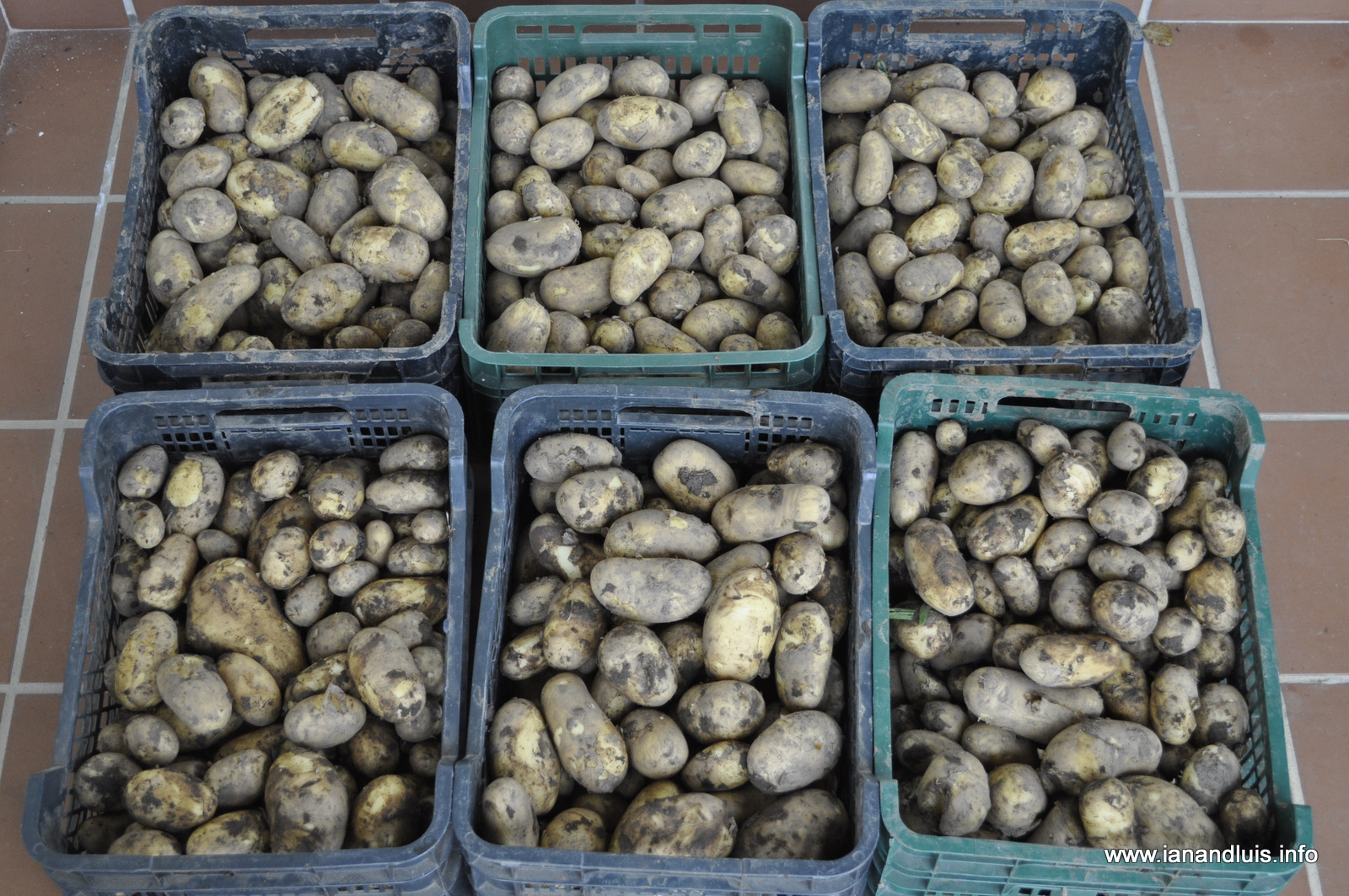
The recent spell of wet weather followed by warm, humid conditions has not been good for our potato crop. We spray with a natural fungicide made from horsetail macerated in water. This is effective to a point but it will never be as good as the strong chemicals from a commercial product. We take this into account and expect that when blight hits, we harvest.

The potatoes will be dried off, cleaned and stored but the tiny new potatoes will be devoured within the first few days, absolutely delicious with a knob of butter and some chopped fresh mint.


If we harvest soon after the first signs of blight then the crop is unaffected and we can enjoy good quality newly dug potatoes. This year has been a successful crop with early planting in late February making a total of 16 weeks in the ground. The variety was Spunta and we planted 100. We have little choice here so we usually buy whatever seed potatoes are available from the local agriculture cooperative.


Elsewhere in the garden the Air Hyacinth is coming into blossom and looking great. We started out with one very small clump; a gift from a lady in the village. This has grown and been divided many times. They are the easiest plant to grow with little care apart from clearing dead fallen leaves that get trapped in winter. We have several large clumps dotted around and always try and split them and pass on whenever we can. My parents have one in the UK but they take it into the conservatory during winter as it would die given a hard frost.


Thursday, May 09, 2013

Top of the crops - Peas

No comments:
If our vegetable garden is like many others, there are probably a couple of crops that seem to do much better than anything else. I suspect it is due to several local factors such the soil, fertility, weather, position, pests and diseases as well as other factors such as seed viability, variety, compatibility with local growing conditions and general care, and of course the perfect twiggy pea stick.


One crop that never disappoints at La Pasera is the humble pea in it's many forms. Each year we grow 3 or 4 types of pea crop including: Mange Tout; Sugar Snap Peas; Pod Peas x 2. This year, in addition, we are trialling a purple podded pea (Mr Bethal) sent to us by a friend.


Currently we are harvesting about half a kilo of Mange Tout a day and they are delicious. We eat them raw in the main with salads and as a snack but they are equally wonderful in stir-fry, soups and curry. What we can't use we will give away, freeze, feed to some local pygmy goats or compost.

peeeeaaass...peeeeaaass...


We eagerly await the new purple podded peas to see how they shape up for taste and cropping, early signs suggest they will fare well.


What crops well for you?

Friday, February 22, 2013

Growing and pickling peppers

No comments:
There are many pepper varieties to chose from. Here at La Pasera we tend to concentrate our efforts on those varieties that grow well during the humid Summer months we get so close to the coast. The peppers we grow are old varieties traditionally grown on the north coast.

Isla peppers is a variety that originates in Cantabria and produces rather fleshy and very sweet fruits even before they ripen and become red. The other variety is a very mild and pleasant chilli pepper called Guernica from the Basque country; delicious even raw. This year we were given some Cayenne peppers for us to germinate that we intend to dry and use in cooking.


We like our peppers and have fine-tuned the variety and methods by which we grow and preserve them.
Peppers are slow to germinate and more so this early in the season without a heated propagator or greenhouse. Our pepper season commenced a few days ago when we started germinate the seeds by soaking then in water for 12 hours after which we cover then with a wet tea towel in a closed plastic container. We wait until they start showing signs of sprouting before sowing in compost and placing against a warm and sunny wall.
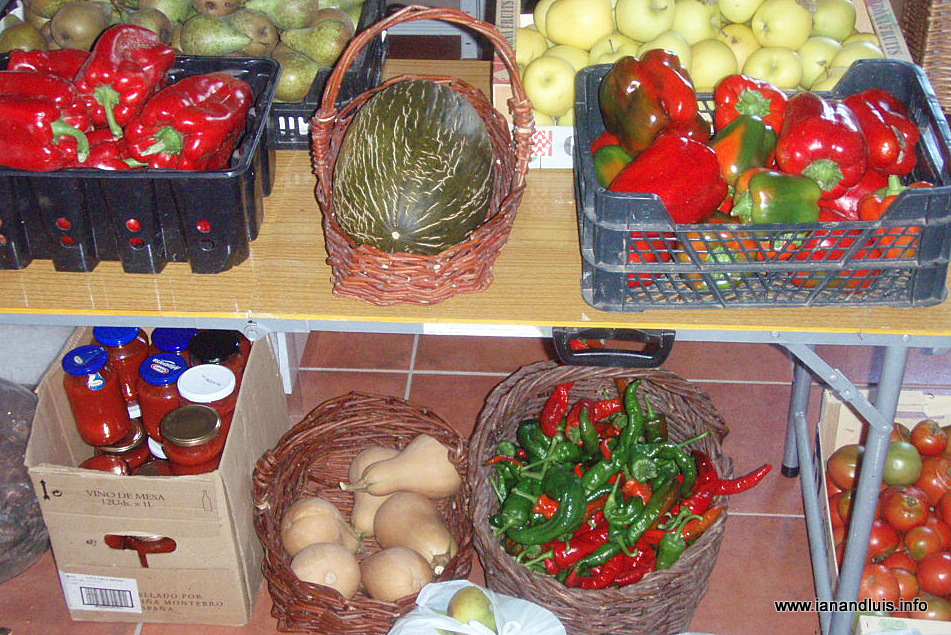
We grow enough plants to provide us with fresh pepper for use in cooking and to eat raw when in season during late Summer and early Autumn. With the glut of chilli peppers and ripe Isla peppers we bottle some and dry the remainder to use in stews, salads and cooking throughout the year.


To pickle the Isla pepper or any other red and fleshy varieties you need to fill the jars with the washed and cut pieces before filling up the jar with a pickling fluid containing 4 table spoons of vinegar and 2 table spoons of sugar per litre of water to which we add spices to taste. Making sure the peppers are fully covered, seal the jars and Bain Marie for 15 minutes. Once cool, store the jars in a cool dark larder and use over the next 12 months.


To pickle the chilli peppers: To vinegar add a few pepper corns, cloves, coriander seeds, cumin seeds, paprika and some olive oil. Bring to the boil for 5 minutes. Then scald the chillies for about 1 to 2 minutes depending on how tender they are. Drain and bottle without cooling them. Fill up the jars with 3 parts of the boiled vinegar and 1 part of boiled but cold water and cover the peppers completely and start using after 1 month in storage. No need to preserve using a Bain Marie. They can be used in cooking or eaten straight from the jar as an accompaniment with hearty soups or with salads.

Friday, February 08, 2013

Designing a herb garden

4 comments:
Herbs are an important part of our food here at La Pasera so when we were planning the garden we decided to try and build a functional herb garden close to the house so that they could be harvested and used fresh.


The main herbs we use are: Lemon verbena, thymes, sages, mints, lemon balm, chamomile, chives and oregano, all of which were ideal plants for siting at the front of the house and with in easy reach of the kitchen. We also grow many others but experience has shown they grown better elsewhere: coriander, parsley, basil, dill and rosemary.


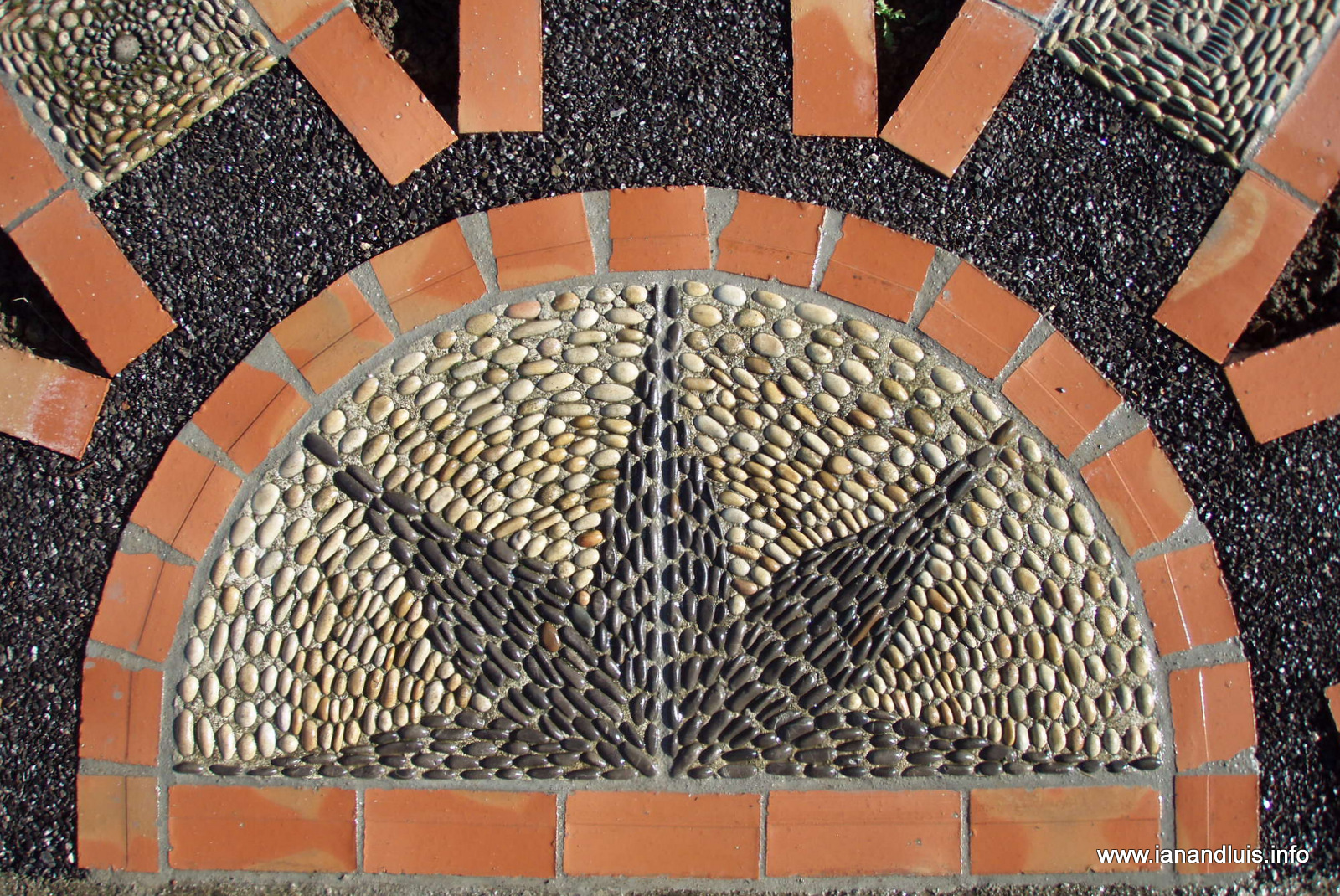
As you all know Luis makes some wonderful mosaics and over the past few years we have amassed a good collection of 30 sq cm mosaics which are ideal for stepping stones. Together with a semi-circle sun, we came up with this design for the herb garden. It allows us easy access to the different beds and also gives access to one of the garden taps which also has a small mosaic terrace featuring dragonflies.


The herb garden also has two rhubarb plants, two young peach trees and at the moment a couple of misplaced fuchsias which are still there from when we used the bed as a nursery bed when we first moved here. The herb garden will be re-planted and plants will be moved once the rain ceases. We will also allow a few marigolds to grow as we use the petals infused in oil for various creams and potions.


Friday, December 07, 2012

Gift

No comments:
Over the past week the rain has been fairly constant and the cooler weather persists. Not being able to get out for longer walks, this weather pattern allows us to get on with a few jobs and tasks that you just don't want to do when the sun shines. I have been sorting out the stores whilst Luis has been away at the first Matanza of the season in his family home in Palencia.


Knowing only too well that he will come back with an estate car full of goods from his Sister Rita, it was important to take stock of what needed using up and also to create space for the additional produce. Sorting through our stores it once again came to mind how generous people i.e. family, friends and neighbours are.


Over the past few weeks we have been gifted:

A Christmas cake
A crate of home-produced cider
A couple of kilos of locally grown Avocados
Approx 20 Kilos of apples
A jar of rich brown sugar from France
several jars of jams and pickles
Sweet Chestnut Paste and eggs
A brand new leather jacket


In addition, Luis returned from Rita's with:

30 jars of Pasata concentrated tomato sauce)
15 jars of Pisto (concentrated tomato sauce with pumpkin, pepper, onion marrow and paprika)
5 dozen eggs
8 jars of preserved green beans
4 packs of Chorizo
8 kg of sweet oranges
4kg Quince
Cheese
8kg of frozen raspberries
an assortment of vegetables....


We could have also had as much pork, ham, salami, chorizo or pork products as we had wanted but Luis has stopped eating meat for the time being so there seemed no point in stocking up on food that we would not use. The four packs of chorizo he brought home are for friends and visitors. He decided not to participate in the actual slaughter of the two pigs this time as it is never pleasant and not eating meat he did no longer feel obliged to participate. There is always enough work to do following the deed so he was inevitably kept very busy with the processing of the animals.


Together with our own harvests of fruits, vegetables and nuts, our bulk buy products and the produce we process into jams and pickles, we have a well stocked larder and really do not need to do much shopping for the foreseeable future.


We frequently gift produce ourselves and enjoy giving family, friends and neighbours samples of our soap, hand-creams, jams, pickles etc... Our thoughts on giving can be found here on one of our other blogs. A big thank you to all.