Showing posts with label Art. Show all posts

Sunday, August 02, 2015

The holiday season in Asturias

5 comments:
Asturias is a popular destination during the heat of the summer in Spain. Many Spanish people come during the main holiday period of last two weeks of July, August and beginning of September. Many leave their town and city based apartments where the summer temperatures rarely fall below 30 degrees Celsius, to come to the milder and more tolerable northern coast; Spain's Natural Paradise, Asturias.


The once quiet towns and low-key cities now buzz with extra traffic, more pedestrians and busy terrace cafes and bars. The beaches that are mainly deserted for 10 months of the year become a mosaic of sun chairs, beach umbrellas, beach towels and sand castles. The hundreds of peaceful walking routes become punctuated with walkers, ramblers, cyclists and runners, the gentle hum of the mountains ring out with cattle bells and camera shutters and the subdued markets come to life with extra stalls and animated stall-holders eager to sell their wares to passing tourists.


As you wander around the small fishing villages, farming communities and hidden towns, the aromas of cured ham, grilled fish and seafood, still cider and barbecued meats float through the air with unprecedented regularity and the haze of wood smoke intensifies the tapestry of greens, golds and blues that are typical of summer here in Asturias. During the next few weeks we will see and hear a proliferation of fiestas, music festivals, street theatres and recitals, all geared up to entertain and bemuse both the locals and the incomers; something for everyone.


It is great to see this influx of visitors during the summer months and although it can upset our normality, we realise that the economy needs it. What always confuses us is why Asturias is so quiet during the remainder of the year? We appreciate that it is the main holiday period for many Spanish workers but we feel that there is no-where better to visit in Autumn or Spring and even Winter than this beautiful region of Spain. OK the weather can be unpredictable particularly in Spring and sometimes in summer but cooler and wet weather fronts rarely last for long and after all, that is why Asturias is so green and lush. With mountains, woodlands, pastures and coast, larger cities and quaint villages all easily accessible within half an hour no matter where you stay, Asturias really does cater for all tastes.


Below are a couple of videos that show some of the beauty of Asturias, the first is a video from the hotel we first stayed in on our first time in Asturias (worth a visit) and the second is one I have featured before of the Cares Gorge; the most iconic walk in Asturias. Who knows we just might meet here one day....?


Winter walk along the Cares Gorge, Picos De Europa, Asturias and León, Spain from Tomas Millar on Vimeo.
A walk along the Ruta Del Cares in Northern Spain. Posada de Valdeón - Caín (León) to Puente Poncebos (Asturias) - Courtesy of www.casausborne.com.

Filmed using:
DJI Phantom Quadcopter
GoPro Hero 3
H32D Gimbal

Thursday, July 16, 2015

Portraits in Mosaic

2 comments:
Luis has just returned to Asturias from a two week mosaic course in Belgium and from visiting fellow mosaicists in both Belgium and Holland. Needless to say he has had a brilliant and very productive time. The piece he chose to work on in Belgium under the tutelage of Mireille Swinnen at http://www.mozaiekstudio.be/ was based on an ageing Pierrot clown - a portrait in tessarae using a direct method in a painterly style. I was really pleased with his choice as for those of you who don't know I was once a keyboard player for a band called My Pierrot Dolls in the early 1980s (who incidentally are still playing gigs in and around Yorkshire in the UK - check them out if you get a chance). Despite a very active social programme, with Mireille's guidance he managed to complete the portrait with only the framing and mounting left to do.


Whilst in Belgium he shared some studio time with Jeannot Leenen a really talented mosaicist who you may remember created a portrait of one of our cats, Wentworth. Jeannot has very kindly now completed a second portrait, this time of Gawber so we will be able to display them in their full glory together: The Asturian Prince and The Asturian Hunter.


Luis ended his mosaic adventure in Holland and spent a few days with another great mosaicist Conny Van Der Wende who owns and runs  Tiles and Tools . Now back and filled with renewed energies, new techniques and numerous ideas, I am looking forward to his new projects... Watch this space.

Saturday, October 25, 2014

Mosaicos La Pasera, an update.

3 comments:

As a mosaicist and whilst living at La Pasera, I have designed and created numerous decorative pebble mosaics that now adorn paths and a small terrace. My passion for this mosaic genre stems from my love for pebbles and a holiday we once took in the Greek Island of Rhodes where we saw many decorative mosaics been used as pavement. After returning home, Ian got me as a present, a book by Maggy Howarth titled "the art of pebble mosaic". Since then, I have completed a good number of mosaics that decorate our garden and have had several as commissions.


For my latest pebble mosaic of a flower pot made out of small pebbles and terracotta roof tile, I spent several hours selecting the right sized pebbles no grater than 1 cm in diameter. Using these small pebbles, I was able to create small mosaics light enough to be used as a decorative picture hung on a wall,

This little Mosaic (31x22 cm)  was made as a present for a mosaic artist friend of mine who comes from Belgium and whom I recently met when I travelled to Chartres in France to visit several international mosaic exhibitions.
Although I usually I work with natural stones for my Roman style mosaics my last two commissions required me to use smalti (vitreous paste) made by the Orsoni family in Venice following centuries old recipes. This allows me to choose from a wide colour palette. This was the case of my latest commission for a birthday present depicting a lobster.

Using smalti has been an enjoyable challenge that not only required me to learn to use new tools but also required to adapt and use different processes and as a result I am researching several mosaic courses to see which one can suit my needs better specially since I want to learn more about colour use within mosaic art.

XII th century stone carving in one of the porticoes of the Gothic cathedral in Chartres.
I recently returned from Chartres where I attended the opening ceremony of the 10th edition of the internationally renowned mosaic "Prix Picassiette" celebrated on alternating years. During this event, I met many mosaicists and mosaic artists with whom I have been communicating via the Internet and several mosaic art forums I am a member of.

In Chartres I was able to spend time not only admiring the beauty of many works of art but also having an opportunity to study different mosaic techniques specially those used in 3D mosaics as I have in mind several projects for mosaic sculptures that in time I want to create and place around our garden here at La Pasera. You can follow my mosaic work on my dedicated and newly updated blog: Mosaicos La Pasera 

Monday, October 06, 2014

If you go down to the beach today....

3 comments:

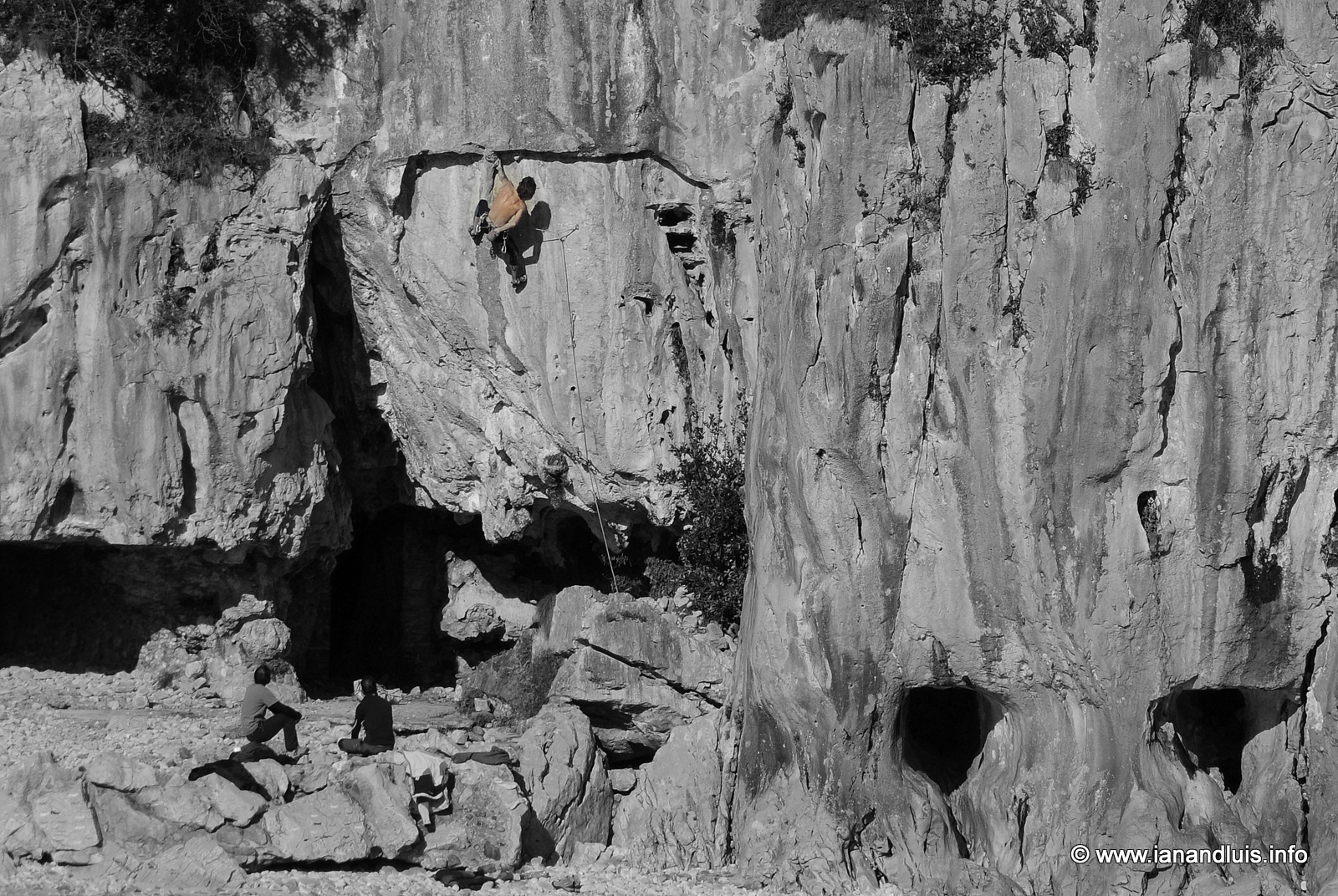
You're in for a big surprise... Well at least on the beach at Cuevas del Mar here in Asturias. This beach is about 5km from La Pasera and we occasionally walk to it from our house along the cliffs and through villages and country lanes. The area is peppered with caves (hence the name), many of which are shouting out to be explored.

The beach hit the local news this year as the severe spring storms devastated the sand, taking most of it out to sea and leaving very little apart from pebbles. This small beach is popular during summer as it's a quiet bay is ideal and safe for swimming. The locals campaigned for sand to be brought in as they were concerned that having no sand would affect the holiday trade. It is estimated that it could take up to 5 years for the sand to return naturally.

Earlier in Summer

The beach also has an interesting history with several pebble lined caves, steps and barbeque which was once a beach bar several decades ago according to locals (in the photograph with the climber). Climbers also use the cliffs on the beach for fine-tuning their skills.


The lack of sand hasn't deterred someone from making best use of their time on the beach, we don't know who built all these but we admire their patience and creativity. All rather splendid and needless to say Luis + Pebbles = Happy. I have to say his effort was rather good but don't take my word for it, judge for yourself. 


Monday, July 21, 2014

The Asturian Prince - Wentworth

4 comments:
The Internet attracts a lot of criticism for all sorts of reasons but it can also be a wonderful resource and mechanism to connect with people you would not normally come across by other routes.

We have developed friendships with many people over the years via the Internet both through our blog and through various social networks. It never ceases to surprise us both how generous these virtual friends can be.


One such friend offered to make us a portrait, in mosaic, of Wentworth, our beautiful black cat: named after an area of South Yorkshire where we used to live. Jeannot Leenen is a mosaic artist from Belgium Luis initially met through one of the Internet based mosaic groups they both belong to. We have always admired her beautiful work and over the years Luis has became very good 'pen-pal' friends with her via the Internet. Her kindness and generosity both as an artist and a person are boundless and later on this year Luis plans to meet up in person when they both visit the internationally renowned mosaic exhibition that will take place in Chartres, France.


Words cannot express how magnificent this portrait is. She has captured his character, his posture and his ever-changing black glossy coat as it reflects and absorbs the changing light - absolutely stunning.


Jeannot knows how pleased we are with this gift and it will be a lovely moment when Luis can meet with her in person and share their passion for the art of mosaic.

Sunday, July 13, 2014

An Asturian tale...

1 comment:
Follow my blog with Bloglovin

We read that there was to be a celebration of the recent restoration of a 13th century romanesque church near Ribadesella in the area of Monte Moro: Iglesia De San Salvador.  What was more interesting was that the church had well preserved wall frescoes from the 16th Century not discovered until the civil war in the 1930's. A trip to see them was planned...


The church has recently been renovated and partially restored mainly due to the perseverance of local people who for the past 78 years have struggled to get their simple but significant church protected from further decay.


The story goes that the church was built in the 13th century to serve the local agricultural population from the nearby villages of Sardalla, Dezangos, Nocedo and Tresmonte which nestle in the rich green pastures and mountains just off the coast. As well as addressing religious affairs, the church would have served as a meeting place to discuss local issues and for trading goods and local gossip.


In the 16th century, a priest, bishop or wealthy patron commissioned a series of wall frescoes depicting God as the saviour, the last supper, the passion of the Christ, the ascension to heaven and the wrath of the devil. As most people were unable to read or write, the frescoes served as strong symbolism to reinforce the word of the church.


Some time between the 16th and the 19th century, the frescoes were covered in a lime wash, probably to disinfect the building following an outbreak of disease that was decimating the local population. The meeting place was recognised as a possible source of contamination. An extension to the original church and bell tower was added in the 19th century.


The frescoes faded from memory until 1936 when the church was partially destroyed by fire during the Spanish civil war. Parts of the lime wash began to crumble and expose elaborate wall paintings underneath.


The local parishioners continued to worship in the church despite the roof of the extension being open to the elements. If it rained, they would open their umbrellas and continue with their prayers.


The church has been renovated but there is still work to do. A new roof has replaced the charred remains of the extension, some of the frescoes have been further revealed and cleaned but there is much more to do and reveal. Drainage has been improved around the church to reduce humidity in an effort to preserve the delicate paintings and the walls have been rendered on the outside.


The rear of the church floor remains covered in very uneven limestone flags whilst the original building's floor has had a horrible scree of concrete lain. I only hope this is a temporary fix as it really does detract from the naive beauty of this piece of Asturian history. Apparently, on excavation, graves were found from the main doorway through to the alter. When money permits, further restoration work will be done to the frescoes and further renovation work done to the church. Let's hope the floors are restored as opposed to renovated, concrete just doesn't work.


Wednesday, May 21, 2014

The Kingfisher has flown its nest - mosaic

11 comments:
A few weeks ago Luis was asked to design and create a mosaic intended as a gift for a birthday. The brief was: a Eurasian Kingfisher. Working with the people involved they agreed on a design and composition, size (quite large 70cm x 85cm), how it would be constructed to suit the position it was to be hung and what materials it would be made from.

A pencil sketch was used to agree the main design elements but they very much left it up to Luis to interpret their idea.


The next task was to source the appropriate materials, choose the colour palette, prepare the base and plan the construction methods. He decided to use a mixture of marble, limestone and Orsoni Smalti from Italy as this would give him the colour palette he required to capture the beauty of this wonderful bird. Materials were sourced and work commenced.


Mosaic work on this scale and with such detail is labour intensive. Long hours were spent studying kingfishers and refining the design, planning the project, cutting the tesserae and reviewing methods and techniques. The mosaic is worked in reverse so you never know what the finished surface will look like until it has been set, dried and turned.


Once the mosaic is complete, the worrying times commence as cement glue is spread carefully across the surface of the mosaic and onto the cement backing board on which it will be mounted.


Several days later the mosaic is turned, cleaned and closely examined.


The next stage is to grout elements of the picture, seal, polish and generally put the finishing touches to it including a hanging device and more weather-proof sealant and wax.


Phew, all was well and the 130 hours he put into the mosaic was well worth the effort, it looks magnificent. Needless to say the recipients were very pleased with it and will now have the pleasure of seeing it proudly displayed on the wall of their cottage and garden.

There is always a sadness to see such a piece fly the nest but on the other hand there is a sense of achievement and consolation knowing that it is going to a place where it will be cherished.


A big thank you to Jeannot Leenen and Ornella Martens, two mosaic artists from Belgium for their generosity and guidance throughout the project.

Anyone interested in Luis' work can view his range of work here: www.mosaicoslapasera.com

Email: artesanialapasera @ gmail.com (remove spaces)