Saturday, March 22, 2014

How we grow onions

2 comments:

Onions are a vegetable we simply adore and with the exception of last year when due to adverse weather conditions we lost the entire crop, we tend to be self sufficient throughout the year. We use lots of onions in salads, cooking and in the home-made pickles and chutneys we enjoy and share with friends and family.


Growing onions is relatively easy as they are a fairly trouble free vegetable provided that you use a rotation system so that you avoid growing them in the same spot for at least 3 years. The rotation system we follow at La Pasera means that it is on the fifth year that we plant them in the same spot. Avoiding growing them in the same spot on consecutive years helps to minimize the chances of onion fly infestation not only destroying your crop but also of your soil becoming depleted of specific nutrients.

Onions can also be susceptible to downy mildew in particularly wet seasons as it was the case here at La Pasera last year. In spite of applying a fungicide based on horse tail they failed to thrive and we lost the entire crop so this years we are hoping for a better growing season. Time will tell.


Onions can be grown from seeds sown by late September, alternatively you can buy onion plants or small bulbs (onion sets). We normally buy young onion plants at the local weekly market from a local grower who grows varieties that will better withstand our temperate but humid climate during the Summer months; besides, the little plants are already used to our local climate conditions as opposed to those grown in other parts of the country.

We grow four hundred onions, enough to see us through the season and to share with friends and family after they get strung in mid Summer. We find that the red and white onions (150 of each variety) keep very well and usually are ready to be harvested by mid July while the early ones will start cropping in May.

This year we will soon start cropping the ones the planted in November, so far they look great.


We aim to have dug the green manure in the bed where we plan on planting the onions by late January or early February. After 3 weeks we also dig in our own compost. This ensures a good supply of nutrients and will maintain soil humidity during the hotter Summer months.


We also collect some bags of very well rotted farm manure from a farmer who lives in a nearby village. This is a very crumbly and black substance with lots of worms that will provide fertility to the small onion plants and also helps to improve the soil structure.


Planting onions is a job I enjoy in spite of the effort and few hours it takes to complete. The day we plant the onions, we use some wooden planks  to avoid compacting the soil by walking on it and after creating a shallow drill we add some of the well rotted farm yard manure before we water the soil with rain water we collect from the shed roof. The onions will then be gently pushed into the wet ground before their roots get covered with soil. This is the only time we will water the onions as the rain fall will provide the moisture the onions need. Local farmers say that onions are a crop that should not benefit from rain fall during August. In other words, in Asturias it is advisable to harvest the onions before August. Ours have never lasted past mid July.


This year, both Wentworth and Gawber came down the vegetable garden as I was working and provided me with a good excuse to have a break. Wentworth enjoyed rolling over the soft soil before going onto the shed's roof and Gawber filed his nails on a wild cherry tree before going hunting and coming back to present me with the land vole he had caught.


Sunday, March 16, 2014

Blue tits nesting in the garden

2 comments:
We wrote some time ago about making new nesting boxes for the garden. Last year great tits nested as they have done for the past 5 years in the existing box but the two new ones were inspected, but not used. This year however, we have blue tits.

Two new nest boxes sited in 2013

One of the boxes is sited on a very old and leaning cherry tree that we can see out of the lounge window. The other morning whilst cleaning out the stove, I looked up and spotted a pair of beautiful blue tits flitting from branch to branch and eventually one of them, landing on the box and entering with nesting material.


A good minute or so past, the other bird kept watch nearby.


The blue tit re-emerged and spent another 20 seconds or so looking around before hopping out and flying off again only to return a few minutes later.


Having lots of birds around is important to maintain a natural balance in the garden. With a bit of luck, a good brood of chicks and frantic feeding regimes we'll have much fewer of these little caterpillars to contend with in the coming months.


Monday, March 10, 2014

Soft-fruit manoeuvres

8 comments:
Next to the vegetable beds we have a long and narrow bed for soft fruit: raspberry, gooseberry, blueberry. We have never been happy with the soil in this bed as it is mainly the original clay from the meadow with very little else mixed in. This year we decided it was time to upgrade it by forming a raised bed.


We constructed the bed out of the same wood the vegetable beds are made of; this allows us another 25cm of soil to be added. The bed now measures 9 m x 1.2 m.


We added lots of home-made compost and horse manure. The raspberry canes were sorted and a few decent ones re-planted. The blueberry are a pretty sorry sight but we'll give them another go and if they do not take off, we'll replace them at the end of the year. The gooseberry is one of several we have dotted around the garden and they seem to do well. We'll put some rhubarb leaves under the bush to prevent sawfly and hope for an abundant crop. Hopefully we'll have plenty to make our favourite gooseberry and mustard seed pickle.


Meanwhile, we have cut the red and black current bushes back, creating the classic goblet shape and we need to tackle (trim and tie) the blackberries that run 6 meters along the fence.


Thursday, March 06, 2014

A photo walk to the coast

No comments:
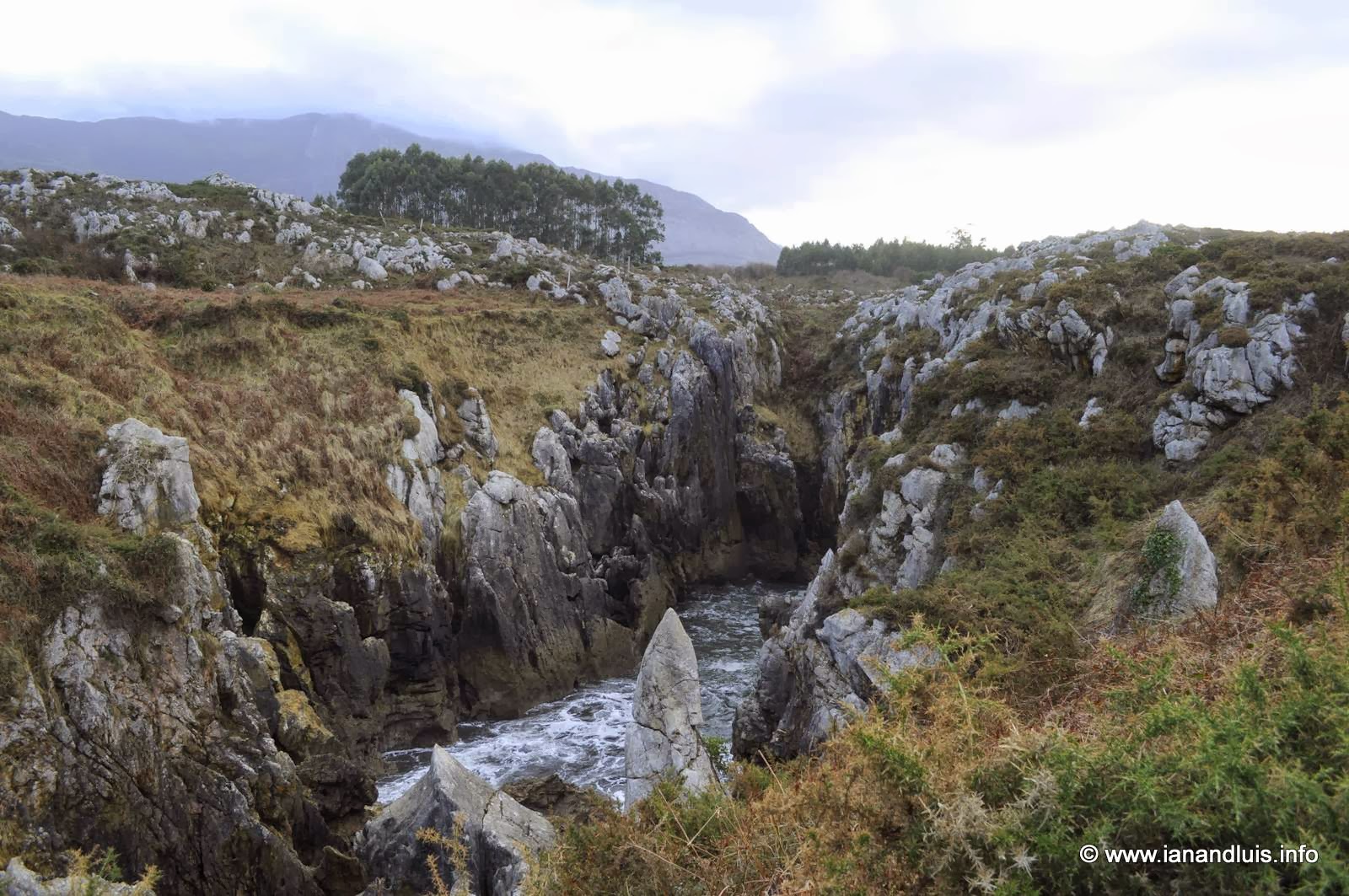
Some of you will know that we live near the coast of the Bay of Biscay. As the crow flies, it is about 1.5 km, but to get there you need to follow one of the many old paths and caminos (tracks) still used today by farmers and villagers to access pastures where they graze their animals and grow crops. The land is not used as much these days and many of the fields have been left to over-grow. Boundary walls have collapsed and the deep ruts of the limestone paths have eroded further, but it still has a charm.


Walking from La Pasera (late afternoon) we headed down the camino which starts in the centre of the village near Angel's goats. This is a typical Asturian haystack. The track twists and turns and is bordered by many small apple orchards, still maintained for cider apple production.


There are small wooded areas and large areas of bramble and it is not uncommon to spot deer. There are a few pastures given over to horses, cows and goats. It is not unusual to spot a small vegetable patch tucked away in a corner of a field.


The track leads to a path that stretches along the cliffs leading to westward to Ribadesella and eastwards to Guadamia.


The ragged limestone is constantly honed by the weather and rough seas and in places has collapsed resulting blow-holes both large and small.


This time we walked down to Guadamia and returned via the lanes and villages. Following several days of wet and cool weather it was really good to get out for some fresh air.


Saturday, March 01, 2014

Time to make more hand-cream

No comments:
Hand-cream makes sense for men and women alike. It protects the integrity of the skin by moisturising and helping keep the skin elastic and flexible. The better the condition the skin, the less likely you are to get cracked and broken skin, especially around the nails and with less opportunity for infections. Good skin condition also helps small cuts and injuries to heal quicker.


With the building work, constant gardening, joinery projects and Luis' mosaic work, our hands take a battering so a good dollop of a hydrating cream helps tremendously. Made with calendula infused oil, lavender infused oil, almond oil and natural un-purified beeswax, our cream is healing and nutritive.


The recipe can be found here and is an adaptation of one or two recipes we have read about and tried. This particular cream keeps well and is relatively quick to make. It is so much better than commercial creams that are full of preservatives, colourings and refined oils and waxes.


Luis made two generous pots today which will see us through the busy Spring we have planned.


Monday, February 24, 2014

Wild Boar in the garden

2 comments:
We've known for sometime that wild boar visit the garden but up to now we haven't seen them. We occasionally see a small group of them in the lower field at dawn or dusk but our garden visits happen in the dead of night.


The tell-tale signs are turf up-turned and small holes dug with trotters and snouts. They love bulbs especially allium, lords and ladies and Spanish bluebells. A small group can cause a lot of damage in a very short time.


This morning I went to check the Bushnell night camera and immediately spotted an area of up-turned turf and a few holes where the boar had been. I hoped that the camera had managed to get the evidence on film...

Sure enough there are half a dozen short videos of what looks like a young, solitary female, wandering back and forward around the wild area of the garden. When the boar goes out of shot you can hear her digging at the side of the camera before she returns into shot near the pond.


Thankfully they never seem to venture into the vegetable beds which are very close. Saying that, up to now, we have had little damage from any garden visitors including deer, boar, badgers, martens....Don't forget to check out the wide variety of wildlife we get in and around La Pasera on our Smaller Tales from Toriello Blog.

And finally, Wentworth and Gawber enjoying a moment of togetherness in the evening sun.


Wednesday, February 19, 2014

Preparing for Spring

No comments:
There is always an optimistic quality about longer days, brighter skies and glimpses of winter sun. The weather has been very mixed here with storms along the coast causing hide tides and gale-force winds, lots of rain, followed by a few days of warm day-time sunshine and bright clear night skies. A few trees down locally but no damage for us which is good.Whatever the weather, we know that at this time of years there is always lots to do.


We have pruned the fruit trees very little this year in the hope that we will have the harvest we didn't this past summer. The fruit bushes will be lifted and put into a new raised bed (when the wood arrives) and the vegetable beds and seed trays are slowly filling up with peas, twiggy pea-sticks, lettuce, beetroot and kohlrabi.


We are still harvesting flower-sprouts, purple sprouting broccoli, cabbage, leeks, kale, celeriac, winter lettuce, swede and fennel. The oats that were sown as a green manure have been dug in the bed where onions and potatoes will be planted. We have already bought our seed potatoes so it won't be long now before we have a day digging them in.


We have pruned some hedges but more needs doing and soon. We will thin out the hazel and use the poles somewhere in the garden. The wild flowers are out in force and there is plenty of colour in the flower beds and rockery area. A general tidy up of leaves, trimming back dead flower heads and moving the odd plant always brings positive results. The Gunnera has been chopped back as it had expanded in every direction and was becoming too dominating. We will leave the dead leaves on to protect the new shoots in the unlikely event of frost.


The water-lily plants have been taken out of the pond in readiness for splitting and thinning out. The root systems had already swamped the bottom of the pond and was in need of doing. We'll re-pot these and pop them back in the pond next month.


The hard-landscaping is at last coming close to an end and with any luck we should have finished the terrace later this month. Then it will be the final push on the front garden and driveway. With Spring just around the corner we are looking forward to another productive year in the vegetable garden and hopefully be able to relax and enjoy the garden now it has taken shape.


Thursday, February 13, 2014

A road trip along the route of silver part 4:The Vultures of Monfragüe

2 comments:
After spending a few days based in the city we were eager to get out into the wilds of nature once again and relax into our normal pace of life. We had read about the Monfragüe National Park and as it was only an hour away from where we were. We decided to have a day walking in the hope of spotting some birds and wildlife we wouldn't normally see. On our list were: the Iberian Lynx (possible but highly unlikely x 2), Bonelli's Eagle (possible) and the Black Vulture (probable).


The park comprises over 18 hectares of mixed scrub and woodlands stretching along the river Tajo. It has been declared a unique refuge for the most representative Mediterranean wildlife. Driving through the national park, the evergreen oaks were impressive, the slate studded mountains and deep green gorges were worthy of the occasional stop. With binoculars in hand there were many small birds to spot and try and identify.


We parked at the visitor centre in Villarreal de San Carlos, a small village and amenity that is currently undergoing extensive infra-structure upgrade including new paths, road surfacing and car parking. There were a range of leaflets available both in English and Spanish, each detailing walking, cycling, horse-riding and car routes throughout the National Park. We decided we would head for Cerro Gimio in the hope of seeing the Black Vultures (Aegypius Monachus) of which there were reported to be up to 250 breeding pairs. It was only about 8km but we could extend it if we felt like, which in the end we strayed here and there but more or less stuck to the route as there was plenty along the way to keep you occupied.


The trails were well marked (for Spain) and the paths and tracks were is reasonable repair. The landscape was very interesting and so different to what we are used to in Asturias. My only disappointment were the hundreds/thousands of plastic tree guards and poles that were so obvious throughout the landscape on your way into the reserve. These had been placed when saplings were planted some time ago and there seemed to have been  such a terrific failure rate. We wondered if the now defunct tree guards would be left to rot or if efforts would be made to tidy them up?


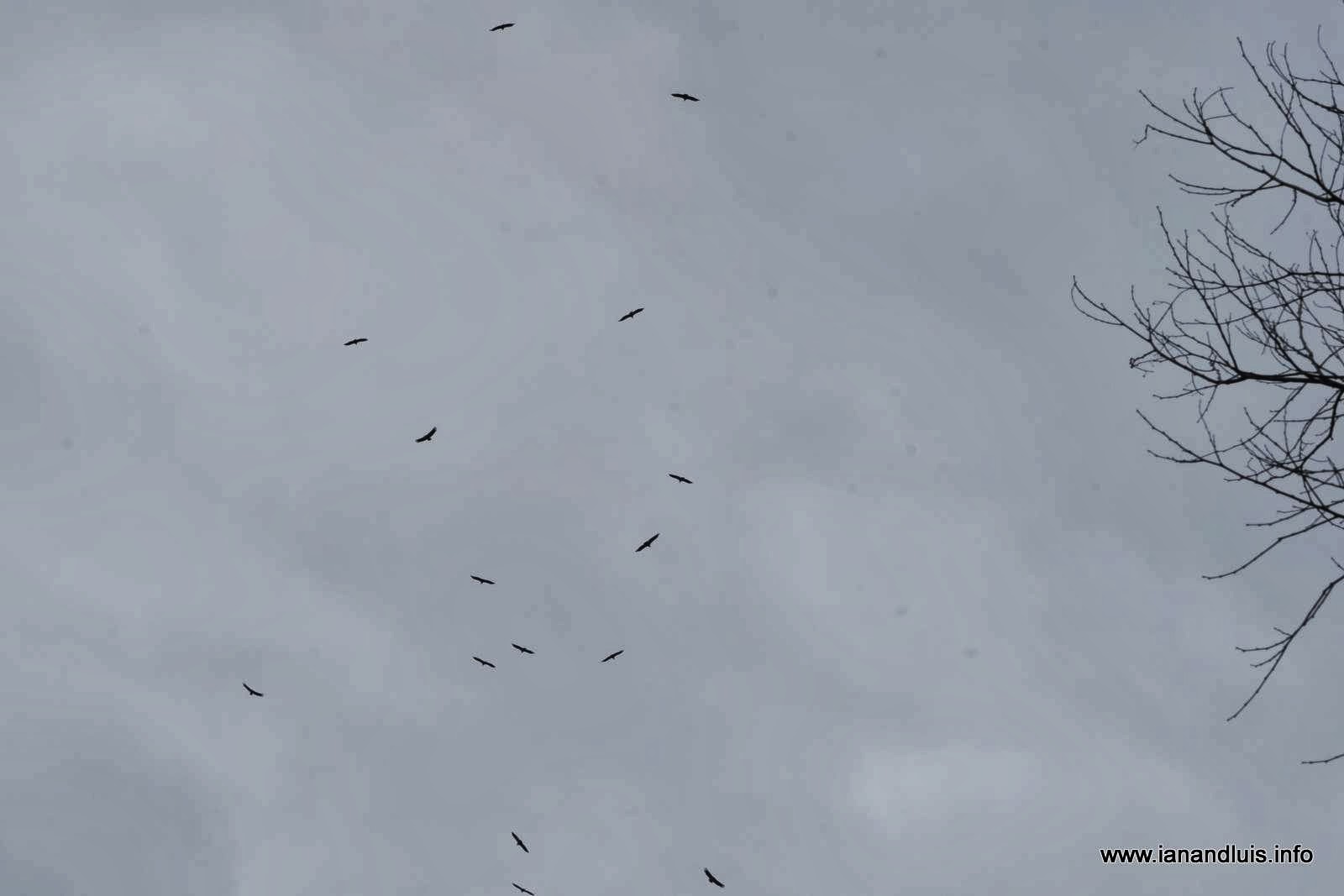
Along the trail we saw small birds aplenty, we came across two Stags on separate occasions (but too slow with the camera) and many vultures gliding high above. After lunching at the side of a slowly trickling stream, we decided we would climb up to the top of  Cerro Gimio in the hope of closer views of the vultures. Only 372 metres or about 1000ft.


At the top we could admire the twists and turns of the Rio Tajo and spy on the roosting and nesting sites of the vultures way below. We were soon rewarded with fly pasts from many soaring birds, not too close but a much better view than from the valley below. We sat for quite a while and admired their grace and their impressive 8 foot wingspan.


We saw the vultures, we think we saw an eagle but couldn't see in any great details and we missed the Lynx completely, perhaps just as well.


Feeling very relaxed and a bit tired from a great day Monfragüe National Park we returned to our hotel and dined out at a really good Italian restaurant. The remainder of our journey home was uneventful but for the threat of snow as we headed for the mountain pass. Fortunately we made it home in time for dinner and looked forward to being back at home with Wentworth and Gawber who both made no fuss or acknowledged our return other than their usual laid back blink of the eye and flick of the tail....but that's cats.