Wednesday, April 27, 2011

Making home-made balsamic vinegar

No comments:
This recipe for home made Balsamic vinegar has been adapted from one found in a herbal book many years ago. It is not the pure balsamic that is associated with Italy but a variation on a theme - a flavoured and marinated condiment that can be used in a variety of ways. Salad dressings, soups, sautéed vegetables and any other dish that needs a spicy, flavoursome vinegar.

We use a good quality cider or apple vinegar but any other basic vinegar can be used as a base. The mix of herbs and spices is really down to personal taste and therefore you might wish to change some of the ingredients we use to others that you prefer. The key to producing a balanced vinegar is to ensure the overall taste is not over powered by one ingredient.


Decant a third of the 750ml bottle of vinegar to make space. Add, a generous sprig of sage, thyme and rosemary. Place 15 black peppercorns, 20 coriander seeds, 12 cloves and 15 cardamom seeds in the bottle along with 30 raisins. Top up the bottle with the remaining vinegar, seal and store in a cool dark place for 2 months. The colour will change slightly as the herbs and spices infuse with the vinegar. Decant and discard the herbs and spices and use as required. We make about 3-4 litres a year for personal use and occasionally a few extra bottles for gifts to friends and family.

An additional use for this vinegar is for cleaning surfaces - use diluted, not only does it disinfect, it will help deodorise as well.

Saturday, April 23, 2011

Easter Horse Racing on the Beach

No comments:
Every year (beach conditions permitting), Ribadesella hosts a horse racing event on Santa Marina beach in the town. Fortunately, there had been no last minute storms taking the sand back out to sea or bringing in tonnes of wood and debris. What flotsam and jetsam had arrived in town had been diligently cleared by the local council in the days leading up to Good Friday.

Luis' birthday fell on Good Friday this week so we walked into town to meet with friends and watch the racing. A much smaller event than previous years (recession and all that I suppose), never-the-less enjoyable and well supported by locals and holiday makers in Town for Semana Santa.

Here are a few pictures and a short video of the event:


Wednesday, April 20, 2011

Snake in the grass - Vipera Berus - Adder - Viper

1 comment:
It is not often we come across snakes but when we do it a great opportunity to take a closer look. The adder is probably the most common snake around here that we see. This one was about 55 centimetres long and 6 or 7 centimetres thick in the middle. This little beauty was crossing the road in front of us when we were out walking near Gaudamia cliffs at the weekend.


I tried to get up close and personal but he was obviously not in a friendly mood and wanted to disappear into the grass verge as soon as possible. Needless to say, Luis was well out of reach...(his pet hate, ssssnakesssss...).


More information here: Vipera Berus on Wikipedia

Monday, April 18, 2011

The garden in Spring

3 comments:
The garden is looking really vibrant at the moment with sharp spring weather encouraging lush and healthy growth. We've lost a few plants over autumn and winter but replaced them where necessary with cuttings given by neighbours or with divisions we made in early spring.

Most of our blog posts are about the growing food side of life at La Pasera. We thought it was about time to celebrate the garden and take stock of where we are and where we are going to with regard to the future of the garden.

We use the garden a lot throughout the year and have tried to find a balance and sympathy to the local landscape.


It has developed slowly over the past 6 years and there is still lots of things to do. We need to pave the patio and steps leading down to it. We are also about to complete a  flight of pebble mosaic steps and small seating area now Luis has nearly finished the 40 mosaic slabs it needs in total. The driveway and front garden still require  attention but as we are doing all the work ourselves, it takes time, money and energy.


The wildlife aspect of the garden is important to us and where we can we encourage insects, amphibians and birds by creating areas that are attractive to them i.e. water, shade and shelter, food. A future project soon to be started I hope, is to build a small transportable hide for photography that can be used in the various areas of the garden. I will let you know how we get on with the design and construction - If anyone has any ideas or plans for such a hide, please get in  touch soon.


Wentworth and Gawber enjoying one of their many vantage points.


Monday, April 11, 2011

Chives - many uses and a great, delicate taste

No comments:
We grow a wide variety of herbs and use them in cooking whenever we can. They add a certain quality to dishes and if used appropriately, they can add a depth of flavour and enhance the flavour of the ingredients of the dish.
Chives have always been a firm favourite. Not only do they look great in amongst other herbs and flowers but they are so versatile.


Fresh chives can be used in salads (including the flowers), chopped and used in egg, cheese or potato dishes. In fact chives can be used wherever its delicate onion flavour is not overpowered. The flowers can be marinated in a good wine or white vinegar for two weeks, strained and then the vinegar used is a variety of dressings and dishes. The vinegar has a lovely pale purple colour which fades over time so it is best made fresh each year.

Beware.....chives have aphrodisiac properties according to Siberian legend and have been cited as an aid to relieve congestion, cold and flu. This year we are also growing garlic chives, not sure how much of an aphrodisiac they will be....

The mass of chive flowers in early spring is also a magnet for numerous species of insects.

Friday, April 08, 2011

Course: Weaving a cane seat - Cursillo: Restauración de sillas en Rejilla

No comments:


Short course in chair restoration – Weaving a cane seat.

Dates: May 20-22nd  or October 7-9th 

Venue: Asturias, Spain

Cost €200 (includes materials, lunch and refreshments)

Content:

Due to demand generated from www.artesanialapasera.com I am pleased to offer a short course in chair restoration – weaving a chair seat in rattan cane. The course will include:

1.   Preparing a chair for restoration
2.   Materials and techniques
3.   Finishing and aftercare

At the end of the course the participants will have woven a chair seat using rattan cane.
Participants can bring along their own chair for re-caning or purchase one from our small stock (details on request)

The course will take place in a workshop at La Pasera. There will be a maximum of 5 participants on each course to ensure quality tuition from the instructor Luis Laso Casas. 

Luis has been restoring cane and rush seating for the past 10 years. He has re-caned and re-rushed chairs old and new from a variety of sources. From exhibition pieces to dining room suites, boudoir chairs to Thonet, he has restored somewhere in the region of 500 chairs and overcome many challenges to accomplish the craftsman finish that has become his trademark. There maybe both English and Spanish participants on the course but as Luis is bi-lingual, this is not a problem. You can also practice your Spanish is you so wish!
   
The programme will commence on Friday lunchtime with an informal chat and lunch. The course will be structured to ensure maximum support for participants and where necessary, one to one tuition. A vegetarian lunch will be provided on each day the course. If you are unsure about anything or if you require further information, please contact Luis at :  artesanialapasera @ gmail.com (no spaces) Telephone 0034 646436562


Cursillo de restauración de sillas: Rejilla

A consecuencia del número de gente quienes me han preguntado donde poder aprender a tejer un asiento de rejilla, esterillado francés, me complace el poner a su disposición los siguientes cursillos de restauración de asientos de rejilla o rattán.

FECHA:

20, 21 y 22 de Mayo del 2011


7, 8 y 9 de Octubre del 2011

LUGAR:

Ribadesella, Asturias, España.

CONTENIDO:

El curso incluye:

Preparación del asiento antes de la restauración.
Materiales y herramientas
Técnicas.
Tintes y cuidados.
Al final del cursillo, los participantes habrán tejido artesanalmente un asiento usando junquillo o tireta de rattán. Los participantes podrán traer su silla si así lo deseasen; de lo contrario, dispongo de una pequeña selección de sillas listas para ser restauradas las cuales están a la venta en caso de que un participante no tenga una silla propia para restaurar.

MATRICULA:

€200.00. La matrícula incluye los materiales, tres comidas principales basadas en una cocina vegetariana y bebidas no alcohólicas durante el día. Puedo facilitar una pequeña lista de hoteles cercanos donde los participantes puedan alojarse durante el cursillo.

Aquellos interesados en participar en este cursillo deben ponerse en contacto con: Luis Laso Casas a través del email artesanialapasera@gmail.com

NUMERO DE PLAZAS:

El número de plazas está limitado a un máximo de 5 participantes.


Tuesday, April 05, 2011

Fence? Hedge? - Repairing the Fedge

No comments:
When we first arrived at La Pasera, clearing the garden and setting up a decent working area was high on the list. We needed something to separate the working area from the rest of the garden that would be practical, look natural and if possible serve a function. Copied and adapted from something we'd seen back in Yorkshire at Worsborough Country Park, in Barnsley, using branches and twigs from coppiced and pruned trees, we formed a Fedge. A sort of cross between a fence and a hedge.


It has to be strengthened and posts replaced every couple of years but this small amount of maintenance is well worth it as it lives up to expectations in every way. The grass and wild flowers are left to scramble up it whilst the diversity of wildlife that has taken up residence  never ceases to delight us.


Toads, lizards, slow worms, stag horn beetles, woodlice, field mice and spiders live in natural balance alongside other insects and invertebrates. The insects pollinating the crops, the toads and the slow worms feeding on slugs, the slugs, snails and woodlice composting the vegetation, the birds feeding on insects and larvae, butterflies sipping the nectar from the wild flowers whilst all are occasionally challenged by a passing curious cat.

Slow Worm

Friday, April 01, 2011

Celebrating 50 years a vegetarian - well almost...

2 comments:
This year it will be approximately 50 years since I excluded meat or fish from my diet.  As a child I would always reject meat and hated fish unless either could be disguised in minced up, highly processed sausage or fish-cake. My parents despaired and eventually gave up trying to encourage me to eat flesh but had the good common sense to feed me lots of fresh vegetables, fruit, eggs and cheese, later followed by new vegetarian dishes that emerged on the market such as nut roast or soya products. We grew some vegetables when young and I remember having my own grave-shaped plot in which I grew a few cabbage and salad crops.


To mark this journey to sustainable vegetarianism, I intend to publish some of my favourite vegetarian recipes developed over a half century of not eating meat or fish. Surprisingly, the term vegetarian wasn't included in our day to day vocabulary back in the 1960s although the term has been in use since 1847. Looking back it was "he doesn't eat meat or fish", as simple as that. I made do when out and made up for it at home. There were brief periods when I could be encouraged to eat a burnt thin slice of crispy bacon or a bit of tinned salmon mixed with breadcrumbs and butter however, these experiments were usually short lived and never to be repeated.

The first recipe will be home-made hummus - simple, nutritious, versatile and tasty. Having made hummus for many years it was only after speaking to a Turkish lady here in Asturias that I started adding cumin. Needless to say, it was the missing link and truly adds depth of flavour to this easy recipe.


HUMMUS
350gm cooked chick peas and cooking fluid 
salt - half a teaspoon
garlic 5-6 bulbs (to taste)
2 large dessert spoons of tahini paste
lemon juice
Olive oil
fresh chopped parsley
chopped spring onions
Cumin - 1 teaspoon (to taste)

Blend or mash together chickpeas, tahini, ground garlic with salt, lemon juice with enough of the cooking fluid to form a loose pate type textured spread. Smooth is good but some texture can also be left in the paste. Stir in chopped spring onions, cumin, parsley and oil until well mixed. Adjust quantities to suit personal taste - will keep well in the fridge for up to a week but it never lasts that long. Best eaten in copious amounts with fresh-baked bread or clean, crisp celery. Spoonfuls can also be used as a tasty thickener for soups and stews.

Luis still eats meat when he knows of its origin and growth, and he still enjoys fish but equally these days values the variety that including vegetarian food in your diet gives you. Guests who visit invariably choose the vegetarian options and the many residents of our village who have tried vegetarian food at various village fiestas have always come back for seconds, which is great to see. Feedback on the recipes would be great.

Thursday, March 24, 2011

Growing vegetables: Peas

No comments:

Some people may find at times, that growing vegetables and gardening in general is something daunting and complicated by lots of information. Whilst difficult to make sense of for some, for others, gardening comes more natural. We both have encountered gardening throughout our lives and although we had created a flower garden in our previous home, it was while living at La Pasera that we started growing vegetables in a much bigger scale. My advise to people is to get a good book and not to be frightened to experiment, ask a friend for advice and to adapt the information available to the particular conditions your garden presents you in terms of soil structure, sun exposure and amount of rain.

Here at La Pasera, we have heavy clay soil, frost is rare as we live so close to the coast but high humidity and abundant rain fall do present us some challenges. One of them is how to increase the growing season and the range of vegetables we can grow.


Peas are a vegetable that we greatly value in cooking and like to grow as many as we can so that we can eat them fresh as well as preserve in the freezer after blanching. We found that although the heavy soil is slowly improving with the organic matter constantly being added to it, peas used to have a poor germination rate and we had to sow several times in order to get a few plants. The method we now employ works very well for us and the little extra work is well worth it as we guarantee a vary high germination rate a lot faster than using normal methods as described in all gardening books.

We love sharing our ideas and what works with the villagers, some of whom have adopted our methods. There are some local gardening techniques that we have incorporated and adopted to our particular needs with good results such as the use of well rotted farm manure for onion planting but this will have to wait for another blog entry.


To get back to pea growing, La Pasera style, we pre-soak the peas overnight in a bowl of cold tap water and in the morning we cover them with a damp cloth and are kept in a plastic container in a warm place until their tap root starts to show, the longer the root is the more vulnerable this is when it comes to handling the pea but the more you advance its growth. This way, we only use the peas that have germinated. They are planted in half a drain pipe using a mixture of well drained soil we make ourselves with our compost to which we add very well rotted manure, our own leaf mould and  some fine grit or vermiculite.

This process only takes a few days and once you sow the peas, they will take a further week to start showing through the soil. You need to ensure you place the pipe in a warm and protected position while keeping the soil wet at all times. It will be just another two weeks before they are big enough to transplant into their permanent place in the vegetable plot. As we cram in the pipe as many peas as we can get, their roots become entangled and you need to be careful while transplanting to ensure you damage their roots  as little as possible, they should be about two inches tall and will have plenty of vegetative growth. Water them in well and stake with pea sticks when they start developing the tendrils.

This is a very unorthodox or unconventional way of growing peas, most gardening books will not advise you on this method especially with the root damage that you might cause when transplanting but it works extremely well for us, the peas do not seem to mind any of the stages along the way and we certainly advance their growth. If you plant peas in the traditional manner, it may take up to 4 weeks for them to germinate especially if the soil is still a bit cold, but if you grow them La Pasera way, they will be two inches tall by the time you plant them out in about 4 weeks.

We have peas and mange tout currently growing in 3 different stages and the first lot has started blossoming in the past few days. Not bad if I may say so and I look forward to some shelling peas if all goes well.


Beetroots, lamb´s lettuces, raddishes, sweeds and turnips are other vegetables we grow this way. Other advantages from this method is that we can protect the young plants whilst they are at their most vulnerable stage from weather conditions and pests without the use of slug pellets or chemicals. Yes, it is rather fiddly and time consuming but well worth it. Several villagers have adopted and adapted this method. It is always good to share experiences in the garden. Good luck if you try this method.

Tuesday, March 15, 2011

Home-made hand cream with beeswax

1 comment:
Hand cream makes sense. If the skin on your hands is in good condition and intact, then the less likely you are to get infections, cuts and abrasions will heal better, your nails will be less brittle and dry rough skin will decrease. Men and women alike should use hand cream. Our lifestyle means our hands tend to get washed a great deal due to the work in the garden, kitchen, workshops and wood store. Having the cats and handling them at regular times of the day also means hands are washed more frequently. Maintaining skin integrity is important and therefore we use hand cream.

Commercial hand cream is often scented heavily or it contains numerous additional ingredients that we'd rather do without. The advance of technology and the development of nano particles is also something that concerns us as we wonder why it s necessary and the long term effects of using them is questionable in our minds.

We came across this recipe some time ago and adapted it to our own. The main ingredients are natural beeswax, almond oil, olive oil, water and pure essential oils. It is an easy recipe and results in a usable, natural hand cream that seems to work well.


The wax and oils are slowly melted in a bain marie until blended smoothly together. The bowl is removed from the heat and the the distilled water is carefully whisked into the mixture until emulsification takes place. If you add the water too quickly, it will separate when cooling and your end product will be unstable, When completely mixed and smooth, 50 drops of essential oils are mixed in until totally blended. The essential oils are chosen for their healing, antiseptic or therapeutic properties. The cream is divided up and placed in suitable containers and left to totally cool before the lids are placed.


One observation we have noted is that when we use commercial hand cream, our cats Wentworth and Gawber, do not like being stroked or held but with our home made product it does not seem to bother them, in fact they seems to quite like it and will often take an inquisitive sniff of our hands.


Basic ingredients: 80grams of Bees wax,  150 ml of almond Oil, 150 ml of olive oil, 50 drops of pure essential oil, 75 ml of distilled water.

Please note: essential oils have various properties, please conduct your own research before using them,

Sunday, March 06, 2011

Fruit flowers

No comments:

Two varieties of wild prunus - hopefully now the frosts have stopped, a good harvest of wild plum looks likely.
 

Tuesday, March 01, 2011

Rambling Pictures - Photograph of the day...

No comments:
Just a quick post to let you know about my latest blog..(yes yet another). Rambling Pictures features a photograph a day, random, thought provoking, interesting, controversial, ideas.....Subscribe or take a look via the link in the sidebar.


In addition, I publish, on-line, a monthly photograph album that reflects my interest in nature and natural spaces. You can access it by clicking The Photographer above or for a preview of February's photographs, click here.

Saturday, February 26, 2011

La Matanza - Slaughtering and processing a pig

5 comments:
There are many places, not only in Asturias but also across the whole of Spain, where during the Winter months, you may still come across "la matanza" or pig slaughter. In Asturias the matanza has become a fiesta in many towns and villages, where people come together in the village hall to enjoy some pork based dishes or go out to some of the restaurants that prepare traditional and modern dishes cooked with pork.

My sister Rita, the matriarch in our family, traditionally organises the matanza in December and January on a Saturday when people are off work and available to help as it is such a big job. Ian, being a vegetarian, needless to say, stays at home.

The matanza cycle starts during Spring when 4 piglets are purchased from a  local pig breeder. The pigs never get named as this practice would make it harder when it comes to Winter time. Over the next few months these piglets will be reared and fed with a range of grains and vegetable matter that comes from her small-holding. The surplus vegetables and fruit that she produces in her large vegetable plot is always enjoyed by the pigs with ripe tomatoes and figs being their favourite.

As the Winter sets in Castilla, the cold weather brings the beginning of a new matanza season and friends and family are notified of the when the matanza will take place.


On Friday, we all start arriving to help. The matanza is always such a big event and an opportunity to get together. The first job to be done is peeling and chopping about 50 kg of onions to make the black pudding. You always hope your eyes will not react to the onions - onions are one of the main ingredient in this black pudding recipe, a recipe which has handed down (verbally) through the generations and is very specific to that part of Castilla.


A big rustic bread loaf is thinly sliced to be soaked in the pigs blood and to be added to the black pudding. It is interesting to hear from those who try Rita's black pudding, they say it is the best they have ever had. Of the 100 or so black pudding made, she keeps very few as there is an extensive list of friends and family who are given some to take home.
The skin is cleaned and clear of hair
Saturday is the big day and my brother, Ruben, would have arranged for some of his friends to come for the matanza which starts with us all sampling one of the several home made orujos (liqueur) normally taken with a biscuit. As the outside temperatures are very low, -10 Celsius is frequent, you welcome the warmth  that the orujo gives you. I quite enjoy the orange orujo, one has to make an exception on such gatherings and drink early in the day.

Once the two pigs are slaughtered, the butchering commences. Once the hairs have been carefully burnt away with long rye grass collected during the Summer, the carcasses are washed and cleaned.

A sample of each pig is taken to the vets for analysis and everyone gets ready to come in for a big lunch. The table will be set for anything between 15 and 20 people gathering to enjoy a typical lunch based on legume,  pork and vegetable stew for which Castilla is famous for and that does not go on too long as the black puddings need cooking and this will take us into the evening as there is always two lots of black pudding to be made.


Sunday is a busy day and with an early start we all gather to process the different joints. We usually have jobs allocated according to experience and ability. The meat destined for chorizo is minced with a hand mixer as this ensures a better texture than an electric one and it is usually one of the younger ones the one who will do most of the mincing. The minced meat is seasoned with rock salt before is marinaded in paprika, oregano, garlic, black pepper and a bit of brandy or red wine. This will be processed later on in the week and piped into casings before hanging up to be aired cured.


Another big lunch is celebrated with the 10 to 15 people helping on the morning. After lunch they gather around before starting their journey back home and are given a package containing black puddings, some chorizo mixture and a joint of meat. The rest of the joints are bathed in a mixture of water and paprika: oregano and salt is added before leaving for some time to marinade.


Monday is a quite day when I enjoy a drive to visit some historical building nearby or one of the numerous Romanesque churches for which Palencia, the province I was born, is famous for. On other occasions, it is nice to wrap up and take the dogs for a walk within a landscape that I am very familiar with and where you can look into the uninterrupted views for miles.

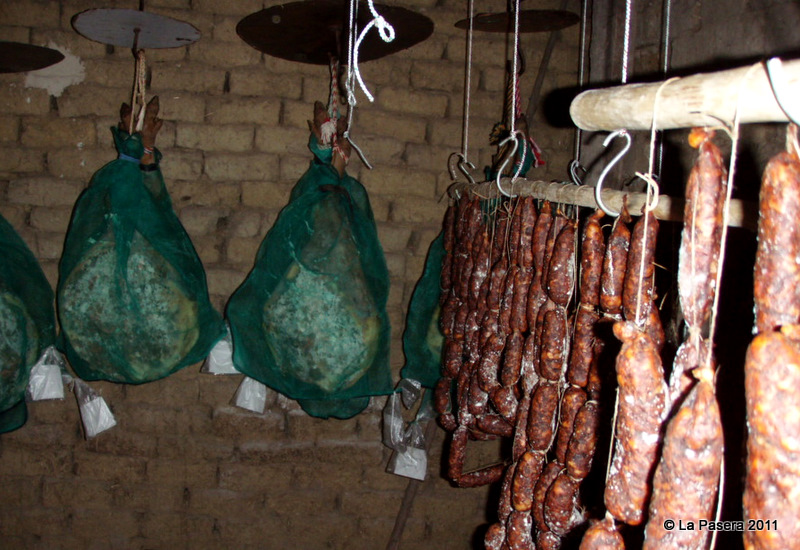
Tuesday is another early day as the piping and stringing of the chorizo and salami mixture, 50 to 60 kg in total, will take some time. Eventually the chorizo and salami will be taken to a cold and dark room to be left to be aired cured. The photo shows chorizo and hams curing.


For me the matanza finishes on Wednesday after the meat that was left to marinate is hung in a warm and dry place to partially cure for a few days before it is preserved in oil. This traditional home curing of the pork requires experience as it does not rely on carefully controlled environments and the using of chemicals.
The matanza is a tradition some people would find difficult to be involved with. I personally only eat meat that comes from Rita's as I know for sure the pigs have been fed a natural diet, I am happy with how the animals have been reared and how the meat has been processed. Although it is tempting to become a vegetarian, each year I enjoy helping with the matanza and returning home with some of the marinated meat, chorizo, black puddings, salami and ham. I always enjoy sharing with those who eat meat friends and family who come to stay. It is easy to buy in shops and butchers marinated pork, chorizo and cured ham but Rita's is certainly in a league of its own and much nicer hence the reason I occasionally still eat some meat.


Monday, February 21, 2011

Pruning fruit trees

No comments:
We have a small orchard here at La Pasera, well Luis tells me that 6 or more trees makes an orchard, so we must have. We have about 12 trees ranging from apple, plum, pear and peach and about another 6 or 7 more wild cherry, orange, nuts and avocado. The orchard part of the garden needed pruning so that we can maximise fruit production. The fruit bushes: gooseberry, red and black current will also be pruned very soon. The raspberry and blackberry are already pruned and trained.

Luis set about the younger trees that fruited for the first time, last year. Some of the pruning is to shape the tree at this young age, to keep the fruit at a sensible height and to encourage fruiting spurs. It might affect this year's crop but it'll be worth it in the end.
We have two very old apple trees that have been neglected for many years, part of the original orchard where the house is now built. We need to make decisions soon on how to manage these as the first drastic prune prompted turbo charged growth resulting in the trees growing unacceptably high. They are really passed their best but being such mature trees, they look integrated with the garden and add some welcome shade in summer., besides, Wentworth and Gawber use them for play-fights and viewing platforms.

Looking forward to our first oranges

Friday, February 18, 2011

A painter's palette from the market

No comments:
We recently visited Gijon's Sunday market. This is a sprawling and diverse market we sometimes like to visit, you can browse and buy a range of items including clothing, shoes, fruit and veg, plants, second hand items... If nothing else, you can think of the visit as a big theatre stage where you are both an actor and an observer.


On this particular occasion, Ian spotted this painter's palette covered in a rainbow of dry oil paints. Some time  ago we admired a similar palette in an antique shop and although very attractive, it was just too expensive. The price tag of the one in the market meant we could not leave it behind. Admiring the random way in which the colours were mixed by the painter can lead your imagination run wild and to think of a miriad of posibilities. It was a pleasant coincidence to have came across an article on the palettes used by different well known painters, click here  to view the full article or Click here if you wish to read the story Ian wrote in his writing blog, inspired by the palette.

Tuesday, February 15, 2011

Otter part two: footage

2 comments:

With Luis busy, I took an unexpected opportunity to walk the Rio Sella with Be the other day. After sighting the otters for eleven consecutive days, Be was pretty confident that we would see at least one of them for a brief moment at least. After walking for 30 minutes or so we were beginning to feel disappointed and decided to watch a goosander as it navigated a small waterfall and rapids. Suddenly Be waved her lens at me and shouted, in a whispery sort of way, to look down river. Sure enough he (the dog otter) was there. Surfacing and diving, bringing bites of food to the surface, turning on his back and chewing away.


His constant dives meant he was hard to follow as you never knew where he would surface. He stopped, several times and look straight at us, probably to assess the threat but fortunately, carried on and became more adventurous and confident.


He surfaced with a medium sized eel and carried it off to the far bank at the foot of the fall, where he devoured it with gusto. Occasionally he stopped and checked his surroundings by sight, smell and sounds. He circumnavigated the rocks and waterfall on the bank, disappearing into fallen trees and reappearing as he plopped into the water on the topside.


We watched, photographed and filmed his antics for up to 30 minutes, losing him from time to time but locating him when water was disturbed or ducks flew.


I have more film but the files are just too big to load with our limited bandwidth.

Friday, February 11, 2011

Restoring Rush Chairs

No comments:

Luis has just spent the past few weeks rushing a set of dining room chairs for a client who has a holiday home in Asturias. There were eight chairs in the set plus two others - a huge amount of work that has taken him about 150 hours. Drop-in seated chairs are much more difficult to handle and therefore take more time. In addition, we have had difficulties in sourcing rush which turned out to be of poorer quality than usual so he took a lot of time selecting and discarding material that wasn't up to standard. Using a combination of Spanish and Dutch rush to complete the chairs, they have turned out well and look great.


Our supplier in the UK has stopped importing rush and Spanish rush is also proving difficult to source. We know there are still commercial growers and suppliers in the Netherlands so we are busy making enquiries via our friend Marleen from El Paraiso del Burro who is originally from Holland and who still has many contacts there.