Thursday, August 16, 2012

Summer harvests

No comments:

Summer is well and truly making its mark on La Pasera. It is generally too hot to walk during the day so we have started going down to the local beach early in the morning before the heat of the day. On our return we harvest what needs to be harvested and put crops that need to dry out on the terrace to dry further.

The earth is very dry, cracks are appearing in the clay soil and the grass is growing slowly and patchy in places. We have had spells of rain but much less than usual and it is beginning to show. Despite the dry weather, most of our vegetable and soft fruit crops are growing well and in some cases, producing bumper crops. I think the warm damp spring gave the crops a great start.


It is a busy time of the year with many of the crops requiring harvesting and processing. The onions were harvested a few weeks ago and have been drying in the store room before being plaited and hung in the loft. With a bit of luck and regular aeration, they will last us until next year. The potatoes are now dry and stored in crates covered with cotton cloth to exclude the light.

We have so many cucumbers and marrows we have been distributing them amongst neighbours and friends, eating as many as possible and processing the rest into Marrow soup or juicing the cucumber for refreshing drinks.


The beetroot are cropping well and as one sowing is used up, another later sowing is beginning to produce young sweet beets that we intend to bottle or eat. Other root crops are growing well and this year we have our first harvest of carrots - only possible since we added sandy top soil. Also, we have swede, celeriac, turnip and parsnips which will be harvested later in the year.

We have begun to harvest our first aubergines, peppers and chilli peppers, so far we are eating what we pick but they will soon outgrow our immediate needs and we will have to think about how we will store them... Maybe bottle the peppers and use some to make pickles and chutneys.


This morning we picked a generous basket of tomatoes. Overall they have been disappointing but we expected they would be as our climate is unsuitable for prolific fruiting. We are too close to the sea and salty sea mists soon destroy the young flowers before setting fruit even though we protect them in a plastic tunnel.

The beans have grown very well indeed but as they come around the same time as so many other crops we tend not to eat many fresh. We leave them on the plant until the pods dry and then harvest and dry further until thy are ready to shell. This usually gives us around 6 kilos of dried beans for use later in the year.

The fennel has been splendid this year and we have eaten many in salads, stir-fries and juiced. If you cut the fennel off and leave the roots in the ground, it will re-sprout and give you a few more smaller fennel for later on in the season. Elsewhere the brassicas, leeks and salad leaves are continuing to grow well despite the dry weather, watered regularly using water stored in butts from around the garden.


3 young fennel re-sprouting from one root
Well that's all from La Pasera for now, I must get out and harvest the blackberries as one of our varieties is full of fruit and if we don't pick them, the birds or mice probably will.


Sunday, August 12, 2012

Do you want to learn to weave a cane seat? - Cursillo: restauración de sillas en rejilla

No comments:

Short course in chair restoration – Weaving a cane seat.


Date:  October 5th - 7th 2012

Venue: Asturias, Spain

Cost €200 (includes materials, lunch and refreshments)

Content:

Due to demand generated from www.artesanialapasera.com I am pleased to offer a short course in chair restoration – weaving a chair seat in rattan cane. The course will include:

1.   Preparing a chair for restoration
2.   Materials and techniques
3.   Finishing and aftercare

At the end of the course the participants will have woven a seat using rattan cane.


The course will take place in a workshop at La Pasera. There will be a maximum of 5 participants on each course to ensure quality tuition from the instructor Luis Laso Casas.


Luis has been restoring cane and rush seating for the past 10 years. He has re-caned and re-rushed chairs old and new from a variety of sources. From exhibition pieces to dining room suites, boudoir chairs to Thonet, he has restored somewhere in the region of 500 chairs and overcome many challenges to accomplish the craftsman finish that has become his trademark. There maybe both English and Spanish participants on the course but as Luis is bi-lingual, this is not a problem. You can also practice your Spanish is you so wish!
 
The programme will commence on Friday lunchtime with an informal chat and lunch. The course will be structured to ensure maximum support for participants and where necessary, one to one tuition. A vegetarian lunch will be provided on each day the course. If you are unsure about anything or if you require further information, please contact Luis at :  artesanialapasera @ gmail.com (no spaces) Telephone:             0034 646436562    

Cursillo de restauración de sillas: Rejilla

A consecuencia del número de gente quienes me han preguntado donde poder aprender a tejer un asiento de rejilla, esterillado francés, me complace el poner a su disposición los siguientes cursillos de restauración de asientos de rejilla o rattán.

FECHA:
5-7 de Octubre del 2012

LUGAR:

Ribadesella, Asturias, España.

CONTENIDO:

El curso incluye:

Preparación del asiento antes de la restauración.
Materiales y herramientas
Técnicas.
Tintes y cuidados.
Al final del cursillo, los participantes habrán aprendido la tecnica basica para tejer artesanalmente la rejilla usando junquillo o tireta de rattán.


MATRICULA:

€200.00. La matrícula incluye los materiales, tres comidas principales basadas en una cocina vegetariana y bebidas no alcohólicas durante el día. Puedo facilitar una pequeña lista de hoteles cercanos donde los participantes puedan alojarse durante el cursillo.

Aquellos interesados en participar en este cursillo deben ponerse en contacto con: Luis Laso Casas a través del email artesanialapasera@gmail.com

NUMERO DE PLAZAS:

El número de plazas está limitado a un máximo de 5 participantes.

Tuesday, August 07, 2012

Summer highlights and review from La Pasera

No comments:
Summer in Asturias is a funny old affair. The weather is usually mixed with intense heat, storms, cool overcast days, misty drizzle and hot muggy nights when the winds carry fine particles of sand from turbulent storms in Africa. Generally speaking, it is never too hot for long, too wet or too cool but remains unpredictable.


The weather of course affects our vegetable and fruit crops but apart from the orchard trees being sparse  of fruit, most things seem to be cropping well. We look like we will have a bumper harvest of blackberries but the raspberries are failing and probably need renovating in Autumn.


The highlights at this time of the year in the vegetable garden are many but fennel, beetroot, lettuce, cucumber and marrow are performing exceptionally well giving us enough for cooking, preserving and juicing. Peppers, carrots, aubergines, squash, beans, tomatoes, celery, celeriac, turnip and a range of brassicas are growing well and we hope will provide enough stock to fill the dehydrator, freezer and larder.


Elsewhere at La Pasera we are busy preparing for the rastrillo (street market) next week where we demonstrate chair cane weaving and take a few completed chairs to sell.  It is usually a great day with all the money collected from stall holders who pay for space, going to medicine without frontiers. Luis' sister will join us again this year to sell her hand-crafted felt accessories.

Cane and Rush Chair Restoration blog:  www.artesanialapasera.com 

Luis' mosaic making goes from strength top strength with a steady stream of enquiries and orders. He has just been asked to design and make a garden mosaic for a family in Madrid who found his work from the Internet so he is really pleased about that.

Mosaic Blog: www.mosaicoslapasera.com

Summer is always a busier time with plenty of work to be done in the garden with the long list of maintenance and building jobs never seeming to get any less. We have laid more mosaic paths, finished damp-proofing the studio, started building a fountain to accommodate a water supply for the garden and we are making headway with sorting out the herb garden.


Not having television gives us a bit more time to enjoy our respective hobbies and interests and this summer saw the launch of a new blog Adventures in Altruism and plans are developing for an exciting new mosaic exhibition. I am writing more and involved in two projects that you will no doubt hear about in time. We are walking regularly, taking too many photographs and trying to keep relatively fit. We have made soap for the first time this year which is great and we continue to make hand-cream with plants from the garden infused in olive oil.

Writing blogs: www.ianhicken.wordpress.com


The cultural calendar in Asturias is extremely packed as usual this summer with varied events and fiestas taking place every week. We have just had the Jazz festival which was great, the International Canoe Descent of the River Sella and the local cheese fair takes place this coming week. Lots more to do and see if we get the time.

Band of young street entertainers from Seville touring Asturias this summer

Wentworth and Gawber are keeping well and sleeping most of the day when it is hot and out most of the night enjoying the sights, sounds and smells of the balmy desert night winds. Gawber had a problem with a plaque build-up on his teeth but he let us clean them and with the addition of natural anti-plaque granules in their food, it should no longer be a problem.

Gawber and Wentworth

And finally, thank you to all of you who follow or read our blogs, we really appreciate your feedback, comments and kind words. This blog now has a regular readership of over 2000 people per month from over 100 different countries around the world. Keep in touch, it is lovely to hear from you.

Friday, August 03, 2012

In a pickle - walnuts

1 comment:
Pickled walnuts are not to everyone's taste but if you are a pickle fan, then you'll probably love these. We tend to pickle about 2kg of walnuts each year but could do many more as they are so abundant around here.


The key is to pick your walnuts young before the shell is beginning to form. You can test if they are ready by pushing a pin through the green outer skin, if ready, it should go straight in and not hit forming shell.

Wash the walnuts, prick with a fork and put in a brine solution for 2 weeks - change the brine after one week. To make the brine dissolve 225g salt in enough water to cover the walnuts.

After the two weeks, carefully drain and leave to dry. They will turn black if not already black. This is perfectly normal.


Prepare the pickling solution. We use a variation of a recipe we found on the internet and over the years we have adapted it to suit our personal taste. Have a look at different recipes and if something doesn't quite work for you, change it the following year. This is our recipe:

Sweet pickling vinegar:
1 litre of malt vinegar
500g dark brown sugar
1 tsp all spice
1/2 tsp cinnamon
1/2 tsp cloves
1 tablespoon grated ginger

Bring the ingredients to the boil and simmer for 15 minutes. Add the walnuts and take of the heat. Leave 15 minutes then decant the walnuts into clean sterilised jars and top up with the pickling vinegar. Seal and label. They will keep for about a year or until consumed. Great in salads, with cheese or savoury dishes.


Thursday, July 26, 2012

How to make gooseberry and mustard seed pickle

No comments:
We have several gooseberry bushes here at La Pasera. They are still young and only one produces fruit in sufficient quantity to be useful but with time we hope to increase the harvest dramatically. The bushes were planted for one reason and one reason only... Gooseberry and Mustard seed pickle (well and the odd crumble if we ever get enough). If you have not tried it, you must, it is to die for.


We cannot take credit for the original recipe (we think it was a Jocasta Innes recipe) and needless to say we have adapted it to suit our taste. So here goes:

225g of rinsed and bruised black and brown mustard seed.
12-15g of cayenne peppers (blitzed with seeds)
1.5 litres of malt vinegar
1.5kg red or green gooseberries
750g of dark brown sugar
100g salt
675g seedless raisins (chopped in a blender)
225g currents (chopped in a blender)
10 cloves of garlic (peeled and crushed)


Add all ingredients to a large saucepan and bring to the boil. Simmer and stir regularly to avoid burning. 40 minutes may be enough but sometimes the gooseberries release more juice which needs to be reduced. The pickle is ready when it is rich and thickened (it thickens more on cooling). Leave overnight covered with cloth until cool and moisture released. Bottle in sterilised jars, seal and label.


This recipe makes about 8 jars of pickle.

It is ready to eat almost straight away but as with all pickles, it matures well and is better kept for a couple of months for the flavours to develop. It has some heat and despite the high salt levels, it does not taste too salty. It keeps for up to a year if you're lucky and don't eat it all before then. We love it with burgers, cheese, pasties or quiche but it also goes well with meats.

Monday, July 23, 2012

New Mosaic - The gardener's friend

4 comments:

New mosaic by Luis, completed and handed over to the clients at the weekend - needless to say they loved it and are thinking about another commission. The name for Robin in Spanish is Petirrojo.

Wednesday, July 18, 2012

Honey Bees: a sting in the tale

3 comments:
We love bees, in fact we positively encourage them by leaving wild areas in the garden and by planting a good mix of flowering plants, bushes and trees. Our local honey bees thrive on the rich carpets of meadow flowers that are in continuous blossom from early spring through to late autumn.


With the decline of bee populations through pesticides, parasites and habitat destruction, it is encouraging to see the efforts people are making in bringing the issues into the public arena. Events here with a swarm of bees earlier in the week have left us feeling saddened and surprised. Let me explain...

Mid-afternoon whilst pottering in the garden we heard our friend Luis the farmer call out for us to come and look at a swarm of honey bees that had settled on a neighbours wall. Camera in hand we wandered up to find a rather large swarm gathered together on an old stone wall of a neighbours house. After taking a few pictures we posted a question on a forum to which we belong, asking if the bees would relocate by themselves as they were perilously close to where people walk and could be dangerous if antagonised. The consensus was that they would move on fairly quickly and should be left alone.


About an hour later we were in the kitchen when he heard a loud hum coming from the extractor fan above our oven hob. We went outside and it was obvious that the bees seemed to be making a new home in the chimney above the fan. We quickly took a large saucepan, switched on the extractor and lit newspaper and damp grass to make as much smoke as possible in an effort to deter their nest building.

After another 30 mins or so the bees seemed to have gone but to be safe we brought to the boil a small pan of vinegar in the hope that the acrid fumes would further dampen their efforts. It worked.

We love bees but didn't want them in the cooker hood or house.


About another 30 minutes later we heard a commotion just up the road and investigated. It was the fire service (Bomberos) scaling ladders onto the roof of a close-by neighbour. Apparently the bees had been going into their chimney since lunchtime and despite efforts to deter them by releasing smoke through their extractor fan, the bees had settled and were busy building comb.

The firemen were sealing the chimney ready to release poisonous gas to kill the bees. There was nothing we could do - that is the way they deal with such swarms. Very sad.

On a lighter note, on spotting me looking at our chimney through binoculars, another neighbour asked me if everything was OK. She was somewhat bemused when I told her we had sheep coming into our chimney - the words for sheep and bees are very similar and I got mixed up!!!


neighbours extractor fan light

We would love to keep bees in the future but it is tightly controlled here in Spain and anyone wanting bee hives has to attend a course, be certified and licensed, and their hives registered and numbered. Maybe one day, and if such a thing happened again we could take the swarm and give them protection in exchange for honey.


Thursday, July 12, 2012

La Pasera - The Soap Opera - The first batch

7 comments:
The stage is set. The props in place, costumes on, camera ready, lighting OK despite being a dull day...Action.

Scene 1

Enter Luis stage left wearing black rubber gloves, a black apron and protective glasses (plus his normal clothes - phew!) Ian decides to stay close by, watching from a distance, camera in hand and making mental notes. Was this a recipe for disaster or was Luis heading for the shower...?

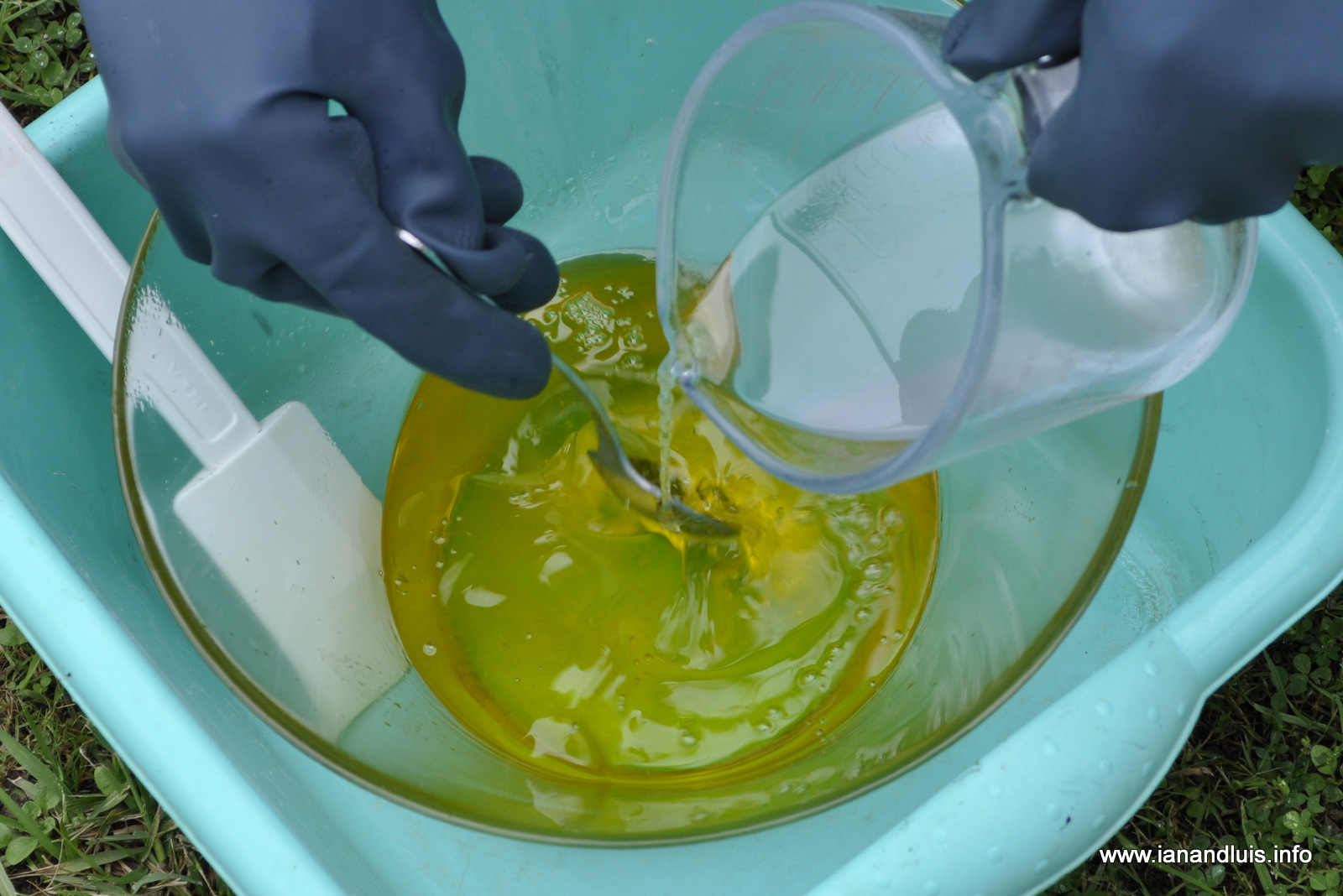
The oils, almond, coconut and olive decide to take a warm bain marie whilst lye (a rather caustic character) and distilled water are carefully measured.


Things begin to warm up and it's all action from now on.

Scene 2

The action moved outside as things started to get tricky and dangerous. It started to drizzle but that didn't put anyone off. All the ingredients were gathered and Luis got tooled up with a rather snazzy spatula and a stainless steel blender. Lemon Grass oil makes an appearance and waited patiently on the side until it was her turn to join in. Lye decided to take a drink to get things warmed up.


Things are stirring, lye and water are introduced to coconut, olive and almond. Vitamin E turned up but waited patiently to be introduced. The soap plot begins to thicken as the blender gets to work - there is no escape now.


Luis manoeuvres his spatula into position and with blenders help, a distinct visible trace is left for all to see. As a last ditched effort to get noticed, Lemon Grass and Vit E enters the mix. One final stir and it's nearly over. Luis decides it's time to turf the mix out into a pre-prepared mould. They should be fine in there as it's fully lined and grease proof.


Scene 3

It's been a quiet night, the mix was kept safe in a cupboard away from The Terror Twins, Wentworth and Gawber. They are renowned for inquisitive ways and there was always a possibility they would sniff it out and get their paws burnt. Gawber kept a close eye on things...


The next day

Lunch was a short affair as Luis was eager to sort out the mix once and for all. He grabbed a sharp knife from the kitchen drawer and took the mould from the cupboard. The mix decided to come out without much of a fight to our delight, but it wasn't over. The deed had to be done. Luis plunged his knife into the bar and cut it into six pieces, it was over. Well almost...


There is always a possibility that such a volatile mix might turn out too soft or crumble but there is a cure. 4-6 weeks in a cool dry secure unit. That'll sort them once and for all, toughen and harden them up. Luis sighed with relief, it had been easier than he thought. Meanwhile, on a shelf not too far away bergamot can be spotted hiding in the shadows...

Will Luis' bubble burst, will he ditch the dirt, why is bergamot hovering in the wings? Let's hope Luis doesn't get into a lather and that he feels cleansed by the experience - only time will tell.

Bookmark now for Episode 2 Coming soon.

La Pasera - Suds Law

With special thanks to Coco at My Galician Garden for her inspirational soap making and gifts of soap.

Sunday, July 08, 2012

Making the most of courgette, marrow, zucchini and cocozelle

2 comments:
At this time of year one vegetable we look forward to is the courgette or marrow. I must admit that until we started growing our own, It had never occurred to me that they are one and the same plant. I know there are special cultivars which suit either end of the growth scale but in essence a courgette is a baby marrow.


We normally grow two marrow plants as they produce well in our warm and damp climate. We have more than enough courgettes for salads and stir fries and sufficient marrows for soups, stuffing and sauté. This year Luis mistakenly planted 4 thinking that two were squash. We decided to keep the four plants so we are poised for the onslaught.

With the dehydrator, freezer and juicer we should soon, cook, consume or store most of what grows, the rest we will distribute to neighbours and friends.


Cream of Marrow Soup


One of my favourite recipes with marrow is soup. A cream of marrow soup that is so easy to prepare, freezes well and tastes delicious. It can be served hot or cold and tastes very different each way.

1 medium to large marrow (best before pips form and harden)
1 large onion
2 cheese triangles (this gives it the creaminess but can be omitted for lower fat)
Splash of oil
vegetable stock cube quenelles (Home made - link here)
200-250 ml of water
salt and pepper to taste.

Coarsely chop all ingredients, bring to boil, simmer for 20 mins until the marrow skins are soft, take of heat and leave to cool for 20 mins. Blitz with blender. This recipe serves from 4-6 people.


Marrow fritter

Another delicious way of using a young marrow is to slice it thinly about half a centimetre, dust in flour (plain, gram or corn) seasoned with a little salt and pepper, dip into beaten egg and lightly fry in olive oil. Turning when browned. As they are cooked, place on a plate and separate layers with kitchen towel until ready to serve. Spices can be added to the flour but be careful not to overpower the delicate sweet taste of the marrow.

This next basket of freshly picked goodies: lettuce, small marrow, basil, beetroot and fennel are to juice for a delicious sweet glass of pure heaven. It always surprises me how you can still taste the individual ingredients at different depths as your taste buds go into over-drive. No more sugar laden commercial juices from now on.

Ready for cleaning before juicing

Wednesday, July 04, 2012

Thinking of relocating abroad? You can learn to live without baked beans.

No comments:
Going back and forth to the UK on the ferry is often a good chance to catch up with other English people who spend time or live permanently in Spain. As there are few English people here in Asturias it is interesting to hear others' experiences. The past few times I have seen a large increase in the number of removal vans returning to the UK and heard many stories of how the dream has been shattered or at least tainted for some.


The economy in Spain is suffering and people are losing jobs or taking cuts in income. The Euro exchange rate for the British pound and the value of savings and pensions has suffered for a couple of years and will probably remain unpredictable for sometime to come. It is really disappointing for many but not the sole reason some are eager to return and regret relocating. I am sure that one reason for many is that they fail to readjust to life in a foreign country and never truly come to terms with a life lived differently.

Luis and I were talking about our past 6 years here and how well we had adjusted to life in a different country and we both agreed a short blog post outlining our experiences might help inform others who dream of relocating to different climes.


If you were to ask us if we made the right decision, the answer would be without doubt, yes. Of course there are continuing reservations about what the future might bring but as we are now, we feel fortunate. The grass however, isn't always greener on the other side. Things do go wrong. Understanding how things work in your new society, getting to grips with social nuances and of course the ability to communicate effectively in a foreign language is a big learning curve with many challenges and hurdles.

To succeed you have to accept that living away from everything that is familiar, can be hard. If you don't, your life in a foreign land will be difficult and will potentially erode your dreams, disintegrate your plans and possibly damage your relationships with those you love.

We can only describe our experience buying a house in a rural community, an hour from any cities but close to several small towns where the Spanish come on their summer holidays. There are few foreigners living here compared with the south of Spain and most people do not speak any English.


Here are some of the key issues that we think people should consider before relocating:

Location: What is the climate like? This sounds an obvious one but you'd be surprised at the number of people we come across who have only ever visited in summer before buying and forget that places can be cold, very cold and wet.


Dream homes in the middle of nowhere or on the side of a mountain are great when young but have you tried cutting a lawn on a 45 degree slope or travelling long and difficult journeys to shops and business. Telephone and internet connection may not be possible despite what estate agents tell you. Remote areas can be lonely places. If you are renovating a mountain house you need to consider that costs will be higher as access for deliveries of goods will be potentially problematic and expensive.

Language: Conversational Spanish is difficult at the best of times but talking about business or negotiating a mobile phone contract or ordering goods can be complex without specialist language skills. Face to face conversations are so much easier than the telephone or written word. Understanding legal documents and processes is a challenge. Expressing feelings in a foreign language is limited for many. Your social and cultural reference points are different which in it's self can hinder communication.


Medical: Unless you are retired and registered as resident then medical cover can be complicated. You can seek out treatment using your European health card but if you require longer term treatment or investigations it could prove problematic. Also, if communication is difficult, this can add to the stress and influence the treatment you may or may not receive. Even if your medical or nursing staff speak English it is likely to be as poor as your Spanish.

Social: I mentioned earlier that social and cultural references may differ. Here in Asturias people are very friendly but don't neighbour other than chatting in and around the village. It would be rare to be invited for something to eat or drink but that should not be taken as not being accepted, it is just how it is. The nuances of social etiquette are interesting to learn when living in a different culture. There are lots of groups, social gatherings for fiestas and a few cultural events throughout the year but your social life will be very different to what it was in the UK.


Family and friends back home: You miss them, of course you do. You might get more family and friends visiting but it puts your relationship on a different footing to what it was. It was unlikely that in the UK they would stay with you and certainly not for 1 or maybe 2 weeks. It is also crucial to remember it is their holiday as well as a visit to see you.

Occupation: There is one thing that is key to settling in another country and that is keeping occupied - having a sense of purpose. If you need to work then that can be difficult given the ongoing economic problems and high unemployment rate. Over 50% of under 26 year old and 22% of the general working population are unemployed here in Spain. Language, once again is an issue for many as learning specialist vocabulary related to a profession or occupation is not covered in standard Spanish courses.


If you do not need to work then it pays to remember that you cannot holiday 12 months of the year.
Keeping your mind occupied with meaningful and worthwhile activities is vital. Hobbies and interests will need to be developed and maybe solitary pursuits especially if you struggle with the language.

Legal: How things work such as insurance, buying and registering a car, paying local taxes, registering and opening a business, contracting workmen, buying a house, renting a house, making wills and a hundred and one other things... are different and need to be fully understood before entering agreements, signing contracts or employing services. The law is different. Many find this aspect too complicated and choose to ignore it or cut corners which in the long run, leads to problems.

Along the way Luis and I have made mistakes, taken chances, become stressed out of our heads, laughed at some of the things we have experienced, been saddened by seeing relationships fail, felt heartened by the generosity of strangers and learned a lot about ourselves and others along the way. One piece of advice we would like to pass on is spend time in the area you eventually want to live in. Go on holiday at different times of year, live like a local, learn the language and be prepared a live a different life. If you are prepared for uncertainty, readily accept change, have the ability to problem solve, can remain positive and keep a sense of humour, then do it. It has been six challenging but very happy years for us.


Friday, June 29, 2012

Walking in Asturias 10: Vega de Ario

1 comment:

Vega de Ario is an area in the Western Massif within the Picos National Park that I simply love. There are magnificent views of the mountains and valleys as you walk along the path and the wild fauna and flora you encounter along the way are special.

Setting off from La Pasera, the Picos de Europa lakes are a 40 minute drive up mountain roads. They never fail to impress. Arriving and parking up at Lake Ercina I took a well signed-posted path towards Majada de Belbin, a little green and luscious valley with numerous stone huts where in the old days, the shepherds would spend several months tending the herds and making cheese; these days there are only two of them used in this way and the rest are weekend retreats.


From Belbin I followed a hill side path that eventually takes you down into a valley and up a small stream where newts gather in the few shallow pools that are fed by water from the melting of the last Winter's snow. At this point I had to climb up to meet the main path that takes you up the mountains and towards Vega de Ario. Most people join at the base of Lake Ercina but I prefer this beautiful detour.


Once on the main path, after about 1 hour of a steady climb, the landscape opens up and flattens slightly and you come across one of my favourite spots within the National Park. There are some fantastic views towards the Central Massif. In this area, the abundance of alpine flowers blossoming at this time of the year within the limestone crevices create a colourful carpet.


At the end of this path there is a manned mountain refuge that people use as a base to explore the surrounding area.

During this walk, I came a cross a group of biologists researching how the area's bird population is affected by the increased numbers of parasites they get as the climate changes with a loss of colder areas and a lack of permanent snow. I also talked to a group of cave explorers from Cambridge University that were exploring one of the several 3000 feet deep caves there are in this particular area.

Just before heading back, I walked towards the edge of the top of the Cares Gorge, the most popular walk in the National Park and the path leading to two peaks I intend to climb in the near future and as part of my learning about mountain orientation and strengthening my map reading skills.

The return along this path takes you directly back to Lake Ercina and the occasional breeze was very welcomed on a very hot and sunny day.

Luis x