.

.

Wednesday, November 09, 2011

The bean harvest

1 comment:
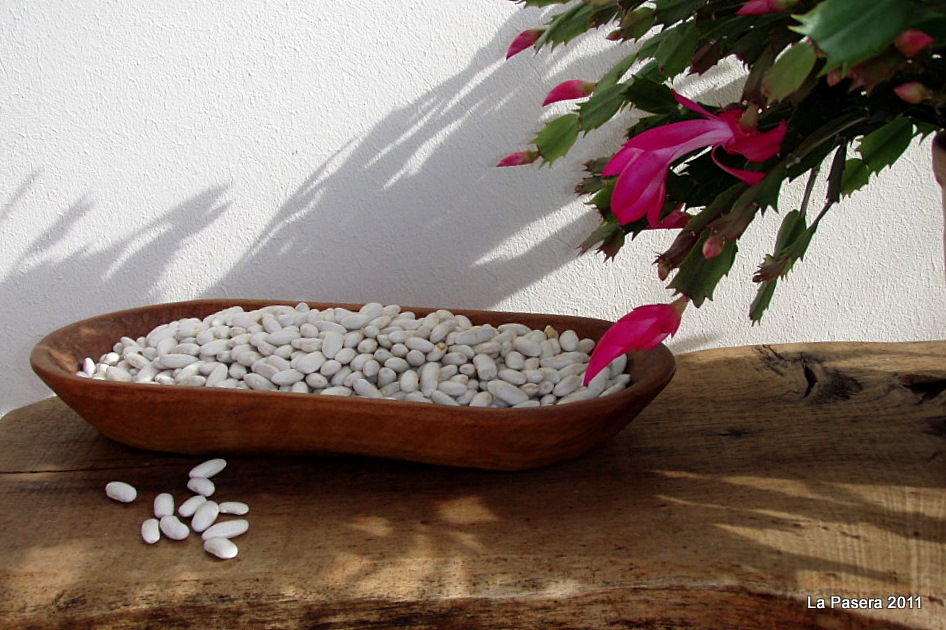
Each year for the past three years we have been letting the beans, we could not eat green, carry on growing until they produce a nice fat pod filled with plump white beans. Most beans will run to seed and give you a good crop to harvest for drying. These will then be stored for eating and seed for the following season.

As the vegetable plots develop at La Pasera we are constantly adjusting what, when and how we grow our vegetables. Learning from experience and getting used to the growing conditions and weather patterns enables us to plan better and make more effective use of what we grow and eat. As eager and willing newcomers to home-produced vegetables, we have tried most things and found that certain vegetables, no matter how much we try to use, never get used whilst others we seem to never have enough of. All unused vegetables are composted but adjusting crops and seasons, we are now finding we are eating increasingly seasonally and composting less.


Beans are such useful ingredient to a whole host of dishes both hot and cold so we took the opportunity to grow more plants and harvest greater numbers of full-term beans. This year we harvested about 5kg of beans which is not a great hoard but never-the-less very welcome. We pick them when the pods are dry and become pale and papery looking. The pods are left to dry for a few days in the sun then the beans shelled and dried thoroughly over the following few weeks. Once dried, the bean are popped in the freezer for 24 hours to ensure any bugs or parasites are killed. Defrosted, dried once again and stored, the beans will keep until needed.

Beans are a fairly easy and rewarding crop with few pests and diseases attacking them. We initially have to protect then against slug and snails attacks using one of several organic methods including organic slug pellets, coffee grounds, ash and egg shells, until the plants reach a certain size after which they can withstand further attacks. We also find that some bean plants are prone to black fly attacks for which we use a soapy water spray every two weeks as this keeps them at bay.


Around the village seeing bunches of beans drying on a balcony balustrade or against a dry wall is a common sight. At the moment, we don't produce enough to do this but given time.....

Sunday, November 06, 2011

Seed: sorting, saving and storing

3 comments:

At this time of year when the dark nights are drawing in, the logs are burning bright and shutters closed, the opportunity to review the seed stock box is welcomed. As with most of us who grow their own food, saving seed and ensuring a healthy and adequate stock is an important and necessary task. Like most, we have a few packs of commercial seed, some collected from our own crops and some kindly swapped with friends and neighbours.

Inevitably, the commercial seed stock runs out of date from time to time so we try to ensure it is used as soon as possible but if it runs over by a few months then it is still used and rarely fails to produce healthy seedlings. Bear in mind though, some seeds do deteriorate over time no matter how you store them. Parsnips and cucumbers have performed poor for us if kept for longer than a year. All the seeds we collect from plants are naturally and thoroughly dried, harvested as required and stored in recycled envelopes. These in turn are kept in a dry wooden chest which helps to keep the seeds cool and dark.

Anyone with further advice or tips on seed collection and storage, please leave a message in the comments and don't forget to subscribe to the blog for updates.


Today we have sown sugar snap peas and mange tout which if grow well will be ready for harvesting in early April. Lambs lettuce and little gem lettuce seeds have been put to one side ready for sowing in the next few days therefore ensuring an early salad crop to follow on from the winter lettuce.

We are currently compiling a list of seeds we need to re-stock over the coming months and thse will either be sourced commercially or from fellow growers.

The chest we use for storing seed was picked up from a market stall a few years ago. Made of pine it was grubby and covered in paint. Stripped and polished, lined with cuttings from magazines and seed catalogues and handles attached to the ends, it makes an ideal container for our seed collection.


If you have a few moments have a look at this Ted Talk film about pollination, absolutely stunning:

Tuesday, November 01, 2011

Preparing the garden and vegetable plot for winter

2 comments:
At this time of year there is always lots to do around La Pasera. The garden needs close attention in relation to cutting back shrubs and plants that are out-growing their space, plants need moving and weeds need weeding out. Each year we make a note of what needs moving due to the wrong growing conditions, lack of space or wrong position. There aren't many plants that need moving but inevitably one or two need attention in the coming weeks. In addition, it is an opportunity to refresh and stimulate new growth next season. Never be afraid to cut back hard, more often than not it works well and results in luscious growth in the spring and early summer.

The extensive cutting back gives us lots of organic material which is of course, composted for future use as a soil conditioner and nutrient. This is an important resource for us especially now as out neighbour farmer is no longer keeping dairy cattle (due to new EU laws....) and therefore our regular supply of manure has dried up! Thanks Brussels.


The pond has needed some attention this year due to the vigorous growth of water-lily and oxygenating plants. After removing some of the plant growth, leave around the edges of the pond to give any inhabitants such as water snails and beetles an opportunity to find the water again. In the next few days we will secure a net over the pond to prevent an excess of leaves getting into the pond as the trees shed in the next few weeks. An excess of organic matter can make the pond murky and promote algae growth.

Earlier on in the season we sank a small bundle of barley straw into the water as the water became very green but remained healthy. The barley straw releases a small amount of hydrogen peroxide as it breaks down thus killing of the algae. Harmless to the pond life, it seems to have worked.


Starting out with only four fish, they appear to be at home in their environment as we now have about 20, that is after giving the Donkey Sanctuary 6-8 for their pond - apparently, Marleen has mentioned that they too have numerous new offspring swimming around.

The vegetable beds are worked on a rotation system and it is always good when one bed can be cleared completely and dug over. One bed has been dug and green manure (Oats) have been sown and is already showing through. This will be dug in during late winter prior to planting up with spring vegetables.


Saturday, October 29, 2011

Pictures at an exhibition

1 comment:
The Mosaic exhibition was officially opened last night with about 30 people attending which apparently is very good. A few of our friends came along and it was nice for Luis to have their support. Jesus, Gloria, Luis and I had all worked hard to ensure that everything looked its best and that a small reception was laid out for those attending - chorizo, tortilla, bread, olives, empanada, crisps, wine and beer.

Unexpectedly (because Luis wasn't previously informed), Jesus and Gloria called the guests to attention and introduced Luis and his work to the gathered crowd. They talked of how pleased they were to see his work and especially a new art and craft for the centre.

Luis rose to the occasion and responded in his usual eloquent manner. It was a great night and we were all very pleased for him and proud.

A mosaic in progress

Luis before the inauguration

Luis being presented by Jesus and Gloria - Ceramicists and sculptor

Part of a photographic presentation

Tuesday, October 25, 2011

Preparing for the mosaic exhibition

1 comment:
The exhibition is taking shape and we have today delivered the last few mosaics to the gallery. The posters and leaflets have been distributed, emails sent and the opening event promoted where practical.

Luis' exhibition has had interest from the radio and press resulting in a trip to Gijon yesterday to participate in a radio interview for Radio Principado Asturias. A funny thing happened on the way to the studio, we were lost as Gijon is a sprawling city with many broad avenues and diagonal cross roads. We headed in the right direction but decided to ask in a local coffee bar. Luis asked the proprietor where RPA was. Nodding at a young blonde woman sat having coffee, Luis turned to be confronted by "Are you Luis? I am Cristina and I am interviewing you this afternoon".

Luis with Cristina Natal
The interview went well and he came across as very enthusiastic and knowledgeable, not too nervous nor too laid back. It was an opportunity to thank the staff at the exhibition centre for their help and promote the event, his blog and his desire for further mosaic experience and training in Italy.

On air, in full swing - fast approaching the 5 '0' clock news
Full interview here (in Spanish):


Saturday, October 22, 2011

Mosaic exhibition

No comments:
It is some time since I first discovered mosaics and since Ian got me my first book on pebble mosaics. Little did I know that it would set my on a path of creative self discovery. Since we moved to La Pasera I have been able to develop my passion for mosaics and after a long wait, I am pleased to invite you to come and see my first solo mosaic exhibition at the Regional Crafts and Applied Arts Center not too far from home.

I am also finalizing the design for my next mosaic project that involves an interpretation of a landscape and landmark in black, gray and white tones. a very exciting project.


I hope you can drop by and enjoy the exhibition that will be inaugurated on Friday 28th October 2011 and will run until 11th December 2011 at the Centro Regional de Artesania y Artes plasticas en Poo de Llanes.

Wednesday, October 19, 2011

The best Piccalilli recipe ever

No comments:
Piccalilli is one of our favourite preserves. Each year, towards the end of the season, there are green vegetables and green unripe tomatoes aplenty so piccalilli is an excellent way of making use of these. This particular recipe has been handed down in our family for the past four generations. Originally from my maternal Great Grandmother Mabel Lund, I have strong memories of this pickle being brought out around Christmas time for Boxing day tea, served with cold meats and cheese.

Autumn Crocus now in full bloom
As with most pickles, it is best made and left to mature for a couple of months before using. This recipe will make about 12 jam jars which is not really a lot if you are a piccalilli addict like me. Double up if necessary... Note: this recipe is in imperial measurement as it always has been... You metric bods will have to do the sums.

Piccalilli

2 cauliflowers
1 cucumber
2 lb of shallots or onion
2 lb of green tomatoes
1 head of celery

About 6 lb of vegetable in total. Chop all the vegetables into small pieces. The cauliflower should be broken into small sized florets and if small enough, the shallots left whole. Soak overnight in a brine solution made with 8 pints of water and 1/2 lb of salt.

The following day, drain and rinse well, leave to drain whilst you make the sauce.


4 oz of mustard powder
1/2 oz of Turmeric
1 lb sugar (can be reduced if necessary)
2 1/2 pints of vinegar
1 cup of plain flour


Make a sauce with all the ingredients, thicken with the flour and gently bring to the boil to cook out the flour. Be careful not to burn the sauce, stir constantly. Add the dry vegetables and bring to the boil and immediately remove from the heat. Cover and leave to cool. Bottle and seal in sterilised jars the following day and label. Hide from everyone except your best friends....


Sunday, October 09, 2011

The worst chutney recipe ever

5 comments:
Following on from the post about the glut... I thought I'd report back on what we have done with some of the produce since. The chilli peppers were cleaned, half and quartered then frozen in layers then bagged. These will be used in variety of ways over the next 12 months. The red peppers have been cleaned and bottled. The weak vinegar solution then heated in a bain marie should keep them in good condition for some time to come however it is the first time we have tried this so we will wait and see.


We have made some glorious soups that have been enjoyed by us and our guests over the past few days. Plenty more has been frozen. The most popular was carrot and coriander with orange soup followed closely by cream of marrow. If any one wants the recipes let us know and we'll put them on the blog.

We have not had to buy fruit or vegetables for a few months now. Locally, the fig trees are full of fruit and Luis has been collecting and processing them for the freezer in readiness to make jam when we get the time. Apples are being harvested and although our own supply has been poor this year, the gift of apples from Luis' sister has been welcome.


We have eaten lots of red, ripe and juicy tomatoes however we need to use many more in addition to a container full of ripened pears. I came across a chutney recipe in a leaflet produced some years ago by a famous vinegar brand and it ticked all the boxes in relation to the goodies we had in store.

I usually cook from instinct and practice rather than follow a recipe, usually I would adapt it if it didn't seem right but last night's chutney effort slipped by. As I added the final amount of vinegar I just knew it was too much liquid. As the recipe was to be simmered for 90 mins, I decided to wait and see. No amount of vapour release could be enough to reduce and thicken. A last minute effort to skim off at least three cups of syrupy liquid helped no end.


Now the chutney is cooled and jarred, it will mature for at least three months and although still a little more loose than I would have liked, we now have 10 jars of very tasty Pear Chutney  in store. The worst chutney recipe ever?, probably. I must remember to act on instinct and amend the amounts for next time.


Monday, October 03, 2011

Processing the glut - 50 years a vegetarian

1 comment:
Every so often we have a glut of produce, not just an unused bag of something from last week's shop at the supermarket like in the old days, but a serious glut of fresh fruit and vegetables. This week we were visited by Rita and Alfredo (Luis' sister and brother in law). As usual they came laden with produce from their own plot - a plot, I might add that makes La Pasera's look like a postage stamp.


Rita, knowing that I am a vegetarian, brought with her about 40 jars of Pisto she had made for me. This is a concentrated base of tomato, with chunks of marrow, pepper, squash, onion, paprika and herbs. Sealed and heated in a bain marie, this useful sauce can be used as a base for soups, with pasta, rice or other vegetables and it is a really useful, quick and easy food to have in store. I usually ration it to ensure we have stock all year round but somehow we still have a few jars left from last season so we will be treating ourselves to a few portions over the next few days.

In addition to the Pisto, they brought with them about 80 kg of ripe tomatoes, 20 kg of green tomatoes, bags full of apples, pears, peppers, chillies, cabbage and carrots. Our larder area in the garage would rival even the best stocked supermarket fresh produce counter.

Some of the produce from Rita and Alfredo
Needless to say, together with the glut of produce we currently have there is a lot of work to be done over the next few days if we are not to waste most of what we have in store. Thankfully, whilst Rita was here she and Luis spent two days of her 'holiday' making tomato frito or passata as you might know it. Here's how:

The tomatoes are washed and cored, blemishes removed then squashed into a rough pulp. The pulp is put into a fine mesh bag and left to drain overnight. The juice that is collected is bottled and frozen as it is one of the best tomato juices you could ever taste.


The pulp is then put through a machine that separates the flesh from the skin and pips (these are composted). Similarly, sautéed onion and peppers are put through the machine and the resulting pulp added to the tomato. This is then boiled and simmered with salt added to taste, herbs if required (I prefer to vary my herbs when used in cooking). When reduced it is put in jars and sealed, then the jars are boiled in a bain marie for 20 minutes until a vacuum has been formed.


In total, she made about 26 jars of tomato frito which together with the Pisto, will ensure we lots of supplies for the coming year.....now to tackle the pear and pepper mountain.


Saturday, September 24, 2011

Midsummer review – Tales from Toriello

1 comment:
Asturias is once again quiet. The beaches are empty, the car parks have spaces, hotels, bars and restaurants are subdued and the villages are almost back to their usual peaceful existence. It is good to see an influx of people during summer but being able to enjoy our environment without lots of holiday makers is better.


The vegetable garden is producing well after a disappointing start. The tomatoes, aubergines, peppers, cucumbers, beans, squash and marrow plants are weighed down with fruit and the winter crops of cabbage, swede, fennel, celeriac, celery and cauliflowers are well ahead of schedule with ample summer rain and warm weather helping them on their way.

Luis has been busy repairing cane and rush seating with a steady flow of work throughout the summer. In addition he has just been given a huge piece of work that involves blind re-caning an antique bergere three piece suite from the 1920s. This is likely to take him the best past of 4 months as each piece of cane has to be individually cut to size, woven and secured. The next chair recaning course takes place in October and there are still places available. If anyone is interested get in touch. He has also completed several new mosaics in readiness for his exhibition that will now take place in October, and another mosaic has been commissioned that he is currently designing.


I have been busy with my photography and writing with several projects on the go and several more in the pipeline. Earlier in the month I was surprised to be highly commended in a short story competition run by the Bat Conservation Trust, The stranger on the bridge is one of eight winning pieces now published in a pdf booklet:   Bat Tales

Together with our friends John and Be, we managed to capture some great night time images in and around La Pasera including a stoat, fox, beech marten and rato topo (being captured by the marten) and a couple of neighbouring cats.

Wentworth and Gawber and sleeping most days and active most nights due to the heat. Wentworth manages to catch and eat several land voles each night leaving just the head and entrails on the doormat for us to see each morning. Gawber catches as many but rarely eats them, just the odd nibble to the hind leg or flank. Young lizards continue to entertain them both and can be often seen tailless warming themselves on rocks and pavements.

All in all it has been a productive summer with some great walks, many ongoing projects and numerous fiestas and events. We are looking forward to autumn which is often much nicer than summer with warm sunny days and beautiful diffused light. I am currently in the UK and hoping to photograph a whale, dolphin or porpoise from the deck of the ferry.


Tuesday, September 13, 2011

Growing onions successfully

2 comments:

Onions are a vegetable that do very well at La Pasera in spite of the heavy clay soil we have and the high humidity we tend to experience in June and July. The heavy soil does not allow us to sow seeds directly onto the soil in September as many of the locals will be doing in the next two weeks. These seedlings will grow over the Winter months and will be planted in their permanent position in early Spring.

At La Pasera, we prepare the soil by digging it over and incorporate organic matter and compost that we have produced during the previous 12 months. This will help to break up the clay and provide a valuable source of organic matter that will help towards increasing the water retention capabilities of the soil and increase the fertility.


As the soil warms up with the arrival of Spring, we will purchase 400 onion plants including red, white and early ones from a local grower that has a vegetable plant stall at the local market held on Wednesdays in Town. We plant the onion seedlings in a way that gives them a very good start and ensures they grow strong and healthy to be able to stand better when the humidity levels are persistently high. For this we will open a drill on the ground, about 3 inches deep, to which we will add a good amount of very well rotter manure. Once the manure is put along the drill we water well the soil before gently pressing the onion root ball and small bulb into the wet, well rotted manure, this helps the roots to settle in. At this stage the onions are resting on the ground at an angle and about 10 to 15 cm apart. Once completed we back-fill the drill with soil and wait a few days before we see the onions are starting to grow straight.

The day we plant the onions is the only day we water them as onions are a crop that require very little if any watering other than the water they get when it rains. As the onions grow we weed them regularly to remove any weeds that will be competing with the onions for water and nutrients. Hoeing the soil also keeps the soil nice and loose. Care should be taken not to cut the onions as they will not sprout again.

Up to now we have found onions to be a trouble free crop and crop rotation does help to prevent soil borne diseases. With a watchful eye you can remove the occasional pest that may graze on the young onion leaves.
By June the early onions are ready to start harvesting. Something that surprises me is how mush sweeter home grown onions are than those we purchase from shops.


This year we sprayed the onions during the high humidity period with a horse tail spray we made ourselves as it is a good organic way to control fungal diseases that proliferate with high atmospheric humidity.
By the early July the onion bulbs are swelling up above ground and the leaves are staring to die back mainly due to the fungal infestation that the horse tail has helped to slow down. Onions should normally continue to grow in the ground well into August. We find that if we get the onions big enough by early July, it does not matter if they are cropped a few weeks earlier than expected. The onions are walked over to knock the stalks down so that they stop growing and they are left on the ground for a couple of days providing that it does not rain otherwise they get brought in and left to dry in a dry and well ventilated area. Once all the leaves are brown and dry the onions get strung before we hang then up in the loft where they will enjoy the rising hot air on the days we are working in the workshop with the wood burner on. This heat seems to ensure the onions last well for months.

This year it was early May when we ate the last of the onions we harvested the previous July. Needless to say that a few always sprout. In time we hope the structure of our soil will be good enough to be able to grow our own onions from seeds.

Friday, September 02, 2011

Visiting the traditional market in Porrua

1 comment:
One thing that Spain does very well indeed is the fiesta and the traditional markets. One recent find was the traditional market and fiesta in Porrua near Llanes about half an hour from home. We have been here nearly six years and only just discovered it.

One thing that Spain does not do very well is marketing. It is often after the event or the day before the event, that posters or publicity is available.

We had heard about the market from a friend in the village who has a butcher shop in town. She was having a stall at the market selling meat based snacks. Scheduled for the last weekend in August to catch the remaining holiday makers, we checked on the internet only to find several sites advertising a range of dates. The only thing for it was a trip to Porrua to make enquiries before the event.


Porrua is a large village nestled in the foothills of the Cuera mountain range. The village is a favourite for holiday makers as it is not far from the coast and it is close to some lovely walking areas. The market was the highlight of the fiesta with over 40 food and drink stalls selling everything from tortilla, chorizo, roasted BBQ ribs, cakes, cheese and of course, cider. There were over 40 craft and artisan stalls selling leather goods, pottery, puppets, hand made notebooks, toys, clothes, blankets, metal work made by a blacksmith doing a live demonstration, and much much more.


Luis took the opportunity to chat with ceramicists about making him a range of none-glazed coloured tiles that could be used in mosaic making. Needless to say he has a pocketful of contacts now and we will be visiting one or two of them to make arrangements for test pieces to be fired.

One of my favourite photographs from the day
Street entertainers, dancers, musicians and sideshows, donkey rides and the chance to travel on an ox and cart kept young and old alike, amused, distracted and delighted throughout the weekend of events and activities. If you are ever in Spain during fiesta time and get the opportunity to visit a traditional market, I can highly recommend it. Here is a short slide show of some of the highlights.


Thursday, August 25, 2011

Downsizing - less is more

8 comments:

Hard work pays dividends
It’s been five years since we took a conscious decision to alter our lives drastically, abandon a decent full-time salary and downsize, abroad. Asturias on the north coast of Spain had captured our imagination and hearts when we came here on holiday several years previously.

Since relocating, many people comment on how lucky we are and how idyllic our lives must be. We are and it is, but not in the way some people believe it to be. Yes you can sit on the terrace and drink gin and tonic, you can laze away your summer days on the beach and you can eat out fairly cheap, in fact some people do opt for the extended holiday type existence. The problem is those who opt for the sun and sangria approach soon get bored, they find that their social circle is, in the main ex-pats, and they moan constantly about how much better it is back in the UK.


Downsizing and relocating brings with it many challenges, in fact twice the challenge of just relocating. For a starter, it can be hard work. Living on a reduced income means that you do what you can for yourself over and above hiring someone to do it for you or buying it in. Leaving family and friends behind is a wrench but on the positive side, they have a holiday home whenever they can get over...

Given the option to fell a tree, generously offered by a neighbour, knowing full well you will have to: use a lethal weapon (chainsaw) to chop down a 30 foot dying cherry tree; process it into firewood size chunks; transport it; stack it; clear up all the non-usable stuff, or to buy a lorry load from a local merchant, we opt for the former.

Growing vegetables year-round does never just happen. After 5 years, we rarely buy vegetables but they come at a price. There is ground to be dug, compost to be made, manure to be brought and added to the beds, seeds to be sown that will need daily care, pests and diseases to contend with that could potentially devastate your crop, tying and staking, watering and weeding, and hopefully, harvesting.


You have a glut of vegetable, several times a year, all requiring processing or storing. This results in full days in the kitchen making pickle, pisto, pesto and jams. Whilst you wait for things to cook, you decide to make bread, which eventually becomes routine as you rediscover the pure satisfaction that is home-baked bread. You cook fresh food and rarely long for convenience food, instead you develop your own and freeze it. Over time you become increasingly imaginative with courgettes and beans, you soon learn that there is more than one way to preserve the fruits of your hard work. Tomato jam, now there’s a first for many.


Home-made soap - nothing better...
DIY takes on a new meaning. After several bad experiences, DIY has come to stand for  “do it yourself as you can probably do it much better than someone else and considerably cheaper”. You learn new skills through trial, error and advice from great neighbours past (Terry and Bob) and present. You begin to realise that small-scale building projects and ongoing maintenance work doesn't necessarily need an estimate nor a shaking of the head that signals this is going to cost. You begin to believe that “actually, I could do that myself”.

Downsizing has never only been about having less money to spend but a conscious decision to try to be more responsible with the earth’s resources. Reduce, re-use and recycle has become the new mantra. In addition, something that was told to me by my mother on more than one occasion has become second nature as we assess our need for more possessions i.e. “Do you really need it and can you really afford it? If the answer is no, maybe, not really or possibly, then we do without. We have reduced our need for stuff considerably by leading a simpler life where it isn’t necessary to be virtually attached 24 hours to a transmitter, where television isn’t our main source of entertainment and where shopping trips are planned when real need arises. We make do and mend where possible and entertain ourselves in much more creative and productive ways.


There is no doubt that this change of direction in our lives has resulted in a complete re-think and re-evaluation of what is important in life. Gone are the days when we sit in traffic jams on our way to work for organisations that are so wrapped up in the politics of managing that they have forgotten what they are there for. Gone are the days when we would spend silly amounts of money on the latest must haves and holidays that were over before they began. Gone are the days where you sit daydreaming and wishing your life away as you cannot wait for the weekend to arrive.

Our new life isn’t perfect, but whose is? The joy of living in a place that you never tire of discovering, the taste of home-grown food, the sense of pride you feel in what you build, make and mend, the daily walks though traffic free country lanes and caminos (small lanes and footpaths), the time to pursue your hobbies and interests and the never-ending motivation to get out of bed in a morning as you are really looking forward to your day makes it all worthwhile.


Overall, it has been the right decision for us. What has become clear is that relocation has been the vehicle and stimulus for change. Downsizing is much easier when you do not have the constant competitiveness of careers, when you are not constantly bombarded with advertising telling you that you life sucks without possessions and when you can take the necessary steps to take stock and re-assess what is important. On reflection, we could have downsized anywhere and not necessarily relocate abroad. The trouble is, when you are in the thick of it, those brief moments of sanity when you think “there has to be more to life than this” are swept away by the constant stream of detritus that comes with a life of convention and expectation.


Chemical free food

Ian Hicken 2011 ©

Monday, August 22, 2011

Visiting mammals

2 comments:
When our friends John and Be recently lent us their brand new Trail Cam I was expecting some interesting results but thought it would take a few days before we managed to film anything of interest at night in the garden... but I was wrong:


Can you guess what it is? Please leave suggestions in comments

La Pasera is surrounded on three sides by fields, cuetos (rocky outcrops and meadows), caves and woodland. We often hear larger mammals scurrying around after dusk, some of which you can identify but others impossible to see or name.
Taken by John Shackleton
www.wildasturias.com
Deer can be often heard, especially the barking of the males, but rarely seen. On occasion we can identify the small herds of wild boar by their rough low pitched growls as they turn over turf looking for bulbs and roots. Rodents of various kinds can be heard gnawing away of fallen nuts with their teeth and hedgehogs can be seen hurrying around looking for slugs, earthworms and beetles, grunting as they work their way around the garden.


We have recently seen a beautiful young red squirrel perched in the top of the old cherry tree, brought to our attention by Gawber who sat for ages trying to work out if it was worth the effort of pursuit. Some years ago, we found a young pine marten during daylight hours, in the longer grass near the hut but have not seen once since.

Wednesday, August 17, 2011

A day at the Rastrillo

1 comment:
For the past few years we have hosted a stall at the annual Rastrillo in the village of Nueva a few kilometers from home. The market is organised by a small committee who raise funds for Doctors without Borders. It takes place on the main street and is very much a mixed bag of stalls and people but never-the-less very enjoyable. We each pay a few Euros per meter of space which is donated to the the charity.

Sara and Maria Esther

Each year we have used the stall to demonstrate chair restoration i.e. cane work and rush seating. Luis usually demonstrates rush and I, the cane. This year Luis' sister Maria Esther wanted to join us to sell her handmade brooches and key rings. Made of felt, leather, beads and other bits and bobs, they are really popular here in Spain at the moment. Her reproductions of animals, symbols, sweets and a host of other designs are really attractive and extremely well made and thought out. With the economy subdued this year we decided to only demonstrate cane seating and not rush, thereby releasing me for the day....only to be on catering duty for the 6 or so relatives and friends who needed feeding.


There were about 25 stalls selling: second hand games and toys, clothing, wooden garden furniture, antiques and bric-a-brac, fair trade chocolate, sweets and coffee, painted roof tiles and chairs of course. All in all considering less people and a bit of a drizzly overcast day, they did really well with Luis selling three cane-seated chairs and taking orders for restoration of others and Maria Esther selling about 60 brooches and key rings.

Meanwhile, back at home a feast was being prepared...