.

.

Saturday, August 13, 2011

Toriello - our village

3 comments:
It struck me the other day that we rarely talk about the village where we live, Toriello. Having been here nearly 6 years now, we know everyone to one degree or another and often pass the time of day with each other as our paths cross.

Toriello has a permanent residency of around 50 people and an influx of visitors in summer, spending time in their holiday homes or visiting family. The village is a collection of houses that are spread over a fairly wide area  and at its centre lies a small village chapel, an old school house (no longer used as a school) and a small village square that is actually triangular. The main north coast narrow gauge railway passes through the centre of the village with small rural trains every couple of hours, a steel train bound for Aviles once a day and the weekly passing through of the Trans Cantabrico, a tourist train that takes it's occupants on a very luxurious journey through the delights of northern Spain.

Toriello

Sited about 1 km from the coast and the Bay of Biscay, we can trek along one of many cattle routes and small caminos to the cliffs and the impressive limestone blow holes that litter the coast line.

One of the many blowholes reaching 300mtrs

Being on the direct route of the Camino de Santiago, we see many back packer pilgrims making their way along the northern coastal route through Asturias, to Galicia. Stopping of at the village fountain to refresh their water bottles and take a short break before they set off for Ribadesella for an overnight stay. Invariably when we meet pilgrims on the path, they enquire how long it will take to reach Ribadesella. Luis always adds on 15 minutes or so in the belief that when they reach town earlier than expected, they will be pleased with their progress and it will brighten their day.


The majority of residents of Toriello are Asturian born and bred and many have not travelled widely however, we do have a healthy population of incomers from Germany, France, Italy, Ireland, UK and other parts of Spain, a few of whom are permanent residents.

Although the Spanish don't neighbour in the same way as we used to in the UK, they do often spontaneously gather on the corner of the lane, outside one of their homes or at the edge of a vegetable plot and discuss the news of the day, the weather, the harvests and the local gossip, nothing malicious, just catching up on each other and enquiring after old friends and neighbours they may not have seen for a while.

Tino, Tina, Vito, (just behind) Luis
A few people in the village make their own cider from the abundant apple orchards that surround the village. Invariably, if we stop for a catch up, the chilled cider comes out and is distributed by the host in a single glass, in turn. - a gesture of sharing. The cider is a still cider and is traditionally poured from above head height to oxygenate it before drinking - only 50 mls or so are taken at a time and then the glass is returned for the next one in line. It's strong, especially when drunk during the day....needless to say, we try and make sure that we bump into people on the way back, rather than on the way out to our daily walk.

Tino - expert cider maker


Saturday, August 06, 2011

Saved by Tortilla: 50 years a vegetarian

3 comments:
Being vegetarian most of my life, there are numerous stories that illustrate the problems associated with not eating meat or fish in a world where meat and fish dominates people's daily food. Having travelled extensively in the past it now seems quite strange that I choose to settle in the one country where being vegetarian is akin to being an alien.


I must say that we have found one or two vegetarian restaurants in Spain that are excellent but on the whole, especially in Asturias, vegetarians are not catered for. The dialogue usually goes along the following lines when ordering food in a bar or restaurant:

Me: I am vegetarian, I do not eat meat or fish, what can you serve me?
Waiter: We have lovely liver.
Me: No meat, fish or offal.
Waiter: We have seafood, lovely seafood.
Me: No meat, fish, offal or seafood.
Waiter: Ah, we have vegetable soup.
Me: Does it have ham or a ham bone in it?
Waiter: Yes, but that is only for flavour...
Me: Can you do scrambled eggs?
Waiter: Yes but they have sea urchin eggs in.
Me: Can you ask if they can do the eggs without sea urchin eggs?

At this point, the waiter usually slopes off into the kitchen and after a few minutes, the cook (granny), assistant cook (daughter), the washer up (grand daughter) and whoever else happens to be in the kitchen, appear with their heads peering around a half open door trying to spot this strange alien  - mind you, he is English....

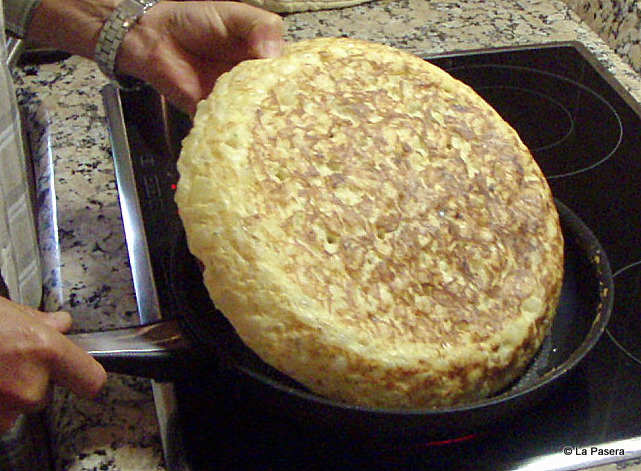
Some restaurants in the past have refused to cook anything other than what appears in the menu whilst others offer a simple egg dish or plain salad. In the majority of cases, the one life saver that can always be relied upon for sustenance is Tortilla - even then you have to be careful that it is a plain tortilla and not cooked with chorizo, ham or tuna fish. Here is our recipe for a life saving Tortilla.

Tortilla de patatas


Peel and dice enough potato to fill a non-stick frying pan, add one finely chopped onion. Sauté in olive oil until the potato and onion is cooked and slightly browned and caramalised. A lid can be used to speed up the frying and reduce the amount of oil used. Season with salt.


Meanwhile, whisk about 6 eggs (for an average sized frying pan) and add any herbs you fancy. Thyme or sage work well but are not traditionally used.


Add the cooked potato and onion to the egg mixture and mix carefully - a thickish creamy consistency is required. Add a touch more oil to the pan, bring to heat then add the mixture to the pan. Cook for several minutes until browned and partially set (steam vents come out of the mixture). Turning at this stage can be problematic but here in Spain we use a special plate with a handle on but a dinner plate could be used if need be. Put the plate on the tortilla over the pan, lift and quickly turn the pan and plate. Add a touch more oil to the pan and bring to heat, carefully slide the tortilla back into the pan until cooked to taste.


Remove from the pan by turning with the plate and pan again, leave to cool and serve with fresh salad. A life saver!

Monday, August 01, 2011

Course: Weaving a cane seat - Cursillo: Restauración de sillas en Rejilla

No comments:


Short course in chair restoration – Weaving a cane seat.

Dates: October 7-9th 

Venue: Asturias, Spain

Cost €200 (includes materials, lunch and refreshments)

Content:

Due to demand generated from www.artesanialapasera.com I am pleased to offer a short course in chair restoration – weaving a chair seat in rattan cane. The course will include:

1.   Preparing a chair for restoration
2.   Materials and techniques
3.   Finishing and aftercare

At the end of the course the participants will have woven a seat using rattan cane.

The course will take place in a workshop at La Pasera. There will be a maximum of 5 participants on each course to ensure quality tuition from the instructor Luis Laso Casas. 

Luis has been restoring cane and rush seating for the past 10 years. He has re-caned and re-rushed chairs old and new from a variety of sources. From exhibition pieces to dining room suites, boudoir chairs to Thonet, he has restored somewhere in the region of 500 chairs and overcome many challenges to accomplish the craftsman finish that has become his trademark. There maybe both English and Spanish participants on the course but as Luis is bi-lingual, this is not a problem. You can also practice your Spanish is you so wish!
   
The programme will commence on Friday lunchtime with an informal chat and lunch. The course will be structured to ensure maximum support for participants and where necessary, one to one tuition. A vegetarian lunch will be provided on each day the course. If you are unsure about anything or if you require further information, please contact Luis at :  artesanialapasera @ gmail.com (no spaces) Telephone 0034 646436562


Cursillo de restauración de sillas: Rejilla

A consecuencia del número de gente quienes me han preguntado donde poder aprender a tejer un asiento de rejilla, esterillado francés, me complace el poner a su disposición los siguientes cursillos de restauración de asientos de rejilla o rattán.

FECHA:

7, 8 y 9 de Octubre del 2011

LUGAR:

Ribadesella, Asturias, España.

CONTENIDO:

El curso incluye:

Preparación del asiento antes de la restauración.
Materiales y herramientas
Técnicas.
Tintes y cuidados.
Al final del cursillo, los participantes habrán aprendido la tecnica basica para tejer artesanalmente la rejilla usando junquillo o tireta de rattán.

MATRICULA:

€200.00. La matrícula incluye los materiales, tres comidas principales basadas en una cocina vegetariana y bebidas no alcohólicas durante el día. Puedo facilitar una pequeña lista de hoteles cercanos donde los participantes puedan alojarse durante el cursillo.

Aquellos interesados en participar en este cursillo deben ponerse en contacto con: Luis Laso Casas a través del email artesanialapasera@gmail.com

NUMERO DE PLAZAS:

El número de plazas está limitado a un máximo de 5 participantes.


Friday, July 29, 2011

Maintaining the Septic Tank

No comments:
This year the summer in Asturias has yet to fully bloom. It's warm but a distinct lack of daily sunshine has been upon us now for a good few weeks. We have had more rainfall than average and periods of stronger winds resulting in cooler temperatures than to be expected however, it is still very pleasant.

For some reason, days like today, subdued and dull, bring to mind routine maintenance jobs that need doing around the place. It was on a day like today when we noticed a slight odour coming from the septic tank. Normally there is nothing.

Living so far from mains services necessitates a septic tank which like many other things around the house and garden needs regular maintenance if it is to work effectively All the grey water and sewage is deposited in it and rain water is either collected for the garden or drained into it's own sump. Every six month or so we inspect the septic tank and make sure it is functioning and not in need of emptying. This time, it did.


A quick phone call to Benito and within 30 minutes he is here with his huge tractor, tank and pump. Now I am sure that he quite likes coming here because unlike many of his other customers, he gets help. Luis is always eager to get involved and helps him with the extension pipes, lifts the drain and tank covers, gets him the clear water ready and generally assists. Twenty minutes later, after the system is flushed, Benito and Luis dismantle the gear, we wave goodbye and then swill down the paths and drive. They don't really need it but somehow it feels better for doing it. Then shower.


Other maintenance jobs we tackle at this time of year are making sure locks and hinges are given a bit of WD40, checking sealants and draft excluder, dusting off electrics in the workshop, checking the house for painting jobs, maintain the dry stone walling, check drains, repairing lawns from rato damage, checking waterbutts....and so on. Jobs such as these tend to get forgotten if we are not careful but if kept in mind can save a whole bundle of time in the long run.

Futher afield Ribadesella is once again buzzing with a large influx of people and much preparation work happening ready for the 75th International Canoe Descent of the River Sella on the 6th August. Many thousands of people descend on Ribadesella and Arriondas for the weekend bringing much needed revenue into the area. We'll report back on this years anniversary event.


Monday, July 25, 2011

Jazz Festival in Ribadesella

2 comments:
 Every July in Ribadesella around this time there is a Festival de Jazz in a square outside of the town hall. A substantial stage and marquee is erected completely covering what is normally a small stone square with a few benches and trees, and a covered news stand.  This is serious business. You know from the PA system, lighting rig and team of technicians that this is going to be a pro gig.


Arriving in town around 10pm we join the throngs of people sat outside bars, eating in restaurants and promenading up and down one of the three main thoroughfares in Ribadesella. The dozen or so craft market traders who had set up along the sea front are packing up and discussing how good or bad business has been during the weekend-long event. The smell of the Churros permeated the night air mixing with many aromas from a range of traditional kitchens as the sea breeze changed direction and as we turn around corners.


Outside Café Bergantin, friends and familiar faces mixed with hoards of incomers all busily swapping stories of their day and greeting friends not seen since last season. Council workmen dragged out stack after stack of plastic chairs and arranged them diligently in front of the stage as technicians conducted final checks on lights, mics and smoke machines.
Nick and Gilda

People began to gather as we neared 11pm and the reserved front row filled with the Lady Mayoress and her entourage. The atmosphere is buzzing as several hundred people eagerly await the obligatory opening speech by the same guy each year, his identity still remaining a mystery to us after 5 years worth of events. Two things we do know about him is: he says the same thing each year and, he obviously enjoys the limelight.

To a rapturous applause, the fist band comes on stage and without further ado, start the evening off with a rousing blues guitar instrumental. This year we had the absolute delights of two great outfits. On Saturday it was, The Zac Harmon Blues Band and Sunday brought yet another Gospel choir in the shape of The Late Show Gospel Chorale featuring Lady Peachana. Yes, Lady Peachana, she has been around many more years than her singing 'sister' Lady Ga Ga.

Zac Harmon


This year the festival has only taken place on two nights whereas previous events have been three. Budget cuts I suppose. Never-the-less this free concert is a great event for the town and enjoyable to boot. Although it is advertised as a Jazz festival, it rarely is pure Jazz. Blues bands, gospel choirs and the odd contemporary jazz outfit work hand in hand to make sure everyone has a good time. Judging by the number of people dancing at the front, jigging up and down on the sidelines or stood clapping and singing, the bands seem to be working their magic.

The Late Show Gospel Choral


A couple of links here for you to check out sometime:

Zac Harmon

Lady Peachana

Thursday, July 21, 2011

Mosaicos La Pasera

5 comments:

Luis has a mosaic on display and for sale at the Artisan Centre in Poo near Llanes. The gallery asked him to submit a piece prior to his first full-scale exhibition in September. The centre has offered him as much space as required to exhibit both his Roman and pebble mosaics. Ranging from garden features designed and hand-crafted out of pebbles and other materials such as slate, to art in the form of contemporary wall plaques and insets for occasional tables. He will also take various commissioned house signs as examples. We are currently designing the setting of the mosaics and have secured a great section of a chestnut door complete with hand-crafted nails that is over 100 years old. Once cleaned and prepared, it will look stunning and become a great background for a house plaque or similar.


The centre will organise and pay for all the associated publicity, arrange press briefings and promote the exhibition. Needless to say Luis is busily making further mosaics for display including a large plaque called 'The tears of a clown'. There are other opportunities on the horizon but cannot say too much about it at the moment....ha ha!

We will keep you up to date with developments and will report back.


Visit his new mosaic site here:  www.mosaicoslapasera.com


Saturday, July 16, 2011

Preparing for Winter crops

No comments:
One important aspect of vegetable growing is thinking ahead to ensure a steady supply of vegetables throughout the seasons. At this time of the year we start thinking of the numerous jobs that need to be completed in order to ensure a continuation of crops all through the Summer and into the Winter months.


As soon as the onions are lifted over the next few days, the ground will be dug over to plant the winter crops that were seeded in trays and potted up some time ago such as cabbage, early and extra early purple sprouting broccoli, celeriac, fennel, celery, swede, turnip, beetroots and winter lettuce; cauliflowers and leek plants will be purchased from one of the local growers. These vegetables will be planted in accordance to our rotation system and then any remaining empty beds will be sown in early Autumn with oats, our preferred green manure.


The marrows are producing well and in past years we have noted that the humid conditions we get living so close to the coast cause fungal attacks and the plants are lost in early September. This year we have been treating susceptible crops with horsetail. This year we have grown second lot of marrow plants that we raised from seed in late June to hopefully provide us with courgettes and marrows well into the Autumn and thus ensure we can enjoy cooking with fresh marrows for a longer period. We will let you know what happens.


The beetroots are producing bumper crops and the latest sowing, the fourth, is growing well in the half drainage pipe we sow them in before they get planted out on the ground. At this time of the year with the heat of Summer, we will need to shade the young plants once planted on the ground until they get established, this will take about two or three days.

Elsewhere in the garden we are enjoying a great show of wildlife from the pond and bog garden with numerous acrobatic displays from damsel and dragon flies as they jockey for position to lay their eggs.

Friday, July 08, 2011

Review of the vegetable garden in July

1 comment:
On a cool summer's morning, before the heat of the day sets in and whilst the song birds are in the last throws of their dawn chorus, there is nothing more uplifting than strolling down to the vegetable garden to harvest fresh vegetables and salad crops in preparation for lunch, dinner and the pantry. It always amazes me to see how fast the courgettes swell, how spontaneous the beans appear and how quickly fresh green tomatoes start to blush.

Songs at dawn

July is the beginning of a time of plenty for us here at La Pasera. Our season is slightly earlier than in the UK and with lots of help from mother nature, Luis' planning and planting over the past few months is clearly producing results. The onions are performing well with large swollen bulbs protruding above the soil with their fresh green leaves just beginning to show signs of fatigue. Our summer, early onions have been cropping for a few weeks now and it won't be too long before we think about harvesting the main crop of red and white, in preparation for drying and storing to last over winter, 400 in total. The first crop of beetroot is slowly diminishing as we pick and eat sweet and tender young beets almost on a daily basis. No worries there though, as two further plantings are right behind and will ensure plenty for the coming months.

Summer onions, french beans and marrow

The peppers, aubergines, sweetcorn, leeks and squash are growing well and weekly inspections for black fly, aphid infestation or mildew ensures they remain healthy and at the first sign of attack, treated with our home-made organic remedies. The marrow, cucumbers, beans and tomatoes need attention on a regular basis to help their fruits ripen and swell in the best possible conditions. This requires staking, training or tying the plants, harvesting young fruits to encourage further production and watering at regular intervals, if necessary, to avoid undue stress on the plants.

Ripe and sweet

Lettuce and rocket continue to provide enough leaves for a daily salad and as the chives come to an end, the basil is beginning to grow with its shiny, bright green leaves and pungent aroma.

Bumper harvest 

The soft fruits have done reasonably well this year and we managed a great cop of red gooseberries - already processed into mustard seed and gooseberry pickle and a yummy gooseberry crumble. The day to day work of growing our own food continues with preparations already underway for autumn and winters crops, something we'll cover in the next post so why not subscribe by email to ensure you receive notification of updates.

Saturday, July 02, 2011

Introducing Ribadesella - a town of two halves

No comments:
When we were looking for property here in Spain, we drew a line on a map of Asturias of the area where we would be happy to live. Having visited several times previously, Ribadesella was almost in the centre of where we would prefer to settle. We ended up just 5km away in a quiet village, 1km from the coast. Ribadesella was always a favourite destination and one we never tire of.

Picture from Ayuntamiento de Ribadesella calendar 2011

Ribadesella is a small municipality of which the capital is the town of Ribadesella. It lies in the east of Asturias sited on the estuary of the river Sella, on the green coast of Northern Spain flanked by the Bay of Biscay. It is a town of two halves. The eastern half is the main hub of the town and the western half, across the bridge has a small marina, the main beach (Santa Marina) and a large residential area including hotels and holiday homes...and the high school. Out of season, the town has a population of about 4,500 inhabitants.

For 10 months of the year Ribadesella is a quiet Asturian fishing port where out of the ordinary things rarely happen. There is a small market on a Wednesday morning, many of the restaurants, hotels and shops close for long periods out of season and the small number of residents carry on with their day to day lives occasionally being interrupted and entertained by a coach full of day trippers or some out-of-season pilgrims resting as they make their way along the Camino de Santiago.


High days and bank holidays see increased numbers of incomers staying in their holiday homes or strangers wandering around the town, admiring the three storey Asturian buildings with their splendid glass galleries and busily exploring the nooks and crannies of the old town. Strolling along one, of two promenades is a daily past time for both locals and visitors, either down past the small fish dock along the old harbour wall or to the other side of the river along the promenade that cradles the beautiful Santa Marina beach arriving after 1km or so at the dinosaur footprints that can be viewed at the farthest point of the bay.

July, August and the first half of September see a huge change in the day to day life of Ribadesella and the area in general. Large numbers of tourists descend bringing with them healthy appetites, full wallets and the lust for all things Asturian. Hotels, rental property, campsites, shops, restaurants, bars and street traders take off the dust sheets and fling open their doors in readiness for business. Suddenly, there are few places to park, prices appear to creep up a little and inconsiderate strangers invade our usual chairs and tables at the Café Bergantin.


The main attractions in town include: the Tito Bustillo cave complex with cave paintings dating back to 22,000 BC; Santa Marina beach; architectural delights such as the Indiano houses that are dotted along the beach front and in and around the surrounding areas; easy access to the Picos de Europa national park; a plethora of fiestas and celebrations; and of course the highlight of the year, the International Canoe descent of the river Sella  which takes place the first week in August. In addition, Ribadesella is a centre where a range of outdoor activities such as canoeing, surfing, quad biking, horse riding, walking, caving and climbing can be arranged.


Ribadesella has a rich history, from pre-history to the present day, the town has many stories to tell and even more secrets to discover. It once was a busy port for whaling, salt, and fishing, it played an important role in the war of independance and in the late 1800s and early 1900s many of its residents emigrated to Cuba, Central and South America, making their fortunes, returning home and investing their money in lavish residential status symbols that are still enjoyed today.


Ribadesella's location, its quiet, small town feel, its colourful Celtic history and traditions, its proximity to the Picos de Europa and its spectacular landscapes make up for the few overly busy weeks in summer when we prefer to stay at home for coffee and shop in other nearby towns. It is easy to forget that the incomers and strangers are the life blood of the town, without them, unemployment would be much worse than it is and the traditions and unique culture of this part of the world would probably disappear and be forgotten. A town of two halves i.e. the holiday resort and the residential fishing town, it maybe but each half is co-dependant and co-exists in tolerant harmony year after year.

More information can be found here:  http://www.ribadesella.es/index_in.htm


Sunday, June 26, 2011

Making hay whilst the sun shines and gathering winter fuel

3 comments:
It's been a funny old couple of weeks, making hay whilst the sun shines and gathering winter fuel. The warm weather has brought with it the need to cut the long grasses and wild flower areas we let grow in various areas in and around La Pasera. It is ideal time for the seed heads to dry naturally and shed their load onto the ground ready for next year. The grasses and plants will be allowed to dry for a few days, then gathered and used as brown material in the compost heaps. The islands and areas will regenerate in the next few weeks and give a second flower and grass crop for the bees and insects to feast from, way into autumn.


The large amount of pruning material from the fruit and nut trees have been processed for kindling and the wood store has been replenished ensuring plenty of dry burning wood for the wood burners. Two unexpected sources of wood came about this past fortnight, the first from a man in the village who is clearing some of his woodland to subsidise his income now he is unemployed and secondly from a plot opposite La Pasera where the owner has sold off his mature eucalyptus trees to a local company. As they were felling them we negotiated a price for two large (20M) trees - they felled them and we processed them.


In retrospect, the second lot of wood wasn't a good deal as taking into account the amount of fire wood it has generated plus all the effort of processing and splitting it combined with the time taken, it would have be cheaper to buy it from them once they had done all the work! You live and learn... Eucalyptus is tough wood and heavy. At least we have a well stocked wood store that should keep us going for the next winter and beyond.

Friday, June 17, 2011

Vegetables: sourcing, germinating and planting seeds and young plants

1 comment:
There is no doubt about it that raising vegetables from seeds is time consuming and unpredictable. Germination rates depend on the viability of the seed, the temperatures, methods and disease. Wherever possible we save and dry seed for the following season but of course that is not always possible. Seeds are sometimes exchanged with friends, bought from online catalogues or from nurseries both here and in the UK. If possible we buy or source organic seeds, especially old fashioned varieties or varieties that are known to us for their cropping, taste and resilience.

We have a heavy clay-based soil here at La Pasera and despite digging in as much organic matter as we can possibly get, the structure remains heavy and seed unfriendly - the rain and sun combination help form a hard crust that seeds find impenetrable. Luis has developed various methods of seed germination that work for different seeds and that overcomes the soil problems we face.


Some seeds such as brassicas, beetroots, legumes, sweetcorn, peppers, marrows, cucumber and fennel are pre-soaked in a moist cloth and contained within a small plastic box. This method ensures a high germination rate and advances the growth much faster than sowing direct. The downside of this method is that once germinated, handling the sprouting seeds is fiddly and takes a bit more time. The seeds are planted with tweezers into pods or half drainpipes filled with a home-made mixture of compost where they grow very quickly and are ready for planting into the prepared beds.


Other seeds are sown directly into pods, yoghurt pots or pipes and then transplanted when robust. Salad crops, tomatoes, celery, celeriac and herbs are sown using this method. Very few vegetables are sown directly into the ground, potatoes, onions and leeks being the exception.

We generally buy our onion and leeks from a local plants-man as young plants. They are good quality and cheap. 100 leeks cost around 5 euros and we always end up with more than we pay for as he usually puts extra in the bag. If we produce too many, young plants and seedlings are given away or exchanged with friends and neighbours although some vegetables we grow are met with quizzical and perplexed expressions by some of our neighbours who have never grown or eaten anything like them before. Preparation and cooking advice is always offered....


If anyone is interested in seed swaps or has spare seed that they think might do well in our warm and humid climate, please get in touch. We are particularly interested in blight resistant tomato strains and any unusual old fashioned varieties of vegetables or fruit.

Saturday, June 11, 2011

Making and using natural insecticides and fungicides for the garden

5 comments:
If you are a regular visitor to Tales from Toriello you will already know that we do not use chemicals in the garden and rely on natural control or potions that are derived from natural sources. Our climate here on the coast is a temperate climate that is humid and prone to sea mists. Conditions are such that our vegetables and plants are very susceptible to fungal infections such as mildew and blight, and infestations such as caterpillars, black fly and aphids.


With tomatoes, potatoes, courgette and marrow in full swing it is important for us to minimise the damage caused by fungal infections and reduce the infestations of caterpillars, aphids and black fly on plants around the garden.


The first thing to mention is that healthy plants, grown in fertile and well structured soil, in conditions that suit the individual plant will of course minimise any problems that may occur as will the use of companion planting  to encourage natural predation. We'll cover companion planting in a future post. Even the most efficient, experienced and knowledgeable gardener will succumb to the laws of nature from time to time so for us who are still serving our apprenticeships, infestations and plant diseases are all part of the valuable learning journey that we find ourselves on.

Natural Insecticides:

At the first sign of attack of aphids or black fly, we would normally spray the affected plants with a light soap and water mixture or garlic water made from macerated garlic and water, strained and then sprayed. This will need to be repeated in two or three days time but can be an effective control that is harmless to other wildlife. Rhubarb macerated in water for a few days also works well as a general insecticide.

Caterpillars are not that easy to get rid of and we have found that by far the most effective method is quick dispatch with gloved fingers. Birds in the garden can also help keep caterpillar populations under control especially if nesting nearby and feeding the voracious appetites of a young brood.

If your salad rocket is affected by Flea beetle they try using a spray made up from catnip soaked in water, it wont eradicate them but it will drive them away giving you a better looking crop during their short season.

Natural Fungicides:

Due to our humidity and climate we spray both prophylactically and symptomatically. Our main lines of defence come from two commonly occurring plants i.e. Rhubarb leaves and Horsetail plant. Both mixtures are made by the same method. In a large bucket or container, soak about 500 grams of bruised rhubarb leaves or bruised horsetail plant in a litre of water,  leave covered for about 5 days and stir occasionally. The liquid eventually stinks vile ( a bit like nettle juice if you are familiar with that). The liquid is then strained through a fine cloth and colander to prevent residues that might clog up the filter mechanism on the sprayer. Plants are sprayed, preferably on a dry day, with a good dose of the mixture and repeated as necessary.


This year we are trialling the horsetail mixture on the onion crop, marrows and cucumbers to prevent fungal infections and mildew.

We would love to hear from you if you have any other remedies or suggestions. Sometimes what works for one does not work for another and the experiences of others, trial and error is a great way of learning. Please get in touch or leave a comment if you have found that your own concoctions work for you.  


As with all potions, take care when handling both the raw plant and the liquid. Gloves and masks are should be worn to minimise inhalation or skin contact. If storing the liquids, keep out of reach of young children and pets.