Friday, November 25, 2011

A busy week at La Pasera

No comments:
There is a never ending stream of things to do here at La Pasera, not much different to most people's lives I suppose. The tasks may differ but the need to keep things moving along, no matter where you are, is ever present. There are some jobs that we put off and put off for no real reason other than it either comes lower down on the list of priorities or else it is a job we are not particularly looking forward to.

We completed some much needed building preparation on the drive way this week which has been hanging around now for far too long. Over winter, we aim to make headway with the hard landscaping and drainage needed at the side of the house.

We managed a couple of walks in areas we haven't explored before which was great. Good weather prevailed which made it even more enjoyable.


The garden is nearly ready for winter with just a few more grasses and shrubs to trim and prune. We have levelled some areas of lawn and plan to re-think the wild flower areas for next spring. The vegetables are producing well with a great crop of leeks, swede, celeriac, beetroot, celery, cabbage and broccoli.
Luis has just tied the winter lettuce which will help to tenderise and sweeten the inner leaves. Peas are busy sprouting in half drainpipes and showing lots of new growth in this typically unseasonal warmth.


Lots of cooking going on as usual with making our own fast food - 40 spicy bean burgers for the freezer, bread supplies replenished and the last of the marrows and the first glut of leeks made into soups both to eat fresh and to freeze. We'll feature the recipe for the spicy bean burgers in a later post.


Luis has been hard at work completing work to restore the cane work on an old bergere three piece suite with hall chairs. Good news this week also as he accepts his first mosaic commission since the exhibition.

The cats are looking bulkier since putting on their winter coats and making the most of the warmer weather although there does not seem to be as much rodent activity as they would like. They make their way back to the house in the cool early evening knowing full well that a warm log fire awaits.


All in all, a busy week with everything else that is happening but never-the-less satisfying. A few more jobs ticked off the never ending list.


Sunday, November 20, 2011

The Chestnut Festival

No comments:
In Arriondas at the beginning of November is a festival to celebrate the chestnut harvest and the produce from the vegetable patch (la huerta). Normally a two day event with a several peripheral events, this year it was much subdued in relation to both exhibitors and visitors. The poor economy and 5 million people out of work has seen some tourist events take a knock over the past two years and the scale of such events drastically reduced.

On the first day this year there were no stalls and just a childrens' inflatable bouncy castle and a couple of mobile food vans selling churros (a sweet doughnut type snack) and ice-cream. We had seen a notice advertising traditional sports to take place in front of the medical centre at 5pm so we nipped along to see what was happening.


With disappointingly few spectators, three teams of men took on challenges to chop and saw various logs, competing to be the first to finish the required test. Their axes were like finely tuned weapons, each competitor having a range of axes, each housed in a leather case and stored in a specially crafted box.


The next event on the schedule was walking with weights around a circuit. One man, two weights, walking a small circuit until he is exhausted and can no longer carry on. Sounds easy-ish until you learn that each weight is 51 kg making a total of 102 kg. The winner completed about 8 laps.


The saws were huge with carefully sharpened teeth that would rip through the toughest of logs. 


One man, who we think could have been the overall highest point scorer then gave a display of his axeman skills by chopping and creating steps to climb a vertical log and eventually split a further log at the top - about 4 meters in the air. As there was no presenter or master of ceremonies, it was difficult to ascertain what was happening.


Rounding off the games was a tug of war for the children. Eager teams of boys and girls took the strain and thoroughly relished the effort needed to pull the opposition far enough over the line to win. The best of three. Fortunately each team one a round therefore forcing a tie-break. Each was given a great little baseball cap for their hard work.


It was a great shame that more people didn't attend. It would be a great pity if these low-tech, cheap to put on, traditional type games were to disappear. Such events, albeit fairly modern creations, are important and work on several levels to bind communities together. I can't help thinking that the marketing and presentation side of these events could be much more pro-active. It was a great hour of events that will stay with young and old alike much longer that an hour watching TV or playing computer games.

Just remembered this post about the chestnut fair from a couple of years ago - how things change:
http://ianandluis.blogspot.com/2009/11/chestnut-fair.html


Sunday, November 13, 2011

Making leaf mould - black gold

No comments:
Gardening and growing vegetables in clay isn't something any right-minded gardener would choose however, given no other option, it is something the industrious gardener can learn to live with. Producing good quality compost is essential to assist in replenishing the soil's nutrients and helping to break down those lumps of claggy clay thereby improving the overall structure and fertility.

We use our compost as an ingredient in home-made potting compost along with a small amount of clay soil, vermiculite, sand and black gold... better known as leaf mould. Commercial potting compost here in Asturias is poor quality and expensive so we prefer to make our own.


At this time of year, collecting fallen leaves to make leaf mould is a welcome and regular task. Gawber normally gets in on the act and loves to ride in the wheel barrow around the garden. Having quite a few mature deciduous trees in the orchard and on the periphery of La Pasera means we get lots or raw material to collect. Cherry, oak, walnut, peach and hazel leaves mix with leaves blown into the garden from neighbouring maple, chestnut and fig.  With the advancing late autumn and winter winds from the Atlantic and the Bay of Biscay, we prepare for the onslaught well in advance by covering the pond with a fine mesh and ensuring we have regular collection sessions and adequate containers in which to compost the leaves.


We really don't do anything special with them apart from collect, bin and leave. One lot is an open wooden frame lined with black plastic and an open lid and the other is a green plastic compost bin we were given as part if a local recycling scheme. Given time 1-2 years minimum, we can produce a compost from leaves that really helps with the structure and health of the soil. Just in case you want something a little more comprehensive on leaf mould check out the link below.

A bit more to go yet - this batch is from last year.

Wednesday, November 09, 2011

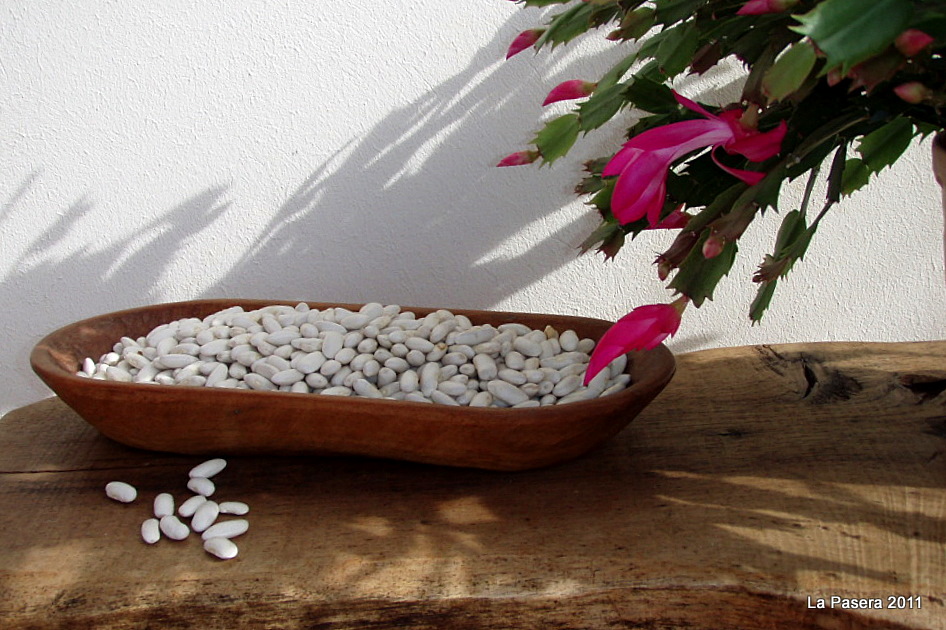
The bean harvest

1 comment:
Each year for the past three years we have been letting the beans, we could not eat green, carry on growing until they produce a nice fat pod filled with plump white beans. Most beans will run to seed and give you a good crop to harvest for drying. These will then be stored for eating and seed for the following season.

As the vegetable plots develop at La Pasera we are constantly adjusting what, when and how we grow our vegetables. Learning from experience and getting used to the growing conditions and weather patterns enables us to plan better and make more effective use of what we grow and eat. As eager and willing newcomers to home-produced vegetables, we have tried most things and found that certain vegetables, no matter how much we try to use, never get used whilst others we seem to never have enough of. All unused vegetables are composted but adjusting crops and seasons, we are now finding we are eating increasingly seasonally and composting less.


Beans are such useful ingredient to a whole host of dishes both hot and cold so we took the opportunity to grow more plants and harvest greater numbers of full-term beans. This year we harvested about 5kg of beans which is not a great hoard but never-the-less very welcome. We pick them when the pods are dry and become pale and papery looking. The pods are left to dry for a few days in the sun then the beans shelled and dried thoroughly over the following few weeks. Once dried, the bean are popped in the freezer for 24 hours to ensure any bugs or parasites are killed. Defrosted, dried once again and stored, the beans will keep until needed.

Beans are a fairly easy and rewarding crop with few pests and diseases attacking them. We initially have to protect then against slug and snails attacks using one of several organic methods including organic slug pellets, coffee grounds, ash and egg shells, until the plants reach a certain size after which they can withstand further attacks. We also find that some bean plants are prone to black fly attacks for which we use a soapy water spray every two weeks as this keeps them at bay.


Around the village seeing bunches of beans drying on a balcony balustrade or against a dry wall is a common sight. At the moment, we don't produce enough to do this but given time.....

Sunday, November 06, 2011

Seed: sorting, saving and storing

3 comments:

At this time of year when the dark nights are drawing in, the logs are burning bright and shutters closed, the opportunity to review the seed stock box is welcomed. As with most of us who grow their own food, saving seed and ensuring a healthy and adequate stock is an important and necessary task. Like most, we have a few packs of commercial seed, some collected from our own crops and some kindly swapped with friends and neighbours.

Inevitably, the commercial seed stock runs out of date from time to time so we try to ensure it is used as soon as possible but if it runs over by a few months then it is still used and rarely fails to produce healthy seedlings. Bear in mind though, some seeds do deteriorate over time no matter how you store them. Parsnips and cucumbers have performed poor for us if kept for longer than a year. All the seeds we collect from plants are naturally and thoroughly dried, harvested as required and stored in recycled envelopes. These in turn are kept in a dry wooden chest which helps to keep the seeds cool and dark.

Anyone with further advice or tips on seed collection and storage, please leave a message in the comments and don't forget to subscribe to the blog for updates.


Today we have sown sugar snap peas and mange tout which if grow well will be ready for harvesting in early April. Lambs lettuce and little gem lettuce seeds have been put to one side ready for sowing in the next few days therefore ensuring an early salad crop to follow on from the winter lettuce.

We are currently compiling a list of seeds we need to re-stock over the coming months and thse will either be sourced commercially or from fellow growers.

The chest we use for storing seed was picked up from a market stall a few years ago. Made of pine it was grubby and covered in paint. Stripped and polished, lined with cuttings from magazines and seed catalogues and handles attached to the ends, it makes an ideal container for our seed collection.


If you have a few moments have a look at this Ted Talk film about pollination, absolutely stunning:

Tuesday, November 01, 2011

Preparing the garden and vegetable plot for winter

2 comments:
At this time of year there is always lots to do around La Pasera. The garden needs close attention in relation to cutting back shrubs and plants that are out-growing their space, plants need moving and weeds need weeding out. Each year we make a note of what needs moving due to the wrong growing conditions, lack of space or wrong position. There aren't many plants that need moving but inevitably one or two need attention in the coming weeks. In addition, it is an opportunity to refresh and stimulate new growth next season. Never be afraid to cut back hard, more often than not it works well and results in luscious growth in the spring and early summer.

The extensive cutting back gives us lots of organic material which is of course, composted for future use as a soil conditioner and nutrient. This is an important resource for us especially now as out neighbour farmer is no longer keeping dairy cattle (due to new EU laws....) and therefore our regular supply of manure has dried up! Thanks Brussels.


The pond has needed some attention this year due to the vigorous growth of water-lily and oxygenating plants. After removing some of the plant growth, leave around the edges of the pond to give any inhabitants such as water snails and beetles an opportunity to find the water again. In the next few days we will secure a net over the pond to prevent an excess of leaves getting into the pond as the trees shed in the next few weeks. An excess of organic matter can make the pond murky and promote algae growth.

Earlier on in the season we sank a small bundle of barley straw into the water as the water became very green but remained healthy. The barley straw releases a small amount of hydrogen peroxide as it breaks down thus killing of the algae. Harmless to the pond life, it seems to have worked.


Starting out with only four fish, they appear to be at home in their environment as we now have about 20, that is after giving the Donkey Sanctuary 6-8 for their pond - apparently, Marleen has mentioned that they too have numerous new offspring swimming around.

The vegetable beds are worked on a rotation system and it is always good when one bed can be cleared completely and dug over. One bed has been dug and green manure (Oats) have been sown and is already showing through. This will be dug in during late winter prior to planting up with spring vegetables.


Saturday, October 29, 2011

Pictures at an exhibition

1 comment:
The Mosaic exhibition was officially opened last night with about 30 people attending which apparently is very good. A few of our friends came along and it was nice for Luis to have their support. Jesus, Gloria, Luis and I had all worked hard to ensure that everything looked its best and that a small reception was laid out for those attending - chorizo, tortilla, bread, olives, empanada, crisps, wine and beer.

Unexpectedly (because Luis wasn't previously informed), Jesus and Gloria called the guests to attention and introduced Luis and his work to the gathered crowd. They talked of how pleased they were to see his work and especially a new art and craft for the centre.

Luis rose to the occasion and responded in his usual eloquent manner. It was a great night and we were all very pleased for him and proud.

A mosaic in progress

Luis before the inauguration

Luis being presented by Jesus and Gloria - Ceramicists and sculptor

Part of a photographic presentation

Tuesday, October 25, 2011

Preparing for the mosaic exhibition

1 comment:
The exhibition is taking shape and we have today delivered the last few mosaics to the gallery. The posters and leaflets have been distributed, emails sent and the opening event promoted where practical.

Luis' exhibition has had interest from the radio and press resulting in a trip to Gijon yesterday to participate in a radio interview for Radio Principado Asturias. A funny thing happened on the way to the studio, we were lost as Gijon is a sprawling city with many broad avenues and diagonal cross roads. We headed in the right direction but decided to ask in a local coffee bar. Luis asked the proprietor where RPA was. Nodding at a young blonde woman sat having coffee, Luis turned to be confronted by "Are you Luis? I am Cristina and I am interviewing you this afternoon".

Luis with Cristina Natal
The interview went well and he came across as very enthusiastic and knowledgeable, not too nervous nor too laid back. It was an opportunity to thank the staff at the exhibition centre for their help and promote the event, his blog and his desire for further mosaic experience and training in Italy.

On air, in full swing - fast approaching the 5 '0' clock news
Full interview here (in Spanish):


Saturday, October 22, 2011

Mosaic exhibition

No comments:
It is some time since I first discovered mosaics and since Ian got me my first book on pebble mosaics. Little did I know that it would set my on a path of creative self discovery. Since we moved to La Pasera I have been able to develop my passion for mosaics and after a long wait, I am pleased to invite you to come and see my first solo mosaic exhibition at the Regional Crafts and Applied Arts Center not too far from home.

I am also finalizing the design for my next mosaic project that involves an interpretation of a landscape and landmark in black, gray and white tones. a very exciting project.


I hope you can drop by and enjoy the exhibition that will be inaugurated on Friday 28th October 2011 and will run until 11th December 2011 at the Centro Regional de Artesania y Artes plasticas en Poo de Llanes.

Wednesday, October 19, 2011

The best Piccalilli recipe ever

No comments:
Piccalilli is one of our favourite preserves. Each year, towards the end of the season, there are green vegetables and green unripe tomatoes aplenty so piccalilli is an excellent way of making use of these. This particular recipe has been handed down in our family for the past four generations. Originally from my maternal Great Grandmother Mabel Lund, I have strong memories of this pickle being brought out around Christmas time for Boxing day tea, served with cold meats and cheese.

Autumn Crocus now in full bloom
As with most pickles, it is best made and left to mature for a couple of months before using. This recipe will make about 12 jam jars which is not really a lot if you are a piccalilli addict like me. Double up if necessary... Note: this recipe is in imperial measurement as it always has been... You metric bods will have to do the sums.

Piccalilli

2 cauliflowers
1 cucumber
2 lb of shallots or onion
2 lb of green tomatoes
1 head of celery

About 6 lb of vegetable in total. Chop all the vegetables into small pieces. The cauliflower should be broken into small sized florets and if small enough, the shallots left whole. Soak overnight in a brine solution made with 8 pints of water and 1/2 lb of salt.

The following day, drain and rinse well, leave to drain whilst you make the sauce.


4 oz of mustard powder
1/2 oz of Turmeric
1 lb sugar (can be reduced if necessary)
2 1/2 pints of vinegar
1 cup of plain flour


Make a sauce with all the ingredients, thicken with the flour and gently bring to the boil to cook out the flour. Be careful not to burn the sauce, stir constantly. Add the dry vegetables and bring to the boil and immediately remove from the heat. Cover and leave to cool. Bottle and seal in sterilised jars the following day and label. Hide from everyone except your best friends....


Sunday, October 09, 2011

The worst chutney recipe ever

5 comments:
Following on from the post about the glut... I thought I'd report back on what we have done with some of the produce since. The chilli peppers were cleaned, half and quartered then frozen in layers then bagged. These will be used in variety of ways over the next 12 months. The red peppers have been cleaned and bottled. The weak vinegar solution then heated in a bain marie should keep them in good condition for some time to come however it is the first time we have tried this so we will wait and see.


We have made some glorious soups that have been enjoyed by us and our guests over the past few days. Plenty more has been frozen. The most popular was carrot and coriander with orange soup followed closely by cream of marrow. If any one wants the recipes let us know and we'll put them on the blog.

We have not had to buy fruit or vegetables for a few months now. Locally, the fig trees are full of fruit and Luis has been collecting and processing them for the freezer in readiness to make jam when we get the time. Apples are being harvested and although our own supply has been poor this year, the gift of apples from Luis' sister has been welcome.


We have eaten lots of red, ripe and juicy tomatoes however we need to use many more in addition to a container full of ripened pears. I came across a chutney recipe in a leaflet produced some years ago by a famous vinegar brand and it ticked all the boxes in relation to the goodies we had in store.

I usually cook from instinct and practice rather than follow a recipe, usually I would adapt it if it didn't seem right but last night's chutney effort slipped by. As I added the final amount of vinegar I just knew it was too much liquid. As the recipe was to be simmered for 90 mins, I decided to wait and see. No amount of vapour release could be enough to reduce and thicken. A last minute effort to skim off at least three cups of syrupy liquid helped no end.


Now the chutney is cooled and jarred, it will mature for at least three months and although still a little more loose than I would have liked, we now have 10 jars of very tasty Pear Chutney  in store. The worst chutney recipe ever?, probably. I must remember to act on instinct and amend the amounts for next time.


Monday, October 03, 2011

Processing the glut - 50 years a vegetarian

1 comment:
Every so often we have a glut of produce, not just an unused bag of something from last week's shop at the supermarket like in the old days, but a serious glut of fresh fruit and vegetables. This week we were visited by Rita and Alfredo (Luis' sister and brother in law). As usual they came laden with produce from their own plot - a plot, I might add that makes La Pasera's look like a postage stamp.


Rita, knowing that I am a vegetarian, brought with her about 40 jars of Pisto she had made for me. This is a concentrated base of tomato, with chunks of marrow, pepper, squash, onion, paprika and herbs. Sealed and heated in a bain marie, this useful sauce can be used as a base for soups, with pasta, rice or other vegetables and it is a really useful, quick and easy food to have in store. I usually ration it to ensure we have stock all year round but somehow we still have a few jars left from last season so we will be treating ourselves to a few portions over the next few days.

In addition to the Pisto, they brought with them about 80 kg of ripe tomatoes, 20 kg of green tomatoes, bags full of apples, pears, peppers, chillies, cabbage and carrots. Our larder area in the garage would rival even the best stocked supermarket fresh produce counter.

Some of the produce from Rita and Alfredo
Needless to say, together with the glut of produce we currently have there is a lot of work to be done over the next few days if we are not to waste most of what we have in store. Thankfully, whilst Rita was here she and Luis spent two days of her 'holiday' making tomato frito or passata as you might know it. Here's how:

The tomatoes are washed and cored, blemishes removed then squashed into a rough pulp. The pulp is put into a fine mesh bag and left to drain overnight. The juice that is collected is bottled and frozen as it is one of the best tomato juices you could ever taste.


The pulp is then put through a machine that separates the flesh from the skin and pips (these are composted). Similarly, sautéed onion and peppers are put through the machine and the resulting pulp added to the tomato. This is then boiled and simmered with salt added to taste, herbs if required (I prefer to vary my herbs when used in cooking). When reduced it is put in jars and sealed, then the jars are boiled in a bain marie for 20 minutes until a vacuum has been formed.


In total, she made about 26 jars of tomato frito which together with the Pisto, will ensure we lots of supplies for the coming year.....now to tackle the pear and pepper mountain.


Saturday, September 24, 2011

Midsummer review – Tales from Toriello

1 comment:
Asturias is once again quiet. The beaches are empty, the car parks have spaces, hotels, bars and restaurants are subdued and the villages are almost back to their usual peaceful existence. It is good to see an influx of people during summer but being able to enjoy our environment without lots of holiday makers is better.


The vegetable garden is producing well after a disappointing start. The tomatoes, aubergines, peppers, cucumbers, beans, squash and marrow plants are weighed down with fruit and the winter crops of cabbage, swede, fennel, celeriac, celery and cauliflowers are well ahead of schedule with ample summer rain and warm weather helping them on their way.

Luis has been busy repairing cane and rush seating with a steady flow of work throughout the summer. In addition he has just been given a huge piece of work that involves blind re-caning an antique bergere three piece suite from the 1920s. This is likely to take him the best past of 4 months as each piece of cane has to be individually cut to size, woven and secured. The next chair recaning course takes place in October and there are still places available. If anyone is interested get in touch. He has also completed several new mosaics in readiness for his exhibition that will now take place in October, and another mosaic has been commissioned that he is currently designing.


I have been busy with my photography and writing with several projects on the go and several more in the pipeline. Earlier in the month I was surprised to be highly commended in a short story competition run by the Bat Conservation Trust, The stranger on the bridge is one of eight winning pieces now published in a pdf booklet:   Bat Tales

Together with our friends John and Be, we managed to capture some great night time images in and around La Pasera including a stoat, fox, beech marten and rato topo (being captured by the marten) and a couple of neighbouring cats.

Wentworth and Gawber and sleeping most days and active most nights due to the heat. Wentworth manages to catch and eat several land voles each night leaving just the head and entrails on the doormat for us to see each morning. Gawber catches as many but rarely eats them, just the odd nibble to the hind leg or flank. Young lizards continue to entertain them both and can be often seen tailless warming themselves on rocks and pavements.

All in all it has been a productive summer with some great walks, many ongoing projects and numerous fiestas and events. We are looking forward to autumn which is often much nicer than summer with warm sunny days and beautiful diffused light. I am currently in the UK and hoping to photograph a whale, dolphin or porpoise from the deck of the ferry.